

- Next President Likely From BNP Standing Committee |
- Resignation of President Mohammed Shahabuddin for ill health |
- Why President Shahabuddin resigned from office |
- President Mohammed Shahabuddin Resigns |
- Experts Call for Better Flood Forecasting, Urban Planning |
Roma Face Exclusion From Ukraine War Compensation Schemes
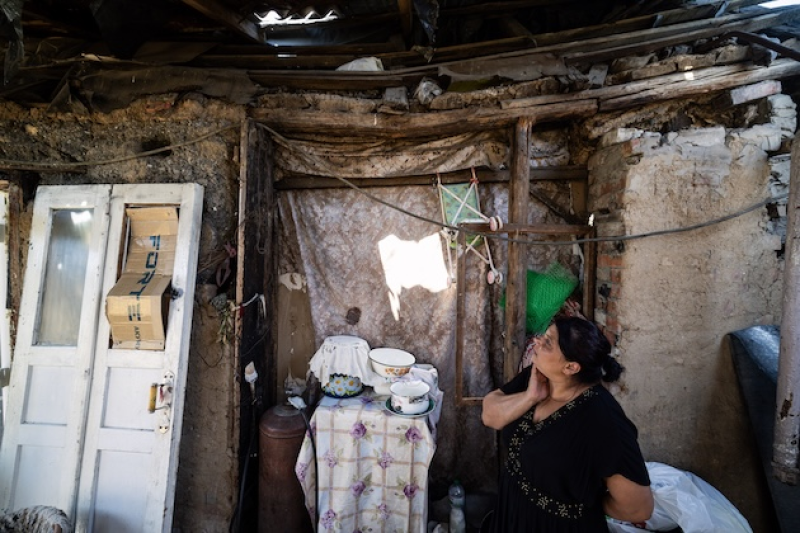
The home of Oksana Serhienko, Merefa village, near Kharkiv, Ukraine.
As Russian forces continue to lay waste to civilian areas of towns and cities across Ukraine, Roma in the country are struggling to access compensation to help rebuild their damaged homes.
Russia’s relentless bombing has, according to the World Bank, left 13 percent of Ukraine’s housing damaged or destroyed, affecting over 2.5 million households.
Despite this, many Ukrainians, including Roma, have refused to leave their homes despite relentless bombing and are determined to keep living in sometimes severely damaged homes to preserve their communities.
A new report shows many Roma—one of Ukraine’s most vulnerable communities—have been unable to access state property damage compensation: only 4 percent of Roma households surveyed successfully secured compensation for war damage, despite widespread destruction.
This is because application requirements disproportionately exclude the Roma population, whose lives were precarious long before the war, according to the Roma Foundation for Europe (RFE), which produced the report.
“Many issues we identify [in our report] affect non-Roma applicants too—particularly in occupied or frontline areas… [but] the situation is more severe for Roma because of long-standing exclusion and economic precarity,” Neda Korunovska, Vice President for Analytics and Results at RFE, told IPS.
As in many European countries, the Roma community in Ukraine has long faced social exclusion and systemic discrimination at societal and institutional levels.
But like the rest of Ukrainian society, they have felt the full effects of Russia’s brutal invasion over the past three and a half years, with many seeing their homes damaged or destroyed.
State compensation for war-related property damage is available, but experts say significant barriers exist—especially for Roma.
These include requirements such as possession of official property documents and proof of ownership, which are often difficult for Roma from communities with informal housing and disputed property rights, as well as the need for digital literacy, which can be a problem for communities with high digital exclusion, according to RFE.
The group’s analysis, based on cases across four Ukrainian regions—Zaporizhzhia, Kryvyi Rih, Odessa, and Kharkiv—shows entrenched legal, administrative, and digital hurdles block Roma from accessing aid meant to rebuild homes and lives.
Zeljko Jovanovic, RFE president, said current compensation systems, designed for order and efficiency, overlook those with fewer resources but no less damage and lack flexibility for the realities of pre-war informal housing, displacement, and occupation.
“Many affected families cannot afford property registration fees or inheritance procedure costs. The average damage of 2,816 Euros represents several months of pre-war salary,” he added.
RFE notes that in regions like Odesa, more than half (54%) of Roma families lack formal property registration, while in Kryvyi Rih, no claims from surveyed households have been submitted due to legal limbo over inheritance, missing paperwork, and lack of resources to navigate the system.
Even in Zaporizhzhia, where property records are strongest, low application rates reflect deep mistrust in institutions, amplified by discrimination experiences.
Some Roma surveyed said they didn’t apply for compensation fearing the government might demand repayment later.
“This reflects deep institutional mistrust,” said Korunovska. “It is rooted in long-standing discrimination. Previous research shows many Roma face negative treatment by officials when seeking housing or services. Surveys show high social distance between Roma and broader Ukrainian society, reinforcing exclusion.”
Nationally, around 61% of submitted claims have been approved, but among Roma, the figure was only 28%. The vast majority (86%) of Roma surveyed never submitted claims due to systemic barriers.
Liubov Serhienko, 69, has lived in her home near Kharkiv for 40 years, which suffered severe damage from bombings—roof and ceilings collapsed, and one room is uninhabitable. Thieves stole household items during a brief evacuation.
Her daughter Oksana describes how the family—three generations living together—use blankets to retain heat in exposed rooms, with snow blowing in during winter.
Neighbors helped with some repairs, but resources are limited and the building remains in disrepair. Relying on a pension of 3,000 UAH (€70), she says she no longer has strength or funds to fix the house.
In testimony to RFE, Serhienko said, “What I want most right now is for my family to have a roof over their heads.”
Oksana criticizes the lack of state help for them and other Roma: “The government doesn’t care. They’ve done nothing.”
Her mother said authorities deliberately discriminate: “[Just] Gypsies, they say. As if we’re not people.”
Andriy Poliakov, 45, has stayed in his damaged home in the Kharkiv region despite being disabled and having no heating, relying on a makeshift stove. He receives no state assistance.
Many Roma distrust authorities, including Poliakov: “They don’t care. Even though I’m disabled and it’s on paper… It doesn’t matter to them.”
RFE calls on the Ukrainian government to reform reconstruction planning, including accepting alternative proof of ownership (utility bills, community testimony), waiving registration fees for war-affected families, and introducing temporary ownership certificates.
RFE hopes to present findings to government representatives soon.
“We hope this data will be a constructive basis for reform, especially as Ukraine aligns with European values of fairness and accountability,” said Korunovska.
Jovanovic added, “Even if full compensation isn’t possible now, temporary support is essential. Roma living in damaged homes are part of Ukraine’s strength and resistance.”