

- UNGA President Urges Four Steps for Rohingya Justice |
- Fugitives can’t be brought back from Delhi through violence: Kobir |
- ICJ asks Myanmar: cease violations, prosecute perpetrators, take back-compensate Rohingya |
- Dhaka Ranks 13th Among World's Most Polluted Cities on Friday |
- Petrol Bomb Allegedly Hurled at State Minister's Home |
UNGA President Urges Four Steps for Rohingya Justice
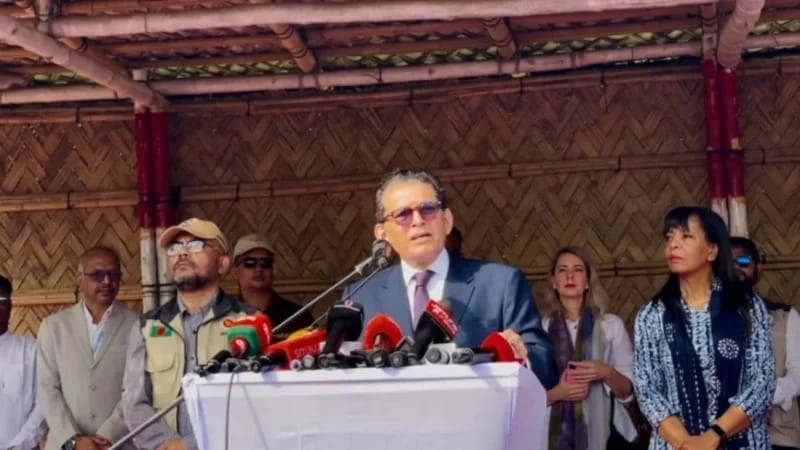
United Nations General Assembly (UNGA) President Dr Khalilur Rahman on Friday made four calls for justice and accountability, safe repatriation, reparations and guarantees against future atrocities following the International Court of Justice (ICJ)'s landmark judgment finding Myanmar responsible for genocide against the Rohingya.
Addressing Rohingya refugees at a football field in the camps in Cox's Bazar, he described Thursday's judgment as a defining moment for the community, recognising the atrocities committed against them during Myanmar's 2017 military crackdown as genocide.
“The court has recognised that you are not forgotten,” Khalilur told the refugees, pledging to convey their voices, particularly those of women, children and young people, to all 193 UN member states in New York.
“The court has spoken with clarity. And implementation of the judgement must now receive the seriousness and attention it deserves,” he said.
His first call was for Myanmar to take immediate and effective steps to investigate people reasonably suspected of committing acts prohibited under the Genocide Convention and, where warranted, prosecute and punish them.
He also urged Myanmar to bring its national legislation in line with the convention and provide assurances and guarantees against a recurrence of such violations.
Khalilur said the international community had a major responsibility to press for full compliance with the judgment and support its implementation.
His second call was for Myanmar to ensure the safe, voluntary and dignified return of Rohingyas to their homeland, in accordance with the court's orders.
He said the judgment also required Myanmar to take measures to reunite families, restore or replace lost homes, land and other property, help locate missing people and ensure the dignified recovery and reburial of those killed.
However, he stressed that repatriation must be backed by effective guarantees, including protection from discrimination, freedom of movement and meaningful participation by Rohingyas in decisions concerning their future.
“No one should be sent back to danger,” he said, stressing that the wishes and voices of the Rohingyas themselves must guide the process.
He also called for continued humanitarian assistance to refugees until a safe and sustainable return becomes possible.
His third call focused on securing reparations for victims. He said Myanmar was required to compensate Rohingya individuals and the community for material damage that could not be remedied through restitution.
Khalilur said Myanmar must submit a report to the ICJ within two years detailing the restitution measures taken and the proposed amount and arrangements for compensation.
Acknowledging that money could not bring back lives or loved ones, he said meaningful reparations could nevertheless help survivors regain security and hope.
He also urged international development partners to increase humanitarian funding for the Rohingya camps, saying Bangladesh should not be expected to shoulder the responsibility alone.
His fourth call was for Myanmar to comply fully with the judgment and take concrete measures to prevent similar atrocities in the future.
He said this would require legal and institutional reforms, training for security forces and effective civilian oversight to ensure that Rohingyas could live without fear.
Referring to Article 94 of the UN Charter, Khalilur said every UN member state undertakes to comply with ICJ decisions in cases to which it is a party. The charter also provides for recourse to the Security Council if a party fails to comply with a judgment.
“As President of the General Assembly, I look forward to engaging with Member States on how we follow up on this issue,” he said.
Recalling that the UN General Assembly declared in 1946 that genocide shocks the conscience of mankind and adopted the Genocide Convention in 1948, he said the international legal framework had now delivered an important outcome for a people with no army and no power.
He thanked The Gambia for bringing the case before the ICJ, the Organisation of Islamic Cooperation for its support, the 11 states that intervened in the proceedings, the court's judges, UN investigators, the Bangladesh government and people, and host communities in Ukhiya and Teknaf.
Khalilur also paid tribute to Rohingya survivors, particularly women who found the courage to testify.
“Justice was delivered in The Hague. Our task is to deliver it here. In these camps. And in your villages in Rakhine,” he said.
Describing November 19, 2026, as a potentially historic day for the Rohingya, he expressed hope that it would mark the beginning of their journey home.