

- Fuel Queues Ease As Supply Rises, Demand Falls |
- PM says govt working to reopen closed factories |
- 7-year Sukuk worth Tk 5,900cr planned for rural bridge project |
- Unplanned bundhs worsen flooding, crop losses in Sunamganj haors |
- Trump admin says its war in Iran ‘terminated’ before 60-day deadline |
UN urges end to attacks on media workers worldwide
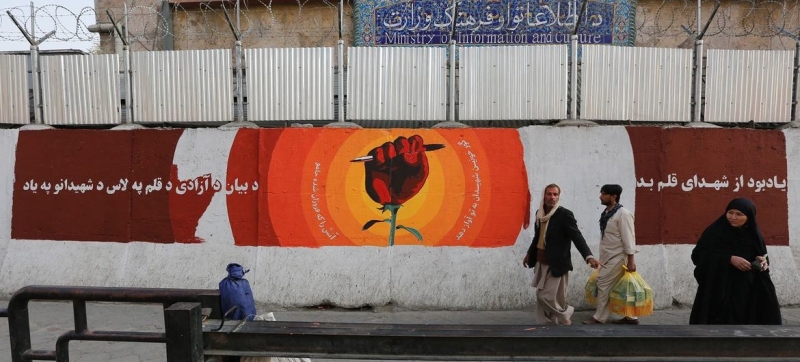
A mural commemorating journalists killed in Afghanistan has been painted on a blast wall in downtown Kabul, Afghanistan (file).
War in the Middle East has made Lebanon the deadliest country for media workers so far this year, but virtually no country offers a truly safe environment for journalists, according to the UN High Commissioner for Human Rights.
Volker Türk highlighted growing threats to the media in a message ahead of World Press Freedom Day, observed annually on 3 May.
“When attacks on the media are normalised, freedom itself begins to decay, and with it, the foundations of peace, security, and sustainable development,” he warned.
A dangerous profession
The High Commissioner paid tribute to journalists and photographers worldwide “who document horrific atrocities, expose corruption, and scrutinise business operations.”
However, he noted that journalism has become an increasingly insecure and dangerous profession, with media workers being “bombed in their cars, abducted from their offices, silenced behind bars, and dismissed from their jobs.”
At least 14 journalists have been killed since January. Only around one-tenth of killings over the past two decades have led to full accountability, while coverage of armed conflict remains the highest-risk assignment.
Gaza and conflict zones
“Israel’s war in Gaza has become a death trap for the media. My Office has verified the killing of nearly 300 journalists since October 2023, with many more injured,” he said.
“So far in 2026, Lebanon is the deadliest country for media workers.”
He added that in many conflicts, local reporters carry the greatest burden, including journalists in Sudan who continue working despite extreme violence, famine, and insecurity.
Press freedom under pressure
UN Secretary-General António Guterres said recent years have seen a sharp rise in journalists being killed, often deliberately targeted in war zones.
He warned that while truth is often called the first casualty of war, journalists are frequently the first to pay the price for reporting it. Press freedom is also under pressure from economic constraints, new technologies, and manipulation of information.
No safe place
Mr. Türk warned that “virtually no country is truly safe for those who speak truth to power.”
He cited his visit to Mexico, where journalists face serious risks when reporting on corruption, crime, and environmental issues.
He also expressed concern over growing transnational repression and surveillance targeting media workers, including Iranian journalists abroad.
Online threats and censorship
Laws on defamation, cybercrime, terrorism, and disinformation are increasingly being misused to silence journalists, while costly legal action is used to intimidate them.
Around 330 media workers are currently detained worldwide, along with hundreds of citizen journalists and bloggers.
Women journalists are disproportionately affected by online abuse, with many facing harassment, smear campaigns, and threats of sexual violence.
Economic and political pressure
Media freedom is also being weakened by economic pressure. In nearly a third of countries, funding cuts and media concentration are forcing local outlets to shut down.
Restrictions on access, internet shutdowns, and news blackouts are also being used to silence reporting. In some cases, alliances between political, corporate, and media interests are undermining democracy and deepening social divisions.
Call for action
Despite these challenges, journalists continue to report from hospitals, conflict zones, and difficult environments because they believe the truth matters.
Mr. Türk called on governments to end persecution of journalists, remove restrictive laws, and ensure accountability for attacks against media workers. He also urged technology companies to address online abuse and disinformation, and stressed the need to protect independent and transparent media institutions.