

- A New Arms Race is Threatening to Take-off—Now in Outer Space |
- Equality ‘ends at doors of Security Council’, Kenya’s Ruto at UNGA |
- কলাপাড়ায় প্রাথমিক শিক্ষায় হ-য-ব-র-ল |
- BDRCS and IFRC scale up dengue response to reach 300,000 people |
- World leaders approve new declaration to tackle rising sea levels |
Gaza Dialysis Patients Endure Donkey Cart Journeys
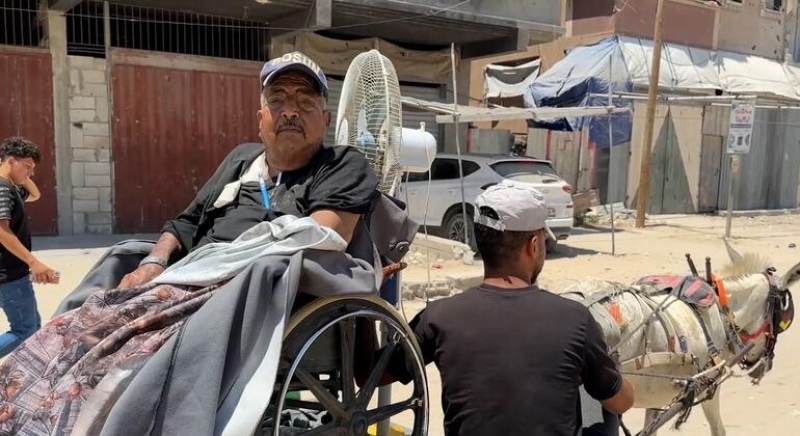
Fathi Haji sits in his wheelchair on a donkey-drawn cart under the blazing sun as he travels to the dialysis centre at Nasser Hospital in Khan Younis, Gaza.
Shortly before sunrise, Palestinian Fathi Hajji begins an arduous journey to Nasser Hospital in Khan Younis in the war-ravaged Gaza Strip three times a week.
The elderly man sits in a wheelchair mounted on a donkey-drawn cart, with an oxygen cylinder and a small fan beside him, as he travels from his tent in the Al-Mawasi area to the dialysis centre.
“Since January 2024, I have been undergoing dialysis three times a week,” he said. “I suffer greatly because of the transportation. I travel by a donkey-drawn cart under the scorching sun. Thank God, what else can we do? I have no other choice.”
Gruelling Journey
Travelling to the hospital has become part of his routine struggle because of destroyed infrastructure, a lack of transportation and the continuing humanitarian crisis in Gaza since the Israel-Hamas war began in 2023.
Although a ceasefire took effect in October 2025, Gaza's health system continues to operate at limited capacity, according to the World Health Organization (WHO).
WHO said Israeli attacks, widespread damage to health facilities and restrictions on the entry of medical supplies continue to hamper healthcare services at a time when patients with chronic illnesses require regular, uninterrupted treatment.
Mr Hajji's experience reflects the reality faced by hundreds of kidney failure patients across Gaza, where damage to health facilities has placed additional pressure on dialysis services, according to WHO and other UN agencies.
Struggle to Survive
For Mr Hajji, the journey to and from the dialysis centre is itself a test of endurance.
Along the way, his grandson, Saif, must repeatedly stop to reattach the wheelchair to the donkey cart because of the rough, unpaved roads.
“There is tremendous suffering during the journey because of the intense heat and the rough roads,” Saif said. “We have to stop every 50 metres to adjust my grandfather's wheelchair, and we arrive at the hospital exhausted and in immediate need of oxygen.”
Shortage of Equipment
After the difficult journey, Saif helps his grandfather transfer from the wheelchair to a bed at the dialysis unit in Nasser Medical Complex, where patients wait for available machines while medical staff struggle to cope with rising demand and limited resources.
Mr Hajji then begins a dialysis session lasting between three and five hours under the supervision of healthcare workers.
“It is very difficult, especially in the extreme heat, so I have to bring a fan with me. I also need to refill my oxygen cylinder every day,” he said.
Hamza Abu Raya, an employee at the dialysis centre, said shortages of equipment continue to worsen patients' suffering.
“We are under tremendous pressure because many of the dialysis machines are worn out,” he said. “We also face shortages of treatment supplies, including bicarbonate, while the medicine Eprex has been unavailable for a long time, increasing patients' suffering.”
According to the UN Office for the Coordination of Humanitarian Affairs (OCHA), shortages of fuel, spare parts and medical supplies remain widespread.
The shortages are compounded by the continued spread of infectious diseases and mounting pressure on Gaza's already overstretched health facilities.
Despite the challenges, humanitarian health partners continue to provide services to the fullest extent possible.
Another Journey Home
After completing his dialysis session, Mr Hajji returns to his wheelchair and waits outside the hospital gate.
He then boards the same donkey-drawn cart for the journey back to his tent, preparing to repeat the exhausting trip again in a few days.