

- BD, EU to sign Partnership Coop Agreement (PCA) Monday |
- Missed opportunities, institutional failures mark BD reforms |
- Telcos Seek Priority Power, Fuel to Avert Outages |
- IFRC, BDRCS 6-Month Lifesaving Response to Measles Cases |
- First cruise ship crosses Strait of Hormuz since war began |
Measles Testing Hampered by Kit Shortage
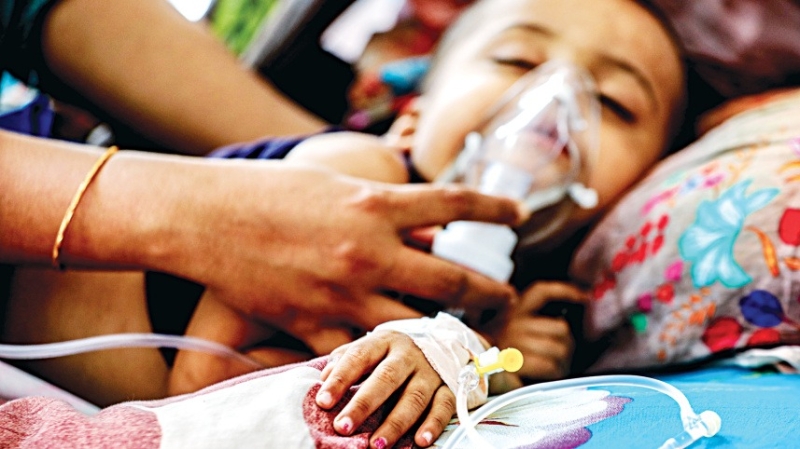
Measles testing in Bangladesh is falling well below capacity due to a shortage of diagnostic kits, raising concerns that the true scale of the outbreak is being underestimated.
At present, testing is conducted only at the Institute of Public Health in Mohakhali, Dhaka, the country’s sole government facility equipped for measles diagnosis. Although the institute can process 300 to 400 samples daily, it is currently testing only around 120 due to limited supplies.
“We simply do not have enough kits to run more tests,” said Director Md Mominur Rahman.
Officials said the kits are supplied by the World Health Organization, with each capable of testing 90 samples. As of Sunday noon, only three kits remained in stock. Later, 60 more kits were delivered, while additional supplies are awaiting clearance at Hazrat Shahjalal International Airport due to administrative delays.
Public health experts have criticised the situation, warning that limited testing capacity is undermining efforts to assess and control the outbreak. Abu Jamil Faisel described the shortage as a failure of preparedness, saying that without adequate testing, the real extent of infections cannot be determined.
Around 300 suspected samples are being sent daily from across the country, but not all are being processed. Between 11 and 18 April, the institute tested 965 samples, of which 641, or about 66 percent, were positive.
Hospitals have also reported delays in receiving test results. At Bangladesh Shishu Hospital and Institute, results have been received for only about half of the samples sent this year, while others remain pending.
In districts such as Barguna, uncertainty persists over testing outcomes, with incomplete reporting on processed samples.
Officials acknowledged that there had been no prior planning for large-scale measles testing, resulting in insufficient stockpiling of kits. The World Health Organization has pledged to supply an additional 100 kits next week.
According to health authorities, 23,606 suspected measles cases have been recorded nationwide between 15 March and 19 April, with 3,044 confirmed through laboratory testing. Experts believe the actual number could be significantly higher due to limited testing.
The death toll continues to rise, with 36 confirmed measles deaths and 181 additional deaths reported among patients with similar symptoms.
Meanwhile, a nationwide measles-rubella vaccination campaign begins today, targeting children aged six months to five years. Authorities aim to vaccinate around 18 million children through fixed centres and community outreach, including schools, childcare facilities and high-risk areas.