

- 42-Year Rainfall Record Broken as Chattogram Floods |
- Flash Flood Risk Rises as Rivers Swell: FFWC |
- Switzerland Beat Colombia to Reach World Cup Last Eight |
- Argentina beat Egypt 3-2 to reach World Cup quarter-finals |
- Bangladesh Leads South Asia in FDI Growth: UNCTAD |
BIBM urges modernization of trade finance
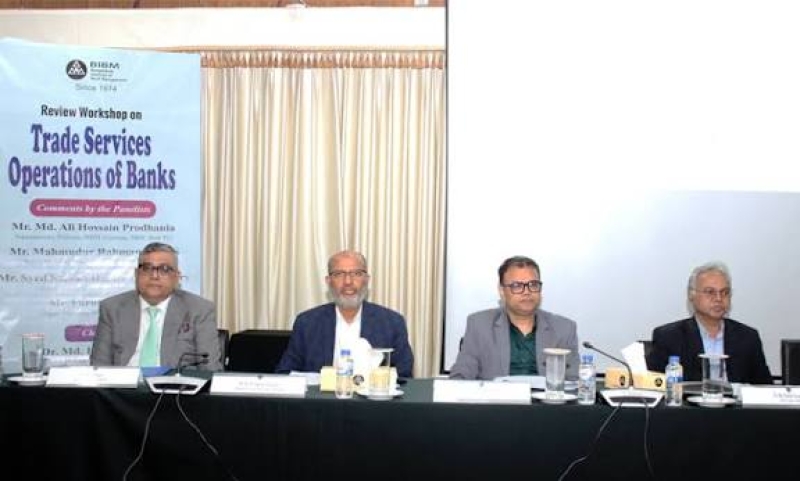
The Bangladesh Institute of Bank Management (BIBM) today stressed the need to modernize trade finance operations, strengthen asset quality and improve risk management to ensure sustainable growth in the country's banking sector.
The observations came at a review workshop titled "Trade Services Operations of Banks" held at the BIBM campus in the city, bringing together senior bankers, policymakers, regulators, academics and researchers to discuss emerging challenges and the future of trade finance in Bangladesh, said a press release.
Presenting the keynote paper on behalf of the research team, Dr. Shah Md. Ahsan Habib, Professor (Selection Grade) of BIBM, said the institute's study found growing asset quality concerns in banks with significant trade finance exposure.
According to the study, trade finance non-performing loans (NPLs) in such banks currently range between 40 and 50 percent, while the ratio exceeds 80 percent in banks that have both high overall NPLs and substantial trade finance exposure.
The research identified the conversion of non-funded liabilities into forced loans as a key factor behind the rise in trade finance-related NPLs.
Financing linked to imports of capital machinery, raw materials, commodities, fuel and scrap vessels has significantly contributed to the deterioration of asset quality, it said.
The study also pointed to structural weaknesses in export finance, noting that the use of back-to-back Letters of Credit (LCs) without legally enforceable sale-purchase contracts has become a major source of NPLs.
Delays or failures in export proceeds, it observed, can transform transaction-based trade finance facilities into forced loans, increasing banks' credit risks.
Chairing the workshop, Dr. Md. Ezazul Islam, director general (DG) of BIBM, emphasized the need to modernize the legal and digital infrastructure for electronic trade documents to facilitate faster, more secure and paperless trade transactions.
He also stressed strengthening Anti-Money Laundering and Combating the Financing of Terrorism (AML/CFT) measures and reinforcing safeguards against Trade-Based Money Laundering (TBML), while ensuring efficient and customer-friendly banking services.
Dr. Ezazul also highlighted the importance of expanding access to trade finance for small and medium enterprises (SMEs) through innovative financial products and risk-sharing mechanisms. He called for better product-level data, stronger risk management and enhanced asset quality monitoring.
He further urged closer coordination among Bangladesh Bank, commercial banks, customs authorities and other stakeholders to build a resilient, transparent and efficient trade finance ecosystem capable of supporting the country's expanding international trade.
The keynote paper was jointly prepared by researchers from BIBM, Bangladesh Bank and Mutual Trust Bank PLC.
Senior representatives from commercial banks and Bangladesh Bank participated in the workshop and exchanged views on strengthening trade finance operations and improving asset quality across the banking sector, reports BSS.