

- Court Denies Bail to 27 Detained From Jasad Office |
- Bangladesh Plans Major River, Canal Restoration Drive |
- Solar irrigation brings savings, extra income to Jhenaidah farmers |
- ADB Approves $100m Loan for Affordable Housing in Bangladesh |
- No Respite From Poisonous Air: Radical Cure Urgent |
Govt Moves to Bring ETPs Online to Save Buriganga
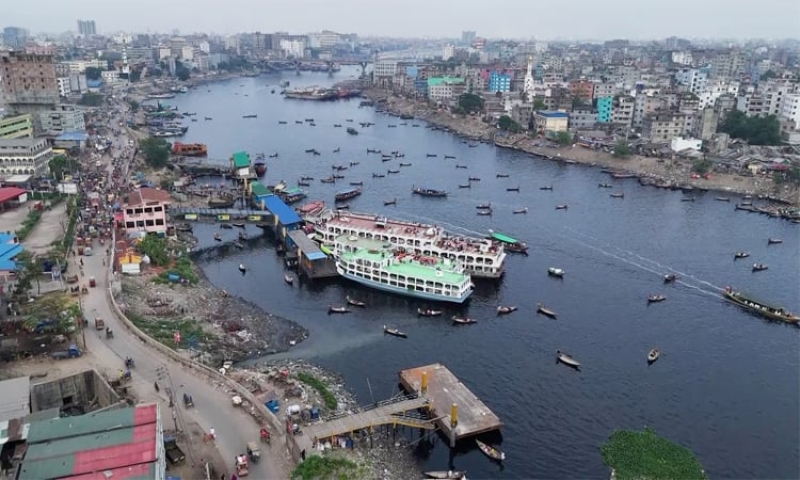
File Photo
The government has launched initiatives to bring Effluent Treatment Plants (ETPs) into operation and strengthen enforcement drives to reduce pollution in the Buriganga River and other water bodies around Dhaka.
Officials of the Ministry of Environment, Forest and Climate Change said the Department of Environment (DoE) is regularly monitoring water quality in the Buriganga and other industrially polluted rivers across the country.
The DoE has set up seven water quality monitoring points along the Buriganga River. Meanwhile, the Bangladesh Inland Water Transport Authority (BIWTA) is continuing dredging operations to improve navigability by removing polluted sediment.
DoE Director General Dr Md Lutfor Rahman said efforts are underway to restore the river’s natural flow by increasing water circulation. He added that work is also progressing to activate ETPs at industrial facilities.
ETPs treat harmful industrial wastewater containing toxic chemicals, dyes, oil, heavy metals and other hazardous substances before discharge, helping protect the environment, aquatic life and public health.
A recent inspection of different areas along the Buriganga found that untreated industrial waste, household garbage and plastic pollution have severely degraded the river, turning parts of its water dark and foul-smelling.
Several dyeing and washing factories, shipbuilding yards and ship repair facilities operate along the riverbanks and surrounding areas. Officials said some establishments have contributed to pollution by violating environmental regulations.
Prof Dr A.K.M. Saiful Islam of the Institute of Water and Flood Management at Bangladesh University of Engineering and Technology (BUET) said stopping direct dumping of household waste into the river is essential to reduce pollution.
He recommended expanding treatment-based waste management, removing illegal structures, marking river boundaries and continuing dredging to remove contaminated sediment and plastic waste.
The Department of Environment said regular enforcement operations are being conducted to prevent pollution in rivers and water bodies surrounding Dhaka.
Under the National Environment Policy 2018, the government has introduced measures to protect rivers, wetlands, floodplains and other ecosystems. Environmental regulations have also been updated through the Environment Conservation Rules, 2023.
BIWTA said it has identified 307 waste discharge outlets along the Buriganga River and has issued notices to owners of illegal riverside structures and establishments to stop dumping waste into the river.
Authorities warned that legal action will be taken against those who fail to comply.
The Buriganga, one of Bangladesh’s most important rivers, flows through Dhaka and Narayanganj districts. The 29-kilometre-long river has played a central role in the growth of Dhaka, which was established on its banks around 400 years ago.