

- Bangladesh, EU Push for FTA, Investment Pact Talks |
- Over 1.14cr workers sent to Middle East in 22 years |
- BNP finalizes 36 nominations for women’s seats in Parliament |
- Alarming trans-fat levels in food despite regulations: BFSA |
- BD, EU to sign Partnership Coop Agreement (PCA) Monday |
Young Volunteers Lead Sea Turtle Conservation Efforts
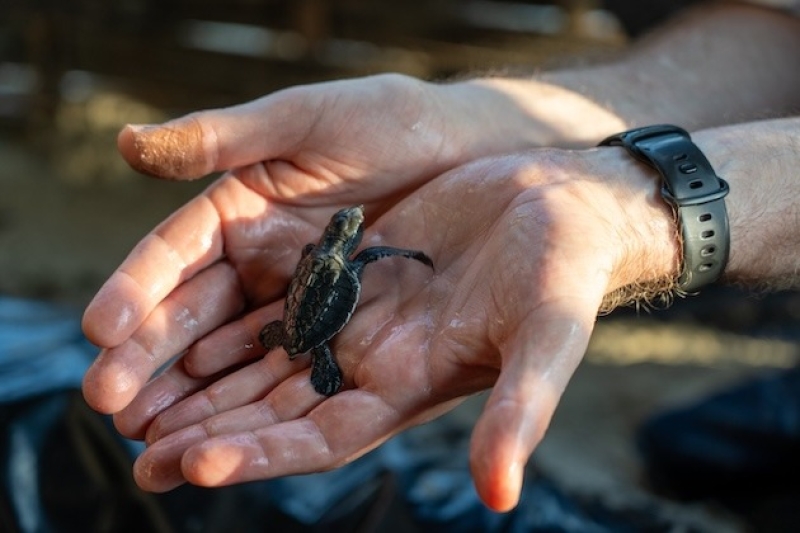
A sea turtle is released from the hatchery in Cox’s Bazar, Bangladesh to begin its hazardous journey to the sea. Credit: UNDP Bangladesh
Every winter, thousands of sea turtles come ashore at Cox’s Bazar, on the Bay of Bengal, to lay their eggs.
Their journey to breeding grounds is fraught with danger. Fishing nets, boat propellers, light pollution, coastal development, stray dogs and other threats reduce their chances of survival.
The area is rich in biodiversity. Five of the world’s seven sea turtle species are found in Bangladesh’s waters, while three species — Olive Ridley (Lepidochelys olivacea), Green Turtle (Chelonia mydas), and Hawksbill (Eretmochelys imbricata) — come ashore to nest.
Despite these challenges, a group of young volunteers works to protect the turtles along the beaches of Cox’s Bazar during the breeding season from November to March, contributing to conservation efforts.
“In the past, we did not understand how sea turtles help marine ecosystems. Now we know they play an important role in conserving biodiversity,” said Rezaul Karim, a resident of Shafir Beel village.
Karim is among the youths trained under a conservation project run by the Arannayk Foundation. The foundation formed a sea turtle conservation group of 25 local youths — 11 women and 14 men — under its Ecosystem Awareness and Restoration Through Harmony (EARTH) project.
The project is supported by the Forest Department, the Department of Environment, and the United Nations Development Programme, with funding from the Global Environment Facility.
The group raises awareness among fishermen, youth and local communities, encouraging a shift in attitudes towards protecting turtles.
Group leader Delwar Hossain said sea turtles play a vital role in maintaining marine ecosystems by regulating food chains and habitats.
He noted that some fishermen believe catching turtles brings bad luck, leading them to kill turtles caught in their nets. “We held several meetings with fishermen to raise awareness about conservation,” he said.
Gabriella Richardson Temm, head of the Small Grants Programme at the GEF, said civil society, Indigenous peoples, and local communities play a critical role in addressing global environmental challenges and promoting sustainable development.
Since its launch in 1992, the Small Grants Programme has supported nearly 30,000 projects across 136 countries, mobilising significant funding for grassroots environmental initiatives.
Community-based conservation efforts have contributed to the recovery of some turtle populations. The Green Turtle is now listed as ‘Least Concern’ by the International Union for Conservation of Nature, though other species remain under threat. The Olive Ridley is classified as ‘Vulnerable’, while the Hawksbill Turtle is ‘Critically Endangered’.
Hatchery boosting conservation
With support from the foundation, the youth group surveyed a 10-kilometre stretch from Reju Khal to Balia Khali beach to identify nesting sites and gather local knowledge.
A turtle hatchery was later established in Boro Inani, now playing a key role in conservation.
Between January and April 2024, 5,878 Olive Ridley eggs were collected from coastal areas, resulting in 3,586 hatchlings — a success rate of 61 percent.
From February to April 2025, 3,199 eggs were collected, with 716 hatchlings released by May.
Volunteers said stray dogs often destroy eggs, making hatcheries essential. “We collect eggs laid on the shore and bring them to the hatchery. Community members also hand over eggs to us,” Delwar said.
Nurul Afsar, another group member, said some local communities traditionally consume turtles and their eggs, and the group works to discourage this practice.
ABM Sarowar Alam of the IUCN in Bangladesh said Cox’s Bazar was once an ideal breeding ground, but habitat loss, poaching and human activity have reduced nesting. He suggested declaring parts of the beach as protected areas and restricting fishing in nearby canals.
Firoz Al Amin of the Inani Forest Range said steps are being taken to control stray dogs to protect turtle populations.
Beyond turtles
Dr Mohammed Muzammel Hoque, national coordinator of the GEF Small Grants Programme in Bangladesh, said the EARTH project goes beyond turtle conservation.
It includes elephant response teams to reduce human-elephant conflict, crab conservation groups, and habitat restoration initiatives. More than 7,780 seedlings have been planted, with about 80 percent surviving.
He said long-term success depends on sustained funding, with plans to generate income through eco-tourism once forest trails become operational.
Abu Hena Mostafa Kamal of the Arannayk Foundation said integrating conservation with livelihoods has helped build a sense of ownership among local communities, ensuring lasting environmental protection.