

- PM Tarique, Li Qiang Hold Bilateral Talks in Beijing |
- Bangladesh’s external debt stands at $78.22 billion: Khosru |
- PM invites Chinese cos to expand value chains into Bangladesh |
- Powerful Quakes Rock Venezuela, Heavy Toll Feared |
- PM invites Chinese companies to expand value chains into Bangladesh |
Solar Cold Storage Launched in Chattogram Facility
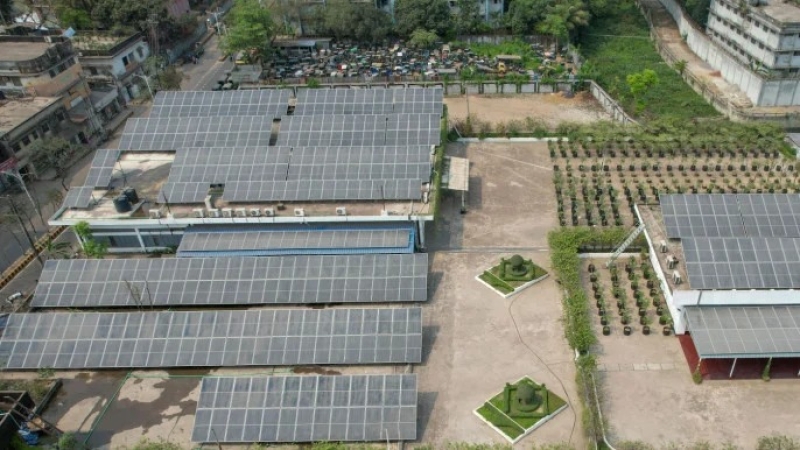
Rancon Group has installed a 296KWp solar system atop its cold storage facility in Chattogram’s Sadarghat. The 482-panel rooftop installation now meets most of the facility’s energy demand, saving around Tk4.13 lakh each month amid rising power prices.
A private industrial group has launched what it claims to be Bangladesh’s first solar-powered cold storage facility at its sea fishing division in the Sadarghat area of Chattogram, as the country continues to face energy challenges and rising electricity costs.
The rooftop-based solar system, installed by an engineering and infrastructure unit of the group, marks a shift toward renewable energy use in the country’s cold storage sector.
Officials said the project was completed in about two months at a cost of nearly Tk 1.3 crore and began operation in April this year. The system has a generation capacity of 296 kWp DC and 250 kW AC.
A total of 482 solar panels have been installed over approximately 28,000 square feet of rooftop space. Each 615Wp panel measures 2,382mm by 1,134mm and can produce about 2.8 kilowatt-hours of electricity on sunny days and around 2.2 kilowatt-hours during cloudy or monsoon conditions.
The cold storage facility requires around 2,200 kilowatt-hours of electricity daily to preserve up to 500 tonnes of fish. According to company officials, the solar system can now meet almost the entire daytime electricity demand under normal weather conditions.
Before the installation, the facility’s monthly electricity bill stood at around Tk 6.72 lakh. That has now fallen to approximately Tk 2.59 lakh, resulting in monthly savings of nearly Tk 4.13 lakh.
In addition to cost savings, the project is expected to reduce carbon emissions by about 210 tonnes annually. During periods of excess production, surplus electricity is supplied to the national grid.
However, the facility still relies on grid electricity at night, as no battery storage system has been installed. Officials said battery storage remains financially difficult due to high import duties and equipment costs.
A senior engineer involved in the project said the system has delivered both financial and environmental benefits, while also improving the company’s compliance profile for international markets.
Industry officials noted that global buyers, especially in export-oriented sectors like seafood, are increasingly prioritising environmentally responsible suppliers.
A senior official of the infrastructure unit said the solar installation is expected to operate for around 25 years, making it economically viable in the long term.
He added that cold storage operations are highly energy-intensive, requiring deep freezing conditions between minus 18 and minus 40 degrees Celsius.
Despite Bangladesh’s strong solar potential, he said investment growth remains limited due to tax structures and import duties. Most renewable energy equipment is imported, making up around 90 to 95 percent of the market.
He also pointed to regional competitors that have reduced or removed duties on renewable energy equipment to attract investment, while suggesting that upcoming fiscal policy decisions could play a key role in expanding solar adoption in the country.