

- 40-foot-long dead whale float to Kuakata sea |
- Bangladesh’s export earnings fall by 7.09pc in May |
- New Force Commander of UNFICYP Lt Gen Minhazul Alam meets PM |
- BERC raises retail power tariff by Tk 1.52 per unit |
Business Leaders Urge Crackdown on Big Traders to Stabilise Ramadan Prices
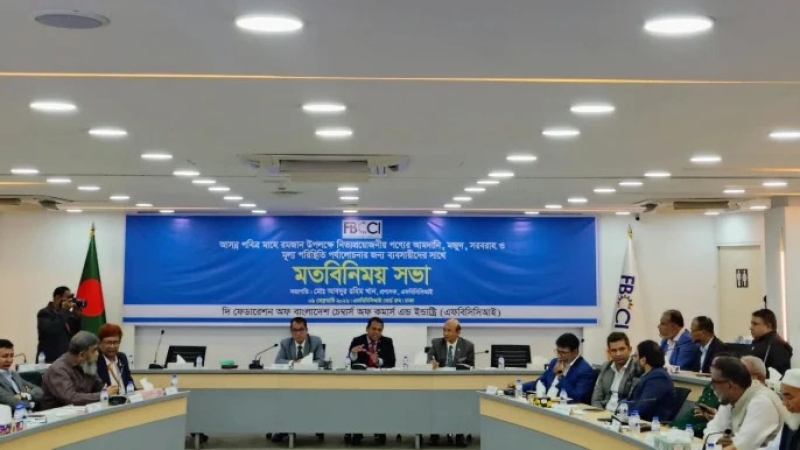
Business leaders speaking at a consultation meeting organised by FBCCI at its Motijheel office on Monday, 9 February, 2026.
Business leaders have called for stricter oversight of major importers and alleged extortion networks, warning that targeting small retailers will not help keep prices of essential goods affordable ahead of Ramadan and the upcoming national election.
Speaking at a consultation meeting organised by the Federation of Bangladesh Chambers of Commerce and Industry (FBCCI), leaders urged authorities to focus monitoring on large importers, mill gates, and key supply-chain points rather than frequent raids on small shops, which they say contribute little to price stability.
The meeting, chaired by FBCCI Administrator Md Abdur Rahim Khan, reviewed the import, stock, supply, and pricing of essential commodities ahead of Ramadan. Khan said FBCCI would actively monitor the market this year to ensure steady supply and fair prices, adding that the volume of letters of credit (LCs) opened is significantly higher than last year, signalling potential stability.
Mohammad Imran Master, president of the Bangladesh Raw Materials Wholesale Traders Association, said perishable goods such as onions, chillies, brinjal, and coriander are in adequate supply. “Prices may rise slightly in the early days of Ramadan if demand spikes, but shortages are unlikely,” he said. Lemon supply could face minor pressure, though no major disruptions are expected.
Golam Mowla, general secretary of the Bangladesh Edible Oil Wholesalers Association, criticised enforcement agencies for repeatedly targeting small retailers. “Small shops are fined hundreds of thousands of taka for minor price differences, while large-scale extortion at mill gates and by big importers goes unchecked. Oversight must focus higher up the chain,” he said.
Market observer Kazi Abdul Hannan warned that large-scale extortion could intensify during Ramadan and the election period. He alleged traders are sometimes forced to pay lump sums ranging from Tk5 lakh to Tk10 lakh to local administration and police, directly affecting commodity prices.
Poultry Association adviser Khandaker Monir Ahmed highlighted the strain on egg producers, who are selling far below production cost. “Against a cost of Tk10.58 per egg, farmers are forced to sell at Tk5–6. Subsidised sales at below-cost prices risk collapsing the industry,” he said.
Consumers Association of Bangladesh (CAB) General Secretary Md Humayun Kabir Bhuiyan said 10 monitoring teams will operate daily across Dhaka during Ramadan to oversee market conditions. He urged traders to maintain cash memos and sell at reasonable profit margins, warning of strict action against those creating artificial shortages.
Business representatives also suggested withdrawing additional duties on dates and importing frozen meat to meet potential protein demand. Taslim Shahriar of Meghna Group said sugar supplies are abundant, with prices down to Tk92–93 per kg at the mill gate, compared to Tk130 last year, and the market is expected to remain stable despite minor international and port-related challenges.
FBCCI former director Gias Uddin Khokon painted a wider picture of systemic issues, alleging widespread bribery and harassment. “To get a gas connection, bribes of up to Tk5 crore are demanded. Bank interest rates have risen despite expectations of a decrease. Extortion and harassment at every step prevent businesses from controlling prices. Monitoring should have started earlier,” he said.
Representatives from government agencies, private sector bodies, business associations, and trade organisations attended the meeting, agreeing that curbing extortion and improving oversight at key supply points are essential to stabilising prices this Ramadan.