

- Govt to Build Padma, Teesta Barrages for Water Security |
- Bangladesh Warned Repeatedly Over Measles Vaccine Gap |
- 163 Olive Ridley turtle hatchlings found on Kuakata beach |
Middle East Crisis Deepens Uneven Global Economic Shock
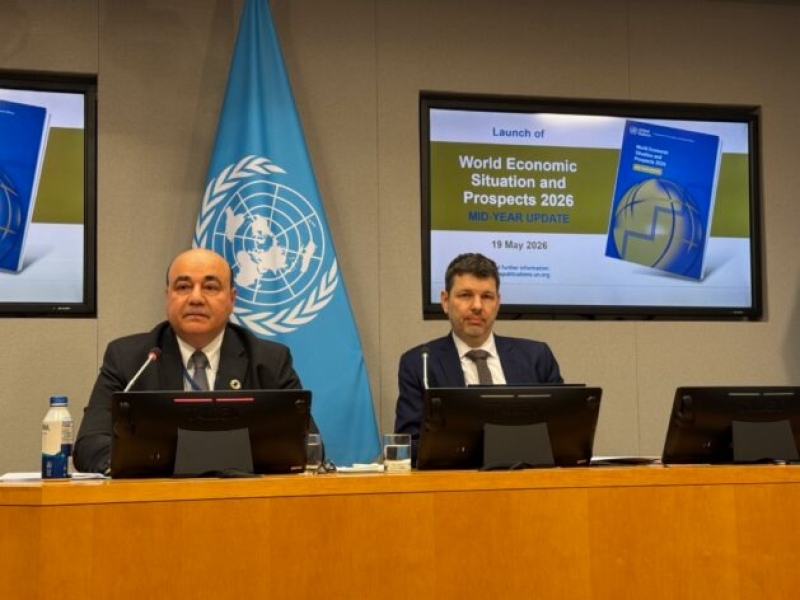
Shantanu Mukherjee, Director of the Economic Analysis and Policy Division of the United Nations Department of Economic and Social Affairs (UN DESA), and Ingo Pitterle, Senior Economist and Officer-in-charge of the Global Economic Monitoring Branch of the Economic Analysis and Policy Division of UN DESA.
The ongoing crisis in the Middle East and the closure of the Strait of Hormuz are placing significant pressure on the global economy, with rising risks to growth, inflation, and trade stability.
A new UN report says the slowdown in global growth, renewed inflationary pressures, and rising uncertainty are affecting all economies, but the impact is uneven across regions and income groups. Developing and vulnerable economies are facing the harshest consequences due to limited financial buffers and weaker policy capacity.
Released on May 19, the World Economic Situation and Prospects (mid-2026 update) outlines how the conflict has disrupted trade, energy flows, commodities, tourism, labour markets, and public finance. The closure of the Strait of Hormuz has further intensified global supply chain disruptions.
“What began as a shock to energy markets has evolved into a broader and more uncertain global supply disruption,” said Shantanu Mukherjee, Director of the Economic Analysis and Policy Division at UN DESA.
Senior UN economist Ingo Pitterle noted that the crisis adds to a series of recent global shocks, leaving the world economy more vulnerable than before. He said the impact depends largely on countries’ exposure to disrupted channels and their policy space to respond.
The report projects global GDP growth at 2.5 percent in 2026, down 0.2 percentage points from earlier estimates, with a modest recovery expected in 2027. While labour markets and select technology-driven investments provide some support, the overall outlook remains weak.
Energy markets are the most affected, with supply constraints, rising prices, and higher transport and insurance costs spreading through global supply chains. Although energy producers are seeing windfall gains, households and businesses are facing rising cost pressures, particularly in lower-income countries.
The report warns that the crisis is also undermining progress toward the Sustainable Development Goals (SDGs) by increasing food insecurity, reducing investment capacity, and widening financing gaps estimated at around USD 4 trillion.
Regionally, Western Asia is expected to be among the hardest hit, with growth projected to fall sharply from 3.6 percent in 2025 to 1.4 percent in 2026. Africa is also facing weaker growth and rising inflation due to higher energy and food costs.
Remittance-dependent economies in South Asia, Africa, and Southeast Asia are particularly vulnerable, with Gulf-linked labour income flows at risk of disruption. Countries such as Bangladesh and Nepal could face pressure on external earnings if remittance flows decline.
The International Labour Organization (ILO) warned that labour markets in affected regions will continue to feel the impact long after the conflict ends, especially in economies closely tied to Gulf energy trade, migration, and supply chains.
Despite the negative outlook, the report says stronger international cooperation and increased investment in renewable energy could help reduce vulnerability to future shocks and build more resilient economies.