

- Iran vows to hit all ME economic hubs if US-Israeli attacks persist |
- Sammilito Islami Bank merger to continue: Governor |
- Biman Suspends Flights to Six Middle East Cities Over Tensions |
- Govt Announces 25pc Rail Fare Discount |
- Middle East War Puts Bangladesh Jobs at Risk |
War with Iran strains US-UK ties as Starmer and Trump clash
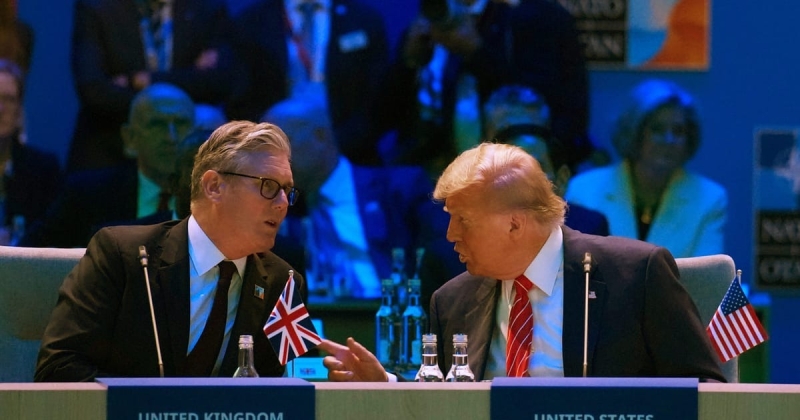
UK Prime Minister Keir Starmar and US President Donald Trump look differring over something. Agencies
LONDON, Mar 3 — Tensions between the United States and the United Kingdom have flared as President Donald Trump criticized Prime Minister Keir Starmer over Britain’s limited involvement in U.S.-Israeli strikes on Iran.
Trump, in an interview with The Sun, expressed disappointment that the U.K. did not match the cooperation of other European countries, saying, “The U.K. has been much different from others… It’s very sad to see that the relationship is obviously not what it was.”
Starmer initially blocked American planes from using British bases for the airstrikes launched on Saturday. He later permitted U.S. forces to operate from bases in England and on Diego Garcia in the Indian Ocean, but restricted them to targeting Iran’s ballistic missiles and storage sites. The U.K. did not join attacks on other Iranian targets.
Even after a drone strike over the weekend hit the British base at Akrotiri in Cyprus, Starmer reiterated that the U.K. “will not join offensive action.” He underscored that British military operations must have a lawful basis and a well-considered plan, implicitly challenging Trump’s approach.
“President Trump has expressed his disagreement with our decision not to get involved in the initial strikes, but it is my duty to judge what is in Britain’s national interest,” Starmer told lawmakers in the House of Commons on Monday.
The spat highlights growing friction in the trans-Atlantic “special relationship,” strained in recent years by Trump’s “America first” policies and transactional approach to global diplomacy. Analysts say the Iran conflict has exposed divisions not only between Washington and London but also among European leaders, with NATO Secretary General Mark Rutte praising the U.S. strike, while Spain condemned it as “unjustifiable” and “dangerous.”
Britain, France, and Germany have collectively emphasized that they were not involved in the strikes but remain ready to support defensive measures to neutralize Iranian missile and drone threats. Domestically, Starmer faces pressure from Conservative politicians who criticized his refusal to join the offensive. Conservative leader Kemi Badenoch backed U.S. action, saying Britain “stands behind America taking this necessary action against state-sponsored terror.”
Despite the disagreement, Foreign Office Minister Stephen Doughty assured the Commons that the U.S.-U.K. relationship remains robust. “Our relationship with the United States is strong. It has endured, it continues to endure, and it will endure into the future on both the economic and the security fronts,” he said.
The Iran war and the handling of the U.K.’s participation underscore the delicate balance Starmer faces in maintaining national interests while navigating the longstanding, though currently tested, alliance with Washington. - UNB