

- 109 BGB Platoons Deployed in Dhaka, Five Other Districts |
- Bangladesh-Denmark May form Trade and Investment Committee |
- Bangladesh—Pakistan trade crosses $1 b |
- Dhaka Ranks 5th Among World's Most Polluted Cities on Friday |
- PM seeks to make Bangladesh a reliable brand in global livestock market |
Bangladesh, Denmark to Plan Post-2028 Cooperation Framework
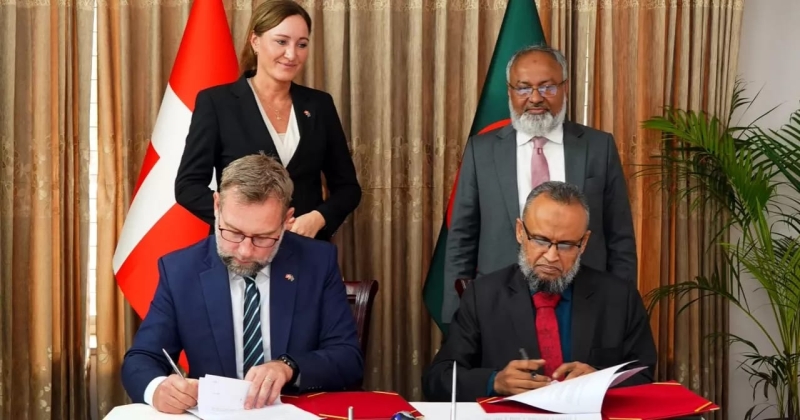
Bangladesh and Denmark have agreed to initiate a process in 2027 to define a framework for bilateral cooperation beyond 2028, building on their existing Sustainable and Green Framework Engagement and Joint Action Plan for 2023-2028.
The process will reflect the growing importance of trade and investment in bilateral relations and the shared ambition of achieving sustainable prosperity.
The issues were discussed at the fourth round of Political Consultations between Bangladesh and Denmark, held in Dhaka on Thursday.
The consultations were co-chaired by Dr Md Nazrul Islam, Secretary (East-West) at the Ministry of Foreign Affairs of Bangladesh, and Elsebeth Søndergaard Krone, State Secretary for International Partnerships at Denmark's Ministry of Foreign Affairs.
Recognising Denmark as an important development partner, Bangladesh emphasised the need for predictable, long-term market access to support its economic development and ensure a smooth and sustainable transition, according to the Ministry of Foreign Affairs.
Denmark expressed support for ongoing exploratory initiatives between Bangladesh and the European Union towards negotiations on a proposed Free Trade Agreement.
Both sides reiterated the longstanding friendly relations between the two countries, based on mutual respect and common interests.
They also reaffirmed their shared commitment to democracy, human rights, good governance and the rule of law.
Bangladesh expressed appreciation for Denmark's continued support in these areas, while both sides recognised the importance of strong institutions in ensuring sustainable development and a predictable environment for trade and investment.
The two delegations reviewed progress since the third round of consultations in May 2025 and discussed further cooperation in climate adaptation, renewable energy, energy efficiency, water management, the circular economy, sustainable agriculture, maritime affairs and education.
They also discussed migration management and skills development, focusing on safe and regular migration pathways.
Building on a decision taken at the previous round of consultations, the two sides agreed to advance a proposal to establish a Bangladesh-Denmark Trade and Investment Committee in consultation with relevant stakeholders.
The proposed committee will bring together relevant authorities to promote trade and investment, address barriers faced by businesses and follow up on commercial opportunities.
The two sides welcomed the signing of a renewed government-to-government memorandum of understanding on public-private partnership cooperation following the expiry of the previous five-year agreement.
They also welcomed an agreement on the implementation of Component II of the Saidabad Water Treatment Plant Phase III, involving a revised procurement strategy for the DKK 2.4 billion project, equivalent to approximately EUR 300 million, supported by Impact Fund Denmark.
Both sides reaffirmed their commitment to strengthening cooperation on sustainable infrastructure and advancing the project to improve access to safe drinking water in Dhaka.
They also welcomed a memorandum of understanding between the Asian University for Women (AUW) and APM Terminals to strengthen cooperation between education and industry.
The partnership will support internships, employment opportunities and maritime education, expanding learning and career prospects for women in Bangladesh.
Denmark reaffirmed its continued humanitarian support for Rohingyas forcibly displaced from Myanmar and their host communities in Bangladesh.
Both sides welcomed the recent judgment of the International Court of Justice in the case of The Gambia v. Myanmar and stressed the importance of justice, accountability and full compliance with the court's judgment.
They agreed to work with the international community to support effective implementation of the judgment and ensure tangible and positive outcomes for the Rohingya people.
The two countries also stressed the need for sustained international attention and support and reaffirmed their commitment to a durable solution to the crisis, including the safe, voluntary, dignified and sustainable repatriation of Rohingyas to Myanmar.
The delegations also exchanged views on regional and global developments of mutual interest.
They reaffirmed their commitment to multilateralism, respect for international law and a rules-based international order, and agreed to strengthen cooperation in relevant international forums.
Both sides agreed to maintain regular follow-up on the outcomes of the consultations and hold the fifth round in Copenhagen in 2027.