

- ADB Approves $100m Loan for Affordable Housing in Bangladesh |
- No Respite From Poisonous Air: Radical Cure Urgent |
- Minimising The Energy Shocks In Bangladesh |
- How Bad Loans, Capital Erosion Pressure Banks In BD |
Bangladesh-India Ties ‘Organic’, Dialogue Must Continue
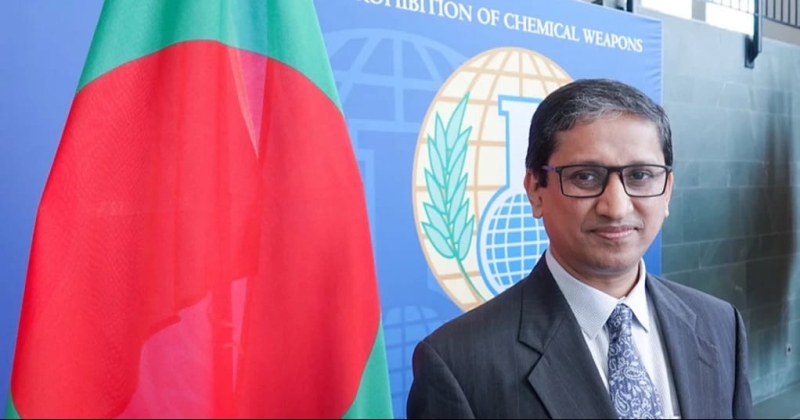
Bangladesh High Commissioner to India Riaz Hamidullah. Photo: Collected
Outgoing Bangladesh High Commissioner to India M Riaz Hamidullah has described Bangladesh-India relations as “organic”, rooted in mutual interdependence and shared interests, and stressed the need for continued dialogue despite differences between the two countries.
“Very simple — this is a relationship which, on several occasions, I've said is organic ... of mutual interdependence. It's a relationship which is in shared interests,” he said in an interview with Indian media.
Hamidullah, who assumed charge as Bangladesh High Commissioner to India on April 7, 2025, is set to leave New Delhi early next month to take up his new assignment as Bangladesh’s Permanent Representative to the United Nations in Geneva.
He said differences in views, perspectives and approaches are natural in any close relationship, particularly between neighbouring countries with an intimate geography.
“But with those, we must remain engaged; carry on conversation, as we need to unpack the interaction between people far more than it is today,” he said.
Expanding People-to-People Engagement
Hamidullah said people-to-people engagement between Bangladesh and India should extend beyond conventional exchanges and reach a much broader section of society.
He identified students, schools and universities as important areas for expanding interaction, saying greater engagement could reach millions of people and make a “distinct difference” to bilateral relations.
“That’s an unattended space that remains,” he said, referring to the need for deeper people-to-people engagement.
Reflecting on his recent experiences in India, Hamidullah said an interaction with students at Delhi Public School (DPS) Srinagar had left a lasting impression on him.
He visited the school after arriving in Srinagar on September 3 and said he was struck by its inclusive and academic environment and the energy of its more than 5,000 students.
During the visit, a Class XII student, RJ Fatima, introduced herself as a radio jockey and invited him to the school's digital radio station, which has been operating since 2019.
Hamidullah recalled that their conversation took an unexpected turn when she asked him: “How do you look at borders?”
“Imagine, sitting in Srinagar, a girl asking this,” he said, adding that he responded to the question with “absolute candour”.
DPS Srinagar was founded in 2003 by Vijay K Dhar under the D P Dhar Memorial Trust. The Dhar family has longstanding links with Bangladesh, including through the late D P Dhar, who played a role in Bangladesh’s formation and its early years.
Calls for Continued Engagement
Indian High Commissioner to Bangladesh Dinesh Trivedi has also recently stressed the importance of maintaining trade, cultural exchanges and people-to-people connectivity between the two countries.
He said issues affecting ordinary people, including the Maitree Express, the Ganges Water Treaty, trade and cultural exchanges, should not be allowed to stall because of political developments.
Trivedi also called for easing trade restrictions, saying people would suffer if such measures remained in place.
India has separately reiterated its desire for a “positive, constructive and forward-looking” relationship with Bangladesh and said it is ready to discuss all bilateral issues through existing structured mechanisms.
The remarks came amid renewed diplomatic engagement between the two neighbours. India has also formally approved Foreign Secretary Asad Alam Siam as Bangladesh’s next high commissioner to New Delhi, with Hamidullah set to move to Geneva.
Celebrating Bangladesh’s National Fish
Meanwhile, a colourful ‘Ilish Fest’ celebrating Bangladesh’s national fish, hilsa, was held at the Bangladesh High Commission in New Delhi.
The event at the ‘Maitri’ Auditorium brought together Indian politicians, diplomats, civil society representatives, academics, journalists and cultural personalities.
During the festival, prominent Indian personalities unveiled A Fish Called Ilish, a book published in Dhaka.
The event showcased hilsa’s deep connection with Bengali heritage, culture and culinary traditions. Guests were served a variety of hilsa dishes alongside traditional Bangladeshi cuisine.
Former Indian Minister of State for External Affairs and journalist M J Akbar, former diplomat and politician Mani Shankar Aiyar, human rights activist and social thinker Syeda Hameed, former Indian ambassador Ronen Sen, sociologist Ashis Nandy and other distinguished guests attended the programme.
The guests praised the taste of Bangladeshi hilsa and the organisation of the festival, which also highlighted Bangladesh’s cultural heritage and hospitality.
Speaking after the book launch, Hamidullah said hilsa is closely linked to Bangladesh’s identity and deeply intertwined with the country’s social and economic fabric.
He also noted that Bangladesh has five hilsa sanctuaries and has taken various initiatives to increase breeding and production of the fish. These efforts, he said, have contributed to greater conservation and production of hilsa.