

- As wars spread, the global food system unravels |
- Holy Eid-e-Miladunnabi Wednesday |
- EU sees Bangladesh as partner of growing strategic importance: Miller |
- Journalism’s main task is to question power: Swapon |
- Rohingya Crisis: Global Community Urges Long-Term Strategy |
EU sees Bangladesh as partner of growing strategic importance: Miller
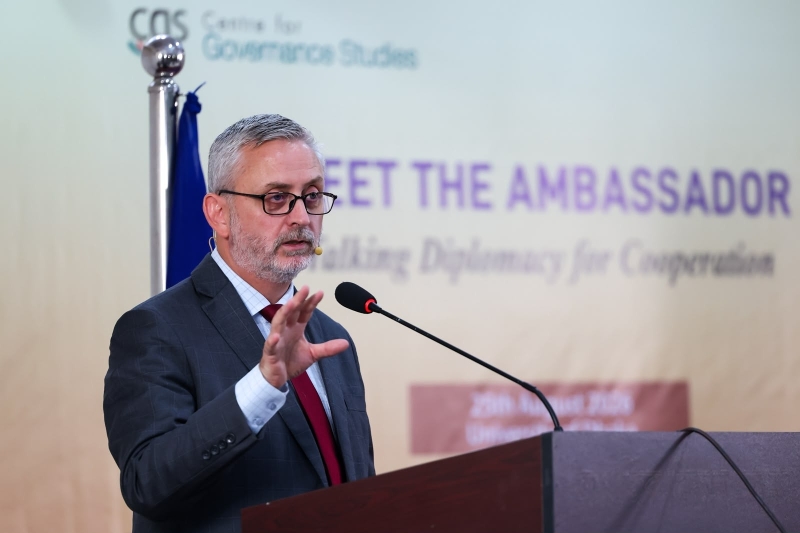
EU Ambassador to Bangladesh Michael Miller speakinhg at a programme of the Centre for Governance Studies at Dhaka Univeristy on Tuesday 25 August 2026.
Dhaka, 25 August -The European Union views its relationship with Bangladesh through a new lens, moving beyond the traditional donor-recipient framework toward an ‘eye-to-eye partnership of equals,’ said EU Ambassador to Bangladesh Michael Miller.
“This is a relationship that has become broader, deeper, and more strategic in the last period. We are actually looking at the relationship through a new lens, we're looking at Bangladesh as a partner of growing strategic importance.”
The Ambassador made the remarks at an event held at Dhaka University today, titled ‘Meet the Ambassador: Talking Diplomacy for Cooperation’ organized by the Centre for Governance Studies (CGS).
Miller said, “there is, I think, a natural convergence between us. Bangladesh understands the value of multilateralism, the importance of international law and the need to act when exposed to global shocks. it has demonstrated a strong record of UN peacekeeping efforts.”
Noting that Bangladesh is passing through an important transitional moment, the ambassador said that the union supports reform ambitions that builds trust between citizens and institutions, and that underpin openness, stability, and prosperity.
“I have to say to you that change of this kind is not easy, and it does not happen quickly. So, perhaps after August '24, there was a sense amongst parts of the population that things would change rapidly. That is not the experience that I have dealing with these reform issues for decades in Europe. It takes time,” he said.
He said economic ties are a key pillar of EU-Bangladesh relations, noting that the EU is Bangladesh’s largest export destination, receiving around half of the country’s exports worth over €23 billion in 2025.
Bangladesh’s LDC graduation, whether or not it is postponed from this year, it doesn't matter, but the development is a major achievement and should be recognized, Miller said. “We are ready to work with Bangladesh to this end, ready to explore now the ambition that has been expressed by the government of Bangladesh to negotiate a Free Trade Agreement.”
He said that the FTA would not be automatic, stressing that Bangladesh must undertake reforms to facilitate trade, strengthen intellectual property protection and the rule of law, and ensure fair competition.
Saying that EU companies can contribute in many sectors in Bangladesh but stuck in modest level while the country need more, he said, “the reality is that the confidence of investors still needs to be reinforced, and this requires transparency, policy predictability, regulatory clarity, and a genuine level playing field. It's why the reform agenda that we talk about, why that reform agenda matters not only politically, but also economically.”
EU has provided more than 500 million euros since the Rohingya crisis began in 2017, with over 50 million allocated this year for humanitarian assistance, development and accountability, while supporting both Rohingya refugees and host communities in Cox’s Bazar, said Millar.
The ambassador said the Indo-Pacific has become central to the EU’s global strategy, stressing the importance of a free, open, inclusive, peaceful and rules-based region. He said Bangladesh is crucial to this vision because of its strategic geography, economic weight, large population and role in regional stability. - UNB