

- Philip Sangma arrested for aiding Hadi murder suspects escape |
- Govt Issues Notice on Visa Extension for Expatriates |
- Khamenei Warns US, Israel in First Speech as Leader |
- Protests, Walkout Mark President’s Address in Parliament |
- UNSC fails to adopt resolution for halting Middle East crisis |
Dredging Revives Dharla, Relief for Riverside Residents
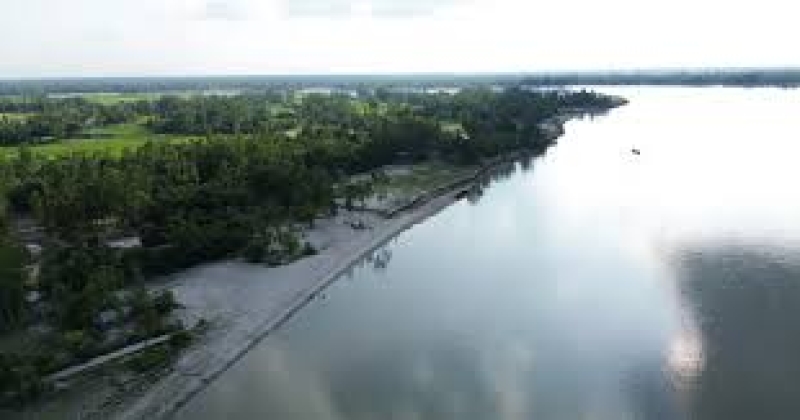
Once known for relentless riverbank erosion and declining navigability, the Dharla River in Kurigram is slowly regaining its vitality as an ongoing dredging project deepens the riverbed and stabilises its flow.
For decades, riverside communities lived under constant threat as the shifting course of the Dharla devoured homes and farmland.
But with dredging now underway along a key stretch of the river, the once-volatile waterway is gradually becoming calmer and more predictable, said locals.
Originating in India’s Cooch Behar district, the transboundary Dharla River enters Bangladesh through Chengrabandha in Patgram and Mogolhat in Lalmonirhat before flowing through Kurigram’s Fulbari, Sadar and Ulipur upazilas.
The river stretches about 60 kilometres and averages around 1.2 kilometres in width before eventually merging with the Brahmaputra at Buraburi in Ulipur.
Years of heavy sedimentation and frequent shifts in the river’s course triggered severe erosion along its banks, forcing many families to abandon their homes and farmlands.
To restore navigability and manage sediment buildup, the Bangladesh Inland Water Transport Authority (BIWTA) launched a project titled Improvement and Restoration of Navigability of the Old Brahmaputra, Dharla, Tulsai and Punarbhaba Rivers.
Dredging began on December 14, 2023, covering around 25 kilometres of the river from Pateshwari in Bhogdanga union of Kurigram Sadar upazila to Kaliganj in Begumganj union of Ulipur.
The project is being implemented at a cost of Tk 263.21 crore and is scheduled to run until June 30, 2027.
BIWTA Executive Engineer Samir Chandra Pal said the dredging is being carried out up to 8.5 feet below the water level to ensure sufficient depth for smooth river flow and navigation.
Officials say the project aims to remove around 16 million cubic metres of sediment.
So far, about 10.3 million cubic metres of sand and soil have already been dredged, marking around 65 percent progress.
The dredged materials are being used in various development initiatives across the district.
These include strengthening flood control embankments, filling low-lying lands and stabilising erosion-prone areas along the riverbanks.
Some of the dredged soil has also been used to fill land for a proposed 30-acre DC Park near the Dharla Bridge, as well as to support development works at schools, colleges, madrasas and flood shelters in the area.
Officials added that part of the dredged sand has been sold through royalty, generating Tk 1.73 crore for the government treasury.
Project design, supervision and digital hydrographic surveys are being carried out by the Institute of Water Modelling (IWM), while district and upazila-level committees monitor dredging activities and the management of dredged materials.
Experts caution, however, that the Dharla has a sedimentation tendency of nearly 97 percent,meaning regular dredging will be necessary to maintain its navigability over the long term.
Despite the challenges, the impact of the project is already visible to those living along the river.
Abdul Quddus, a resident of Jagmohon Char in Bhogdanga union, recalled how people used to stay awake at night during the monsoon fearing that their homes might collapse into the river.
“Earlier, whenever the monsoon arrived we feared our homes would be swallowed by the river. We had to keep watch all night. Now the river is calmer and the water drains quickly,” he said.
Farmer Rafiqul Islam from Nidhiram village in Mogolbasa union said many farmers had previously lost valuable farmland to erosion.
“Now the dredged soil has been used to fill low-lying lands. Some fallow lands have become cultivable again, which has helped us a lot,” he said.
For residents like Shefali Begum of Sarkar Para in Buraburi union of Ulipur, the change has brought a renewed sense of security.
“Earlier water used to remain stagnant during the rainy season and we were always worried about our homes. Now the water recedes quickly,” she said.
At a discussion meeting on the project held at the Kurigram Deputy Commissioner’s conference room in May last year, then Deputy Commissioner Nusrat Sultana said the dredging had significantly reduced erosion and helped floodwaters recede faster.
She also noted that several canals created by past erosion had been filled with dredged soil, helping recover hundreds of acres of land.
Shafiqul Islam, president of the Kurigram District Char Development and Implementation Organisation, said river erosion has been affecting 16 rivers in Kurigram since the 1950s.
“Thousands of people have lost their homes due to erosion of the Dharla. The 25-kilometre dredging from Pateshwari to Begumganj has already reduced erosion significantly,” he said.
However, he emphasised that for long-term benefits, dredging should be extended along the entire 60-kilometre stretch of the river from Karnapur in Fulbari to Begumganj.
Kurigram Sadar Upazila Nirbahi Officer Ismail Hossain said the dredged sand and soil have also supported infrastructure development at many educational and religious institutions across the area.
BIWTA Additional Chief Engineer Saidur Rahman said the benefits of the project are becoming increasingly evident, reports UNB.
“The positive impact of dredging in the Dharla River is clear. We will inform the ministry about the need to continue dredging along the entire river for the benefit of the people,” he said.