

- Bus Fares Rise by 17 Paisa Per Kilometre |
- PM arrives in New York to attend 81st UNGA session |
- Jatri Kalyan Samity urges withdrawal of increased fuel prices |
- Global Diesel Shortage Likely to Persist Into 2027 |
Pakistan, Iran Set $10bn Bilateral Trade Goal: Shehbaz
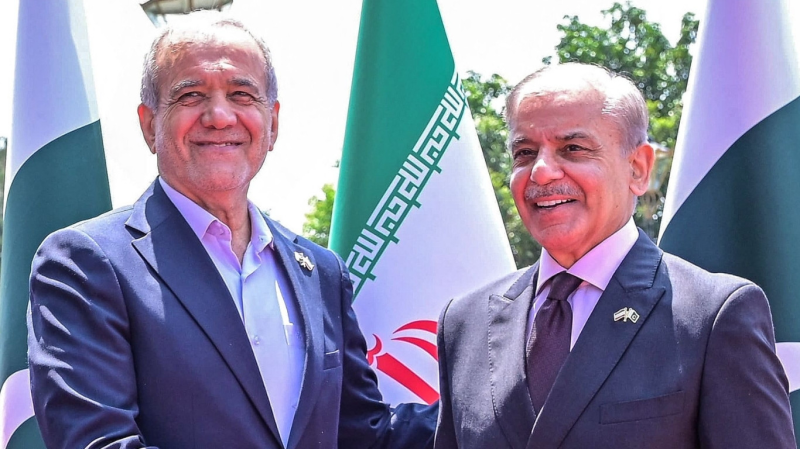
Official photograph taken and released by Pakistan’s Prime Minister Office on 3 August 2025.
Pakistan and Iran have agreed to enhance bilateral trade to $10 billion, with both sides committing to accelerate cooperation across key sectors. The announcement was made during Iranian President Masoud Pezeshkian’s two-day official visit to Islamabad, where 12 agreements and memoranda of understanding (MoUs) were signed.
At a joint press briefing, Prime Minister Shehbaz Sharif said both governments were eager to realise the $10 billion trade target, building on shared cultural and religious ties and a growing economic partnership. Delegations from both countries will continue discussions to turn these agreements into actionable outcomes.
The two leaders discussed a broad range of bilateral issues, including trade, investment, energy, education, and counter-terrorism cooperation. PM Shehbaz reiterated Pakistan’s support for Iran’s right to a peaceful nuclear programme under the UN Charter and strongly condemned recent Israeli attacks on Iranian nuclear sites. He expressed condolences for the lives lost during the conflict and commended Iran's response.
President Pezeshkian, in return, thanked Pakistan’s government and people for their solidarity during the conflict and reaffirmed Iran’s commitment to strengthening ties. He described Pakistan as more than a neighbour — a brotherly nation with whom Iran shares deep cultural and historical bonds.
Twelve MoUs were signed covering areas such as plant quarantine, ICT, science and innovation, maritime safety, judicial assistance, tourism, meteorology, and a joint intent to finalise a Free Trade Agreement. The two sides also agreed on enhanced cooperation in mass media, youth engagement, and the arts.
Commerce Minister Jam Kamal and Iranian Minister for Industry, Mines and Trade Mohammad Atabak held a high-level discussion, focusing on eliminating border trade bottlenecks, boosting exports, and creating trust-based partnerships. Kamal proposed launching targeted trade delegations similar to successful models in other regions, while Atabak emphasised the urgency of consistent facilitation for traders.
Both ministers agreed to maximise existing trade routes and cross-border infrastructure to unlock the full potential of regional commerce. Kamal highlighted the geographic advantage of proximity between the two nations, stating, “If we don’t utilise this discount of distance, we lose both time and cost benefits.”
They also discussed expanding trade connectivity beyond bilateral borders to include Turkey, Central Asia, Russia, and parts of the Middle East. Plans to organise a dedicated B2B (business-to-business) day during future visits were also proposed.
Both sides pledged to fast-track the next session of the Joint Economic Commission (JEC), ensure public-private coordination, and prioritise logistics and border facilitation. With shared cultural ties and strong political alignment, Pakistan and Iran appear poised for a deeper strategic economic partnership aimed at reshaping regional trade dynamics.