

- Philip Sangma arrested for aiding Hadi murder suspects escape |
- Govt Issues Notice on Visa Extension for Expatriates |
- Khamenei Warns US, Israel in First Speech as Leader |
- Protests, Walkout Mark President’s Address in Parliament |
- UNSC fails to adopt resolution for halting Middle East crisis |
Why Iran Can Easily Disrupt Shipping in Hormuz Strait
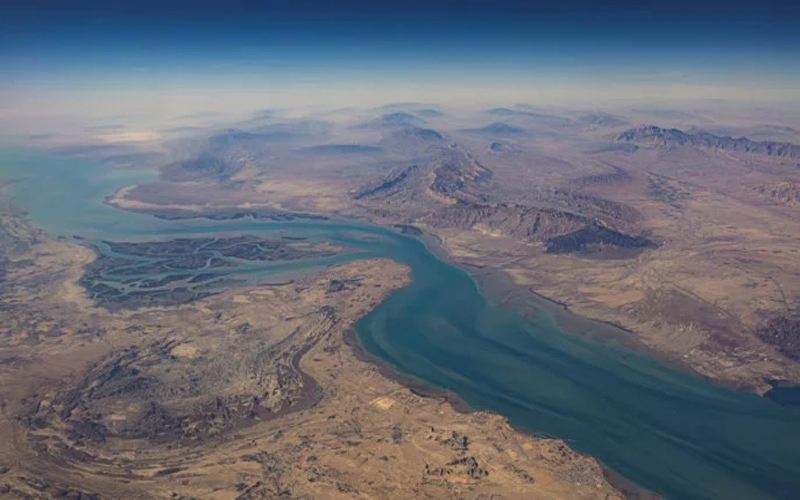
An aerial view of the Iranian shores and the island of Qeshm in the strait of Hormuz, December 10, 2023.
Iran has effectively shut down traffic through the strategically vital Strait of Hormuz, a move that has sharply reduced shipping in one of the world’s most important energy corridors and raised fears of a global oil supply crisis.
The closure follows weeks of escalating conflict between Iran, the United States and Israel, after large-scale air strikes launched on February 28 triggered a wider regional confrontation.
The narrow maritime passage, located between Iran and Oman, normally carries around one-fifth of the world’s oil and liquefied natural gas shipments. However, traffic through the waterway has fallen dramatically since the conflict began.
Data compiled by the United Nations indicate that shipping volumes through the strait have dropped by nearly 97 percent since the start of the war, effectively choking a key global energy route.
A Long-Standing Strategic Threat
Iran has repeatedly warned over the past two decades that it could shut down the Strait of Hormuz if its security or economic interests were threatened.
In 2011, a commander of the powerful Islamic Revolutionary Guard Corps (IRGC) famously declared that closing the strait would be “easier than drinking a glass of water.” Similar warnings were issued during periods of tension linked to sanctions and disputes over Iran’s nuclear programme in 2016 and 2018.
Although such threats were often dismissed as strategic pressure tactics, analysts say the current war has dramatically altered the situation.
The February 28 attacks, which killed Iran’s long-time supreme leader Ali Khamenei, have pushed Iranian leaders to treat the conflict as an existential struggle. As a result, military strategy has increasingly shifted into the hands of the IRGC.
Under such circumstances, analysts say Tehran may see disrupting global energy routes as one of its most powerful tools for exerting pressure on its adversaries.
A Chokepoint for Global Energy
The Strait of Hormuz is widely considered the most critical maritime chokepoint in the global energy system.
The waterway links the Persian Gulf to the Gulf of Oman and the wider Indian Ocean. It serves as the only sea route for major oil and gas exporters including Kuwait, Iraq, Qatar and the United Arab Emirates.
Any disruption to this route can quickly send shockwaves through global markets.
Oil prices have already surged amid fears of a prolonged closure. Analysts warn that sustained high prices could trigger a new cost-of-living crisis similar to the one that followed Russia’s invasion of Ukraine in 2022.
Energy analysts also note that the strait plays a major role in transporting key agricultural inputs. Around one-third of global fertiliser shipments — including sulphur and ammonia — move through the corridor, according to the analytics firm Kpler.
A prolonged disruption could therefore affect not only fuel markets but also global food production and prices.
Some economists warn that an extended crisis could echo the economic shockwaves caused by the oil supply disruptions of the 1970s.
Why the Strait Is So Difficult to Protect
Despite its enormous strategic importance, securing the Strait of Hormuz is extremely difficult.
The main shipping lanes are only about two nautical miles wide, forcing vessels to navigate narrow channels close to Iran’s coastline and nearby islands. These geographical features give Iranian forces significant tactical advantages.
Military experts say even with a weakened conventional navy, Iran retains several ways to threaten commercial shipping.
These include fast attack boats, naval mines, mini submarines and unmanned aerial vehicles. Some analysts also warn of unconventional tactics such as explosive-laden small craft or suicide missions targeting tankers.
Research from the Centre for Information Resilience suggests Iran has the capacity to produce thousands of drones each month, giving it a large supply of relatively inexpensive weapons capable of harassing maritime traffic.
Tom Sharpe, a retired commander of the Royal Navy, said a limited escort operation could be organised to guide several ships a day through the strait using a small fleet of destroyers and air cover.
However, maintaining such protection for months would require a much larger and sustained international military presence.
Security analysts also warn that even if missile systems and naval mines were neutralised, the threat of smaller-scale attacks would remain.
Adel Bakawan, director of the European Institute for Middle East and North African Studies, said ships could still face danger from irregular tactics or suicide operations.
International Response
Concern over the security of global energy supplies has prompted discussions among several major powers about how to protect shipping in the region.
US President Donald Trump has indicated that the United States may begin escorting oil tankers through the Strait of Hormuz.
He also said Washington had instructed the United States International Development Finance Corporation to provide insurance guarantees to shipping companies operating in the region.
Meanwhile, Emmanuel Macron said European countries, along with India and several Asian states, were considering a joint naval mission to safeguard commercial shipping.
However, the French leader indicated such an operation might only be feasible once the conflict begins to stabilise.
France has already begun deploying naval forces, including its aircraft carrier strike group, to areas such as the eastern Mediterranean and the Red Sea, with the possibility of extending operations toward the Strait of Hormuz.
British Prime Minister Keir Starmer has also discussed possible maritime security measures with leaders from Germany and Italy.
Military officials say several options are being studied to ensure the safe passage of commercial vessels through the region.
Lessons from Other Maritime Disruptions
Recent events elsewhere in the region demonstrate how difficult it can be to keep shipping routes open during conflict.
The Iran-aligned Houthi movement in Yemen managed to severely disrupt maritime traffic in the Red Sea and the Bab al-Mandab Strait for more than two years, despite patrols by US and European naval forces.
Many shipping companies responded by rerouting vessels around the southern tip of Africa, a journey that significantly increases travel time and costs.
The Danish shipping giant Maersk had previously signalled plans to gradually return to the Suez Canal route, but renewed instability has again raised doubts about the safety of the passage.
Limited Alternatives
Oil-exporting countries in the Gulf have attempted to reduce their dependence on the Strait of Hormuz by developing alternative pipeline routes.
Both the United Arab Emirates and Saudi Arabia have explored bypass pipelines designed to transport oil directly to other ports.
However, analysts say these alternatives remain limited and vulnerable. A 2019 attack by Houthi fighters on a major east-west pipeline in Saudi Arabia highlighted the risks facing such infrastructure.
For now, the Strait of Hormuz remains the most critical gateway for energy exports from the Gulf — and its disruption continues to pose a serious threat to global energy stability and economic security.