

- Cultivation of Black Baby watermelons on a rooftop in Kalapara |
- Low pressure area on Bay; Maritime ports to hoist cautionary signal 3 |
- Nandini killing: Man sentenced to death in Lalmonirhat |
- Four of a Rangpur family killed for objecting to Yaba taking: Police |
- Bangladesh Rise to Highest-Ever Sixth in Test Rankings |
Landlocked Nations Unite to Fight Climate Crisis and Inequity
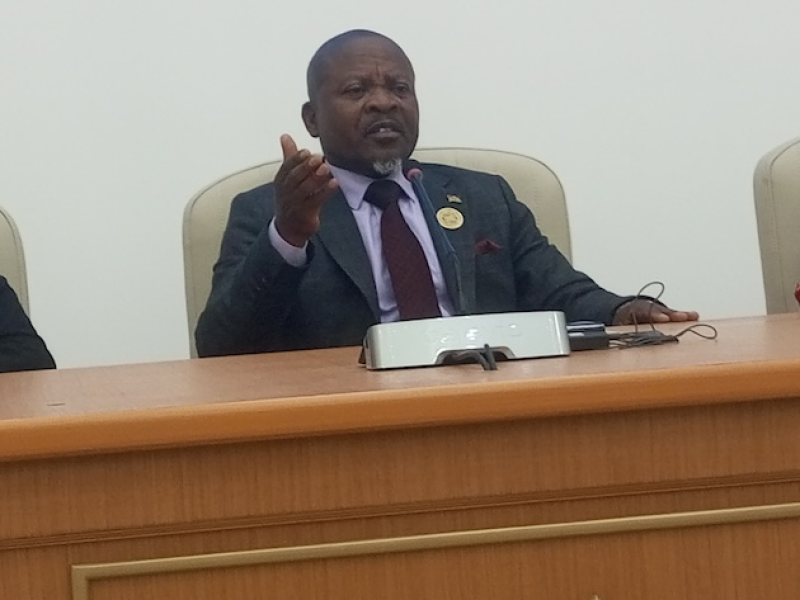
Malawi’s Vice President, Michael Bizwick Usi, addressing reporters during a press briefing at the Third UN Conference on Landlocked Developing Countries.
“The term ‘negotiation’ must be understood in an ethical context… When an arsonist burns down my house and then asks me to negotiate to rebuild it, that becomes the paradox.”
With these searing words, Malawi’s Vice President Michael Bizwick Usi cut through diplomatic pleasantries at a high-level conference of Landlocked Developing Countries (LLDCs), exposing the deep frustration felt by many vulnerable nations battling climate change’s harshest impacts.
Farmers in southern Malawi are still nursing wounds left by Cyclone Freddy, thousands of kilometres away from the glass-and-marble plenary halls in Awaza—Turkmenistan’s glitzy Caspian Sea resort where LLDC leaders are gathered this week. The 2023 storm, one of the worst in the region’s history, ravaged homes, washed away crops, and pushed an already fragile economy deeper into crisis.
Set against the shimmering backdrop of opulent hotels and air-conditioned meeting rooms, the conference has placed climate change high on the agenda. But Usi’s emotionally charged remarks serve as a reminder that for many LLDCs, the climate emergency is not a theoretical threat—it is a lived reality, with each passing season bringing more destruction.
“Many times, we go as a bloc and ask for general assistance. Some packages are not relevant to the causes in specific areas,” Usi added, urging world leaders to recognise the moral dimensions of climate negotiations.
Usi’s comments came as African LLDCs including Malawi, Zambia, Zimbabwe, Chad, Burundi and Burkina Faso celebrated the historic establishment of the Group of LLDCs as a formal negotiating bloc under the UN Framework Convention on Climate Change (UNFCCC). This move is more than symbolic. It marks a long-overdue recognition of the specific vulnerabilities these nations face—and the need for tailored climate finance, adaptation support, and international cooperation.
The formation of the LLDC Group under the UNFCCC was described by Rabaab Fatima, UN Under-Secretary-General and High Representative for LLDCs, as “a critical step toward ensuring that the specific vulnerabilities and unique challenges of LLDCs are reflected in global climate decision-making.”
Fatima added, “This achievement reflects the power of unity, leadership and resilience. It sends a clear signal that LLDCs will play a greater role in global climate negotiations. This gives us the means to effectively articulate and address the unique climate challenges we face today.”
Despite representing only 7 percent of the global population, LLDCs accounted for 18 percent of the world’s population affected by droughts and landslides between 2012 and 2023. With 55 percent of their populations relying on agriculture—compared to the global average of 25 percent—these nations are on the frontline of climate impacts, yet they often sit on the periphery of climate financing and technology transfer mechanisms.
In an interview with IPS, Usi challenged the moral framing of climate negotiations: “Do Bhutan and Malawi have the same issues and problems? Are we negotiating on a fair platform?” His comments cut to the heart of a decades-long grievance. LLDCs are hit hard by disasters they did not cause and lack the resources to respond.
His call for an ethical rethinking of climate negotiations resonated with others on the panel. Dina Nath Dhungyel, Bhutan’s Minister of Foreign Affairs and External Trade, emphasized, “If you really want to fight climate change, each and every country must take responsibility.”
Bhutan, which has over 70 percent of its land under forest cover and is constitutionally mandated to maintain at least 60 percent, has long been a beacon of sustainability.
Still, as Dhungyel pointed out, even countries with exemplary green records cannot shoulder the burden alone.
“It may not be possible for a small nation like Bhutan… to mitigate climate change throughout the world,” he warned.
Historically, LLDCs have been lumped together with other developing nations in broad climate categories. This has led to under-representation of many unique concerns, including fragile transit routes, dependence on drought-prone hydropower, and desertification.
The newly formed LLDC Group will push for:
Dedicated climate finance
Priority access to technology transfer
Support for resilient infrastructure
Recognition in loss and damage frameworks
Targeted capacity building
In 2023, more than 51 percent of LLDC populations faced moderate or severe food insecurity. Hydropower, which provides 44 percent of their electricity, is increasingly threatened by erratic weather. These structural dependencies demand targeted solutions.
The battle for climate finance remains fierce. Chairman Pacheco of the LLDC Group acknowledged the complexity.
“Everybody’s competing. The pie size is not getting bigger… One more group has now been added asking for a slice. It’s not gonna be easy.”
Yet Fatima argued the LLDCs’ distinct voice is not only legitimate but necessary. Her office is working to mobilise the UN system to ensure LLDC challenges are reflected in priorities and programmes.
This momentum builds on Article 4.8(i) of the UNFCCC and the Paris Agreement, which recognise the special needs of LLDCs. Yet until now, these provisions lacked institutional power. The LLDC negotiating group aims to bridge that gap.
The recently adopted Awaza Programme of Action for 2024–2034 identifies climate change as a top priority and outlines support mechanisms in adaptation, disaster risk reduction, and resilient infrastructure. It calls for systematic partnerships and tailored responses.
Inclusion in the formal UNFCCC process amplifies LLDCs’ voices and enables cross-regional solidarity. Many LLDCs also belong to the G77+China, African Group, and Least Developed Countries bloc. The strategy is to build consensus and gain broader support through these networks.
But news of the LLDC bloc reaching the negotiating table gives hope. “If the world can see us, maybe they will help,” says one farmer. “We don’t want to live on handouts. We want to build again.”
For millions of farmers in Malawi and across Africa, the world must listen—and act.
As COP30 approaches, the LLDCs are no longer silent. They have a seat at the table—and they intend to use it.