

- Dhaka Ranks 6th Among World's Most Polluted Cities on Thursday |
- World Leaders See Tarique as Transformative Leader: Adviser |
- Guterres Urges Climate Justice Pact at COP31 |
- Global Climate Action Stalls for Five Years: Report |
- COP31 Update: Developing Nations Demand Action, Reject |
Guterres Urges Climate Justice Pact at COP31
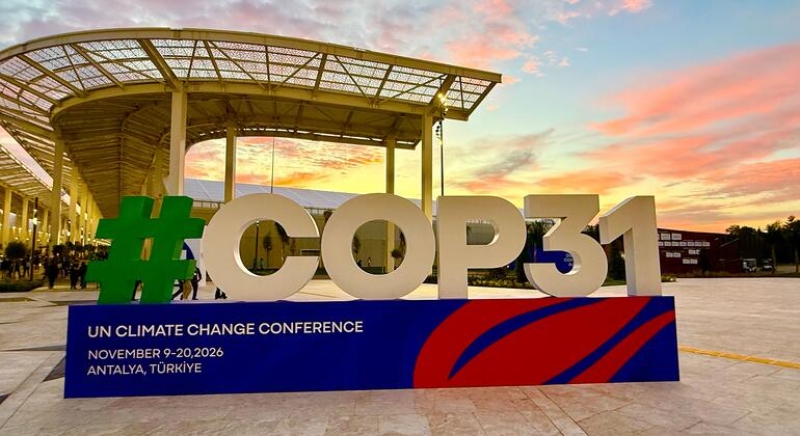
Sunrise over COP31 as participants arrived as early as 5am to avoid traffic closures.
UN Secretary-General António Guterres on Wednesday called for a new global climate justice agreement at COP31, urging governments to tax fossil fuel companies to support countries bearing the brunt of a crisis they did little to cause.
His appeal came as world leaders gathered in Antalya, Türkiye, amid unresolved questions over climate finance and the future of fossil fuels.
The two-day high-level summit brought world leaders to the conference venue, where tighter security, road closures and early arrivals marked the opening of the gathering.
Despite a festive opening ceremony featuring traditional Turkish dancing, colourful performances and a conference theme song, the central message of the day was one of urgency.
Guterres accused major polluters of delaying action and warned that the climate crisis was advancing faster than global efforts to contain it.
“Our planet is heating up. The clock is winding down. It’s make or bake time,” he told world leaders.
He noted that even if countries fully implement their current national climate plans, global temperatures could rise by more than 2.5°C by the end of the century.
However, he stressed that exceeding the 1.5°C warming threshold would not mean abandoning efforts to limit climate change.
“Science is not telling us to surrender. It is telling us to fight harder,” he said, emphasising that every fraction of a degree of warming avoided matters.
A new deal for climate justice
Against this backdrop, Guterres proposed a new climate justice compact to help developing countries move away from fossil fuels while protecting communities already suffering from the impacts of climate change.
“We cannot demand that countries transform their economies while denying them the means to do so,” he said.
The proposed compact focuses on four priorities: accelerating the transition away from fossil fuels through national plans that protect workers and communities; expanding renewable energy; strengthening early-warning systems and climate adaptation measures; and ensuring faster support for countries affected by climate disasters.
It also calls for affordable climate finance, with wealthy nations fulfilling their commitments and increasing investment in developing countries.
The proposal further emphasises international cooperation to overcome trade barriers, technological divides and geopolitical rivalries.
Polluters must pay
The UN chief also criticised fossil fuel interests, accusing them of distorting scientific findings and delaying climate action.
“Fossil fuels must go the way of the dinosaurs,” he said. “The dinosaurs did not have a lobby. Fossil fuels do.”
Guterres contrasted the $95 billion earned by the world's nine largest oil companies in a single quarter with the roughly $600 million received by the international fund supporting vulnerable countries recovering from climate-related loss and damage.
He said the fund's total was equivalent to just 14 hours of the companies' profits and called on governments to impose taxes on windfall earnings.
“Polluters must pay,” he declared, drawing applause from delegates.
Leaders confront unfinished business
Turkish President Recep Tayyip Erdoğan, whose country is co-hosting COP31 with Australia, acknowledged that three decades of climate negotiations had failed to deliver sufficient results.
“This success at the level of ideas has not produced the same results when it comes to implementation,” he said, calling for greater support for developing countries.
Brazilian President Luiz Inácio Lula da Silva warned that climate change was losing ground on the international agenda as wars and trade disputes overshadowed efforts to tackle global warming.
“We started talking more about weapons and tariffs than the survival of future generations,” he said, defending international cooperation at a time when climate science and multilateralism are increasingly under pressure.
Lula also announced that Brazil would develop national roadmaps to reduce its dependence on fossil fuels and end deforestation, building on the work of COP30, held in the Amazon last year.
Tackling methane: The climate emergency brake
Methane, an invisible greenhouse gas that traps more than 80 times as much heat as carbon dioxide over a 20-year period, was another major focus during Wednesday's thematic discussions on zero waste.
Released by fossil fuel operations, agriculture and decomposing waste, methane is responsible for nearly a third of global warming to date.
At a special event, Guterres called on the UN Environment Programme (UNEP) to develop a global standard for near-zero methane emissions from the oil and gas industry.
UNEP is already using satellites and artificial intelligence to identify major methane leaks and alert governments and companies.
Julia Ferini, who leads UNEP's International Methane Emissions Observatory, said the system had helped reduce emissions in 45 cases across 13 countries.
She cited a recent case in Iraq, where a damaged gas pipeline had leaked methane for two years, producing emissions equivalent to those of 350,000 cars. The leak was eventually stopped by applying a coating to the corroded pipe.
“Methane is our climate emergency brake,” she said, explaining that cutting emissions of the short-lived gas could slow global warming relatively quickly and buy time to reduce carbon dioxide emissions.
However, despite more than 5,000 alerts issued since 2023, barely one in eight had received a response, Guterres noted.
Worms turn food waste into useful products
While negotiators in Antalya debated ways to accelerate climate action, young entrepreneurs were already putting practical solutions into effect.
In Botswana, entrepreneur Makwena Moesi is tackling food waste with an unusual workforce: more than half a million worms.
Her company, Viva Organica, collects organic waste from food retailers and converts it into fertiliser through a process known as vermicomposting. The process improves soil health while keeping waste out of landfills.
The business has already processed more than 1,000 tonnes of organic waste.
Moesi, a biologist by training, said climate-friendly solutions must also make economic sense to farmers.
She explained that farmers are more concerned about improving harvests, increasing food production and the affordability of agricultural products than about the amount of carbon dioxide they can remove from the atmosphere.
Where negotiations stand
Alongside the leaders' speeches, negotiators continued discussions on several unresolved issues.
Climate finance: Developing countries called for more predictable funding, warning of shortfalls in support for adaptation and broader climate action.
Loss and damage: Nepal's request for assistance following a glacial collapse raised questions about how quickly emergency funding can reach countries affected by climate disasters.
Emissions cuts: Countries remained divided over the duration and operation of the UN programme designed to accelerate emissions reductions.
Just transition: Negotiators discussed a proposed mechanism to help countries shift towards cleaner economies while protecting workers and communities.