

- Tk 9.38 lakh crore budget with Tk 2.43 cr deficit placed |
- Govt Rolls Out Three-Tier Plan for Economic Transformation |
- Budget is built around ten strategic priorities |
- Ad-din Hospital’s License Revoked Over Newborn Deaths |
- Finance Minister Presents Tk 9.38 Lakh Crore Budget |
New Budget May Raise Some Prices, Lower Costs of Many
Finance Minister Amir Khosru Mahmud Chowdhury on Thursday unveiled a Tk 9.38 lakh crore national budget for the 2026-27 fiscal year, proposing a series of tax, duty and tariff measures that are expected to lower the prices of a wide range of essential goods, healthcare products and technology items, while increasing the cost of certain luxury, imported and environmentally harmful products.
The budget, the first presented by the BNP-led government since assuming office following the February 12 general election, focuses on fiscal reforms, economic stabilization, industrial growth and easing the cost burden on consumers.
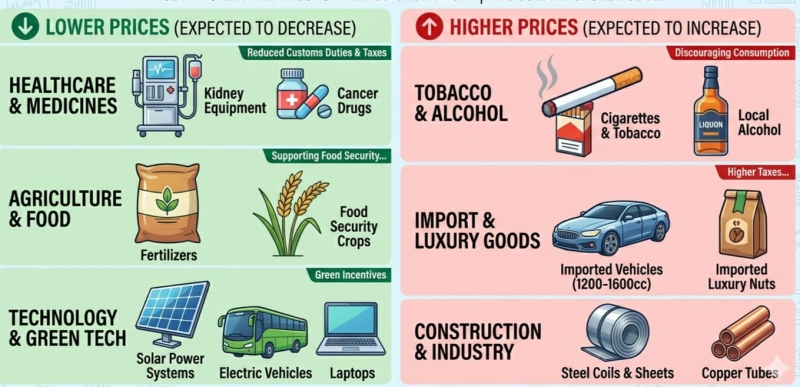
According to the budget proposals, prices of several healthcare products and medical equipment may decline due to reductions in customs duties and taxes. These include kidney dialysis equipment, heart stents, intraocular lenses used in eye surgeries, assistive devices for persons with disabilities, cancer medicines, active pharmaceutical ingredients (APIs), life-saving drugs and other medical equipment.
The government has also proposed measures aimed at making technology products more affordable. Prices of laptop and desktop computers, printers, monitors, computer accessories, SSDs, point-of-sale (POS) machines and smart banking cards are expected to fall. Consumers may also benefit from lower prices of locally manufactured mobile phones, refrigerators, freezers and washing machines.
In a move aimed at supporting food security and controlling inflation, the budget proposes duty concessions on baby food, spices, dates and fertilizers. Prices of veterinary medicines, insecticides, pesticides and feed used in the poultry, dairy and fisheries sectors may also decrease, potentially helping reduce production costs across the agricultural sector.
The budget places significant emphasis on green technology and renewable energy. Tax incentives are expected to lower the prices of electric vehicles (EVs) valued up to $50,000, plug-in hybrid vehicles, electric buses and trucks, e-bikes, EV charging stations, solar panels, solar inverters, battery storage systems and related equipment.
Consumers may also see lower prices for a variety of household and lifestyle products, including water purifiers, water heaters, electric, induction and infrared cookers, ATM machines, CCTV cameras, beauty products, jewelry, musical instruments and cinematography equipment.
However, the budget also proposes higher taxes and duties on several products, which could lead to price increases.
Cigarettes, tobacco products and nicotine pouches are set to become more expensive as part of the government's efforts to discourage tobacco consumption and improve public health. Locally produced alcoholic beverages are also expected to face higher taxes.
Among consumer goods, prices may rise for passenger vehicles with engine capacities between 1,200cc and 1,600cc. A number of imported products are also likely to become costlier, including washing machines, copper tubes, steel coils and sheets, transformers, DC motors, honey, coffee, cashew nuts, toys, tiles, sanitary ware, paints and other construction materials.
The budget proposals could also increase the prices of imported mayonnaise, edible oils, potato chips, leather goods and certain mild steel products.
Economists say the measures reflect the government's attempt to balance revenue generation with consumer relief by lowering duties on essential goods and productive sectors while imposing higher taxes on luxury and non-essential imports.
If approved by parliament, the proposed tax and tariff changes will come into effect from July 1, 2026, and are expected to influence market prices across a broad range of sectors during the next fiscal year.