

- Islami Andolan to Contest Election Alone in 13th Poll |
- 3 killed in Uttara building fire; 13 rescued |
- Late-night deal ends standoff: BPL resumes Friday |
- Global Marine Protection Treaty Enters into Force |
- US Immigrant Visa Suspension Triggers Concern for Bangladesh |
Biman–Boeing Deal Likely This Month, First Jet in 2031
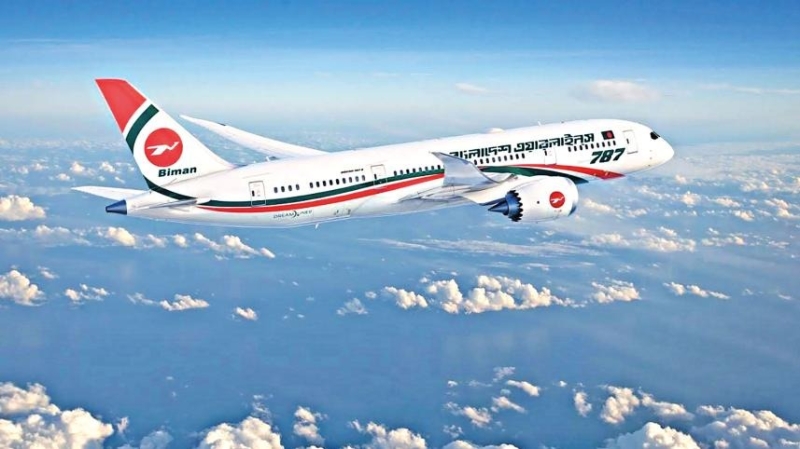
An agreement between Biman Bangladesh Airlines and US aircraft manufacturer Boeing is expected to be signed within this month, with the first aircraft scheduled for delivery in October 2031, according to officials at the national flag carrier.
The remaining aircraft under the proposed deal are expected to be delivered gradually, with the final handover likely by November 2035.
The development follows recent policy-level approval by the Biman board to procure 14 aircraft from Boeing, a move that has effectively sidelined a competing proposal from Airbus for the time being.
Biman spokesperson Boshra Islam confirmed the tentative delivery timeline, saying discussions with Boeing are continuing over contractual and procedural matters. She noted that pricing remains the key issue under negotiation.
“Following the board’s decision, discussions are underway to finalise the agreement and complete the required formalities,” she said.
On financing, Boshra explained that Biman plans to issue a request for proposal to secure bank financing. “We will engage with lenders and select the one offering the most competitive interest rate,” she added.
Biman currently operates a fleet of 19 aircraft, 14 of which are manufactured by Boeing. Under the approved proposal, Boeing is expected to supply two Boeing 787-9 aircraft, eight Boeing 787-10s and four Boeing 737-8s.
The board reviewed Boeing’s initial proposal dated 24 November 2025, along with a revised draft agreement submitted on 20 December 2025, before granting policy-level approval on 30 December.
The national carrier has been grappling with a prolonged fleet crisis in recent years, largely due to difficulties in securing aircraft through leasing. This has disrupted existing routes and delayed the launch of new services.
However, aviation experts have cautioned that board approval alone does not ensure aircraft acquisition. Several critical contractual, financial and regulatory steps still remain.
Former Biman board member Kazi Wahidul Alam said the approval marks only the beginning of a complex process. “Board approval is not the final step. Significant procedures must be completed both before and after this stage,” he said.
According to him, aircraft purchases typically require an upfront payment of around 10% of the total cost, usually arranged through banks. “Only after the down payment is made and the purchase agreement is signed does the order become officially confirmed,” he added.
Recalling Biman’s 2007 aircraft deal with Boeing, Wahidul noted that the signing process itself was complicated and involved multiple layers of approval, including engagement with US authorities. He also pointed out that changes in government can affect the pace and outcome of such agreements.
Biman officials reiterated that the board’s approval merely authorises negotiations and does not create any financial or legal obligation until a formal contract is signed.
Meanwhile, the status of Airbus’s proposal to supply 10 A350 wide-body aircraft and four A320neo narrow-body jets remains uncertain. Biman officials indicated that no immediate progress is expected on alternative proposals following the Boeing decision.
Industry experts have also raised concerns about fleet composition. While the addition of modern wide-body aircraft is expected to improve fuel efficiency and long-haul capacity, over-reliance on large aircraft could weaken commercial competitiveness.
Aviation analyst and former airline executive Wing Commander (retd) ATM Nazrul Islam said not all routes can sustain wide-body aircraft throughout the year. “Operating large aircraft on thin routes leads to empty seats and revenue losses,” he warned.
He stressed that narrow-body aircraft are better suited for many regional and medium-density routes, adding that successful global airlines typically operate balanced, mixed fleets.
The Boeing purchase also carries geopolitical and market implications. Earlier, amid discussions over trade and tariffs with Washington, the government signalled its intention to buy a significant number of Boeing aircraft as part of broader trade considerations.
At the same time, European stakeholders have continued efforts to promote Airbus aircraft in Bangladesh, as the country’s aviation market expands and competition intensifies.
With local carriers holding only about 35% of the growing market, Biman faces mounting pressure to modernise and strategically rebalance its fleet. For now, however, Boeing appears set to dominate Biman’s future expansion plans, while Airbus remains on standby.