

- Bangladesh Exports Rise 13.14% in August to $4.43bn |
- Bay of Bengal turbulent due to clear low pressure, Sgnal No 03 at Payra Port |
- Govt puts rural Bangladesh at heart of development agenda |
- BNP celebrates its 48th founding anniversary Tuesday |
- Dengue situation worsens in Pirojpur |
Iran ready to return to ceasefire if US does: Pezeshkian
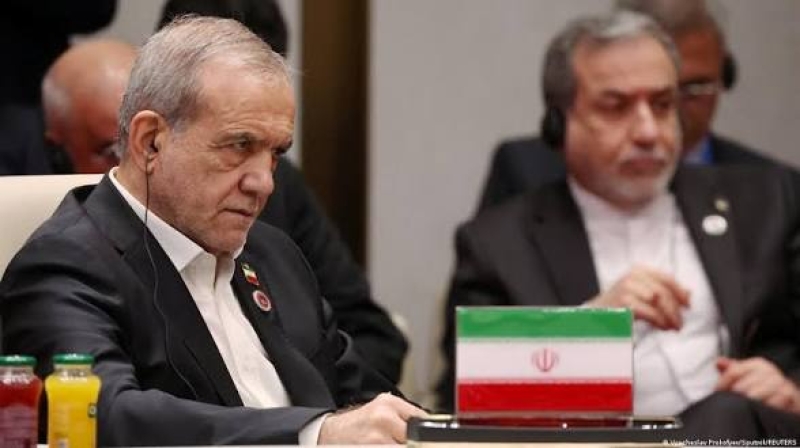
Iran is ready to return to the ceasefire deal reached with the United States in June if Washington does the same, President Masoud Pezeshkian said on Tuesday, in conciliatory remarks following the first exchange of fire between the two countries in a month.
Here’s a look at the latest developments in the Iran war and the wider Middle East. Full coverage can be found here.
“If the U.S. returns to its commitments in the memorandum of understanding, the Islamic Republic of Iran will immediately reciprocate,” Iranian state media cited Pezeshkian as saying at the Shanghai Cooperation Organization summit in Kyrgyzstan.
The June memorandum of understanding called for an immediate ceasefire and started a 60-day period for negotiations aimed at reaching a wider peace deal. Iran agreed to clear the Strait of Hormuz of mines and allow ships to pass during the period, and the U.S. agreed to end its naval blockade, lift sanctions, issue waivers for Iranian oil exports and begin work on a reconstruction package for Iran, among other things.
The agreement broke down quickly, and while there had been a lull in fighting, the two sides exchanged fire at the weekend.
Iran has been working with Oman, which sits on the south side of the Strait of Hormuz, on a framework for managing shipping traffic, though it remains unclear whether the plan would be acceptable to the U.S.
Other Gulf nations have stressed the need to reopen the strait unconditionally. On Tuesday, Saudi Crown Prince Mohammed bin Salman, the kingdom’s de facto ruler, met with Oman’s Sultan Haitham bin Tariq, according to the Saudi Press Agency, which said the two discussed “ongoing efforts to maintain regional security and stability,” but did not mention the Strait of Hormuz specifically.
An Israeli operation to detain a Hamas militant killed at least four people, including two children, in Gaza City on Tuesday, hospital officials said. Residents reported gunfire and explosions in the west of the city around 10:30 a.m. as drones and helicopters flew overhead.
The military said it had struck several targets in Gaza “in order to remove threats to security forces,” adding that no troops had been injured.
Defense Minister Israel Katz said the army had apprehended a senior Hamas operative, without identifying who was detained.
Separately, a child was killed in central Gaza when Israeli troops fired on a group of people in Deir al-Balah, according to officials at the Al-Aqsa Hospital. Four other people, including a child, were wounded, they said.
Israel’s army didn’t immediately respond to a request for comment about the shooting.
Yemen’s state security said that Islamic State spokesperson Abu Huzayfah al-Ansari was killed in Yemen in a joint operation by Saudi-backed Yemeni government forces and the Yemeni counterterrorism forces.
He was killed at dawn Tuesday while he was hiding in a house in Seiyun city in the Yemeni province of Hadramout, according to a security statement published by state-run SABA news agency.
He was hiding among eight civilians, including two women and five children who were unharmed in the operation and were taken to a safe place. One person was arrested after resisting the security forces.
The British military's United Kingdom Maritime Trade Operations Centre said it received reports of an attack on a ship in the Strait of Hormuz, and a second report of an incident involving a nearby tanker.
The UKMTO said a tanker was hit by three projectiles on Monday on its way out of the Persian Gulf through the strait east of Oman. In the second incident on the same day, the center received a report “involving a tanker and military forces” off the coast of Oman, east of the Strait of Hormuz.
There was no immediate claim of responsibility for the attacks.
Iranian Parliament Speaker Mohammad Bagher Qalibaf said Tuesday that Iran controls the Strait of Hormuz.
The Strait of Hormuz “is a place where at least 120 ships used to transit every 24 hours” he said in a video posted on a state TV Telegram channel. “Even if two or three ships manage to pass through on some nights now, that in fact shows that we have control over the entire Strait of Hormuz.”
“The information we have — open and covert, visible and hidden — shows us that after failing in the military and diplomatic arenas, the enemy has added a very broad economic war and cognitive war to its military campaign,” Qalibaf said. “The enemy’s objective in this hybrid war is to create unrest and chaos inside the country. That is their malicious intention. ... Or they may try to force us to surrender through diplomacy. Never.”
Iraq’s Supreme Judicial Council said Tuesday it had completed investigations into 5,704 suspected Islamic State group members who were transferred to Iraq from Syria early this year. Hundreds would be released and the others sent to trial, the council said.
The detainees include people from 67 nationalities, including 3,497 Syrians and 474 Iraqis. Some were European nationals.
The council said investigations failed to establish sufficient evidence in some cases, leading to the release and handover of a Finnish, an American and seven Iraqi detainees to their home countries.
The United Nations food agency warned Tuesday that further escalation of the conflict in Yemen could deepen the country’s already dire hunger crisis unless international actors intervene, reports UNB.
Increases in global food prices are having an impact on “what is already one of the biggest humanitarian crises in the world,” Carl Skau, the Acting Executive Director of the World Food Program, told The Associated Press.
Skau said some families are now eating just one meal a day, while children are beginning to show signs of malnutrition.