

- Bangladesh, Iran Speakers Discuss Bilateral Ties |
- 40 Killed as Bus Plunges Into Ravine in Pakistan |
- Budget steps help stabilize prices of essential commodities |
- Bangladesh likely to face flooding in July-August |
- China open to other countries for economic corridor: Envoy Yao Wen |
Bangladesh likely to face flooding in July-August
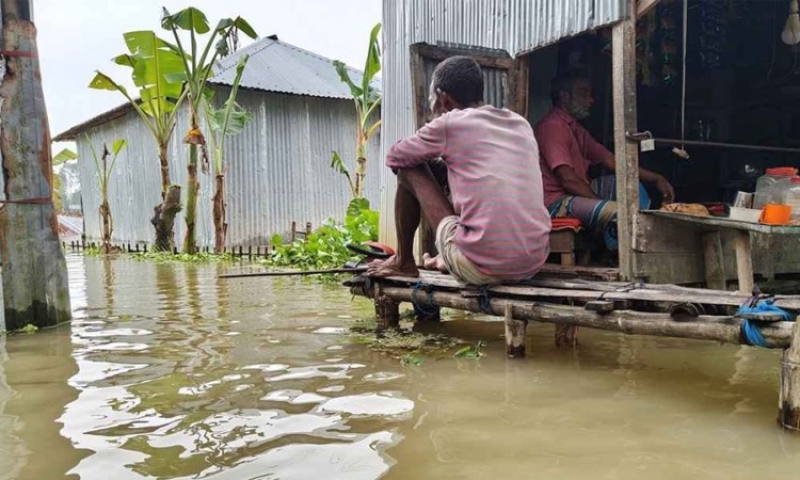
Bangladesh may witness flooding in the Brahmaputra and Meghna River basins in July and August this year due to heavy precipitation in their upper catchment areas, according to the Flood Forecasting and Warning Centre (FFWC).
"Bangladesh remains vulnerable to flooding in July and August due to climatic reasons. During this period, heavy rainfall occurs in major river basins and upstream areas, triggering flood situations in the country," said Sarder Udoy Raihan, FFWC Executive Engineer at the Bangladesh Water Development Board (BWDB).
Historical data shows that this mid-monsoon window has yielded the country's most catastrophic disasters. During the historic 1988 Bangladesh flood, extreme monsoon downpours peaking between August and September inundated roughly 82,000 square kilometers - nearly 60 percent of the country's landmass.
Similarly, the historic 1998 flood lasted over two months across July and August, claiming over 1,000 lives and leaving 30 million people temporarily displaced or stranded.
Raihan said, a flood situation is likely to occur in the Brahmaputra and Meghna River basins in July and August this year.
Experts note that the synchronisation of these two major basins poses the greatest risk. In 2004, a severe flood escalated dramatically when the Brahmaputra and Meghna river peaks coincided in late July, submerging nearly 30,000 square kilometres in the northeastern region alone.
More recently, the 2022 Meghna basin floods and the devastating 2024 floods collectively affected over 13 million people, underscoring the compounding threat of upstream downpours.
Raihan said currently the FFWC can issue flood forecasts for inland river basins up to 10 to 15 days in advance, while coastal rivers for three days.
About the current state of the country's rivers, he said The low-lying areas of the Brahmaputra basin are currently being flooded and water levels are expected to stabilise after five to six days.
He said the Meghna River basin is expected to remain stable for the next few days as no heavy precipitation has occurred in the river basin and its upstream area.
The FFWC executive engineer said a low pressure may form over the Bay of Bengal this month, which may cause sudden flooding in the low-lying areas of the country's coastal region.
According to a flood forecast issued by the FFWC on Thursday, during the last 24 hours, water levels of the Brahmaputra-Jamuna river system have decreased but are expected to increase over the next four days and remain stable on the fifth day.
During the second to fifth day (July 04-07), the Brahmaputra-Jamuna rivers may flow at warning level in Kurigram, Gaibandha, Jamalpur, and Bogura districts, and adjacent low-lying areas may be inundated at some locations.
Water levels of the Ganges-Padma rivers will continue to increase in the next five days but it may continue to flow below danger level.
During the next 72 hours, Surma-Kushiyara (Upper Meghna) rivers may continue to flow at warning level in Sylhet and Sunamganj districts, and adjacent low-lying areas may remain inundated at some places, the forecast said.
Water levels of the Teesta River at Dalia (Nilphamari) and Tarapur (Lalmonirhat), the Kushiyara River at Fenchuganj (Sylhet) and Markuli (Sunamganj), and the Someshwari River at Kolmakanda (Netrokona) are at their respective warning levels, reports BSS.