

- MPO-listed teachers’ eligibility for local polls rests with EC: Shahe Alam |
- How Ganges Treaty 1996 Missed Guarantee, Arbitration Clauses |
- Saudi Arabia, Houthis trade strikes over Bab al-Mande |
- Iraq seizes drone-launching pad used targeting Saudi oil pipeline |
- Elena Rybakina beats Aryna Sabalenka to win the US Open title |
How Ganges Treaty 1996 Missed Guarantee, Arbitration Clauses
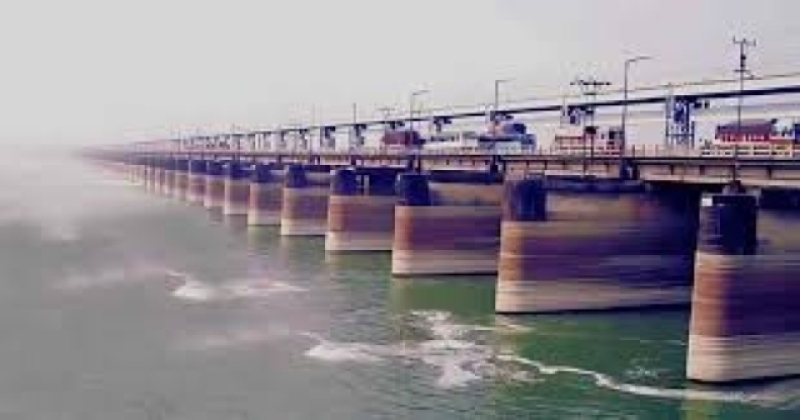
Farakka Barrage - Bangladesh side
Former Foreign Secretary Faruq Sobhan stated that the Ganges Treaty signed between Bangladesh and India in 1996 contained a fatal flaw. The treaty lacked both a guarantee clause and an arbitration clause. Despite raising this issue with Sheikh Hasina multiple times, she remained silent and chose not to speak about it, the Daily Jugantar reported on early Sunday.
Faruq Sobhan revealed that during the negotiations for the treaty in 1996, India had promised assistance in constructing the Ganges Barrage, but that promise was subsequently unfulfilled, the report said.
Faruq Sobhan made these remarks regarding the Ganges Treaty on Saturday during a book launch ceremony at the Foreign Service Academy in the capital. The event marked the publication of two books: "Serendipity in Diplomacy, Between Protocol and Politics" by Ambassador Mahmud Hasan, and "In Search of a Role Model" authored by Ambassador M. Fazlul Karim. He served as the Foreign Secretary of Bangladesh from 1995 to 1997.
According to the report Faruq Sobhan said, "I was the Foreign Secretary at the time. Back then, a conventional argument in favor of signing the Ganges water-sharing treaty was that it would improve relations between the two countries. I was given the responsibility of preparing for the Ganges water-sharing treaty. We held two meetings regarding the Ganges Barrage project. The Indians had privately promised to assist with it. However, like many other things, it eventually died out. We still hope the Ganges Barrage project will be revived."
He said, "Our instructions were to ensure that this treaty would be better than the interim agreement signed in 1977. Therefore, the treaty had to include a guarantee ensuring a minimum of 34,500 cusecs of water, as well as an arbitration clause," the report said
It said Faruq Sobhan disclosed that he was subsequently sidelined from the core negotiation process of the treaty. In his place, Dr. Mohiuddin Khan Alamgir, the Secretary to then-Prime Minister Sheikh Hasina, was tasked with finalising the treaty. Faruq Sobhan stated, "When the final draft of the treaty reached us, Foreign Minister Abdus Samad Azad, Minister of State for Foreign Affairs Abul Hasan Chowdhury, and I reviewed it. We discovered that the treaty had no guarantee clause and no arbitration clause. The next day—which was the day before the Prime Minister was scheduled to travel to Delhi—we went to her and told her not to go to Delhi because the treaty was completely unacceptable. It lacked both a guarantee and an arbitration clause."
He said, "Prime Minister Sheikh Hasina then replied, 'I will go to Delhi and resolve this.' When we arrived in Delhi, we were received at the airport by India's then-External Affairs Minister, I.K. Gujral. Gujral told the Prime Minister, 'We have finalized everything in the treaty; now we need your consent to print it.' I was waiting for the Prime Minister to point out that the treaty lacked a guarantee and an arbitration clause, but she said nothing," the report said.
The report added that Faruq Sobhan said, "At that point, I told her (Sheikh Hasina), 'Please say something.' In response, she said, 'No, you say it.' I then informed the Indian External Affairs Minister, I.K. Gujral, about the absence of the guarantee and arbitration clauses in the draft treaty. In response, I.K. Gujral said, 'Everything in the treaty was settled through negotiations. You bureaucrats always create trouble at the last minute.' At that stage, I became the victim or the villain. Mr. Gujral then turned to the Prime Minister and asked, 'Can I have your consent to print the treaty for signing?' Sheikh Hasina remained silent. Her silence was taken as consent. Subsequently, the Ganges water-sharing treaty was signed without a guarantee clause and an arbitration clause."
The report added, an arbitration clause is a specific legal provision in international treaties through which the contracting parties agree that if any future dispute or disagreement arises between them, they will resolve it through a neutral arbitral tribunal or arbitration rather than going to regular courts.