

- PM Urges World Leaders to Work Together to Achieve SDGs |
- ‘Violence will only defer a problem’: UN Assembly President |
- Ninth Pay Scale Gazette Issued, Higher Salaries From July |
- 11-Party Alliance Begins Dhaka-Rangpur Long March |
- Iran claims it hit an oil tanker in the Strait of Hormuz |
Monsoon-driven waves main cause erosion in Ganges-Brahmaputra-Meghna Delta
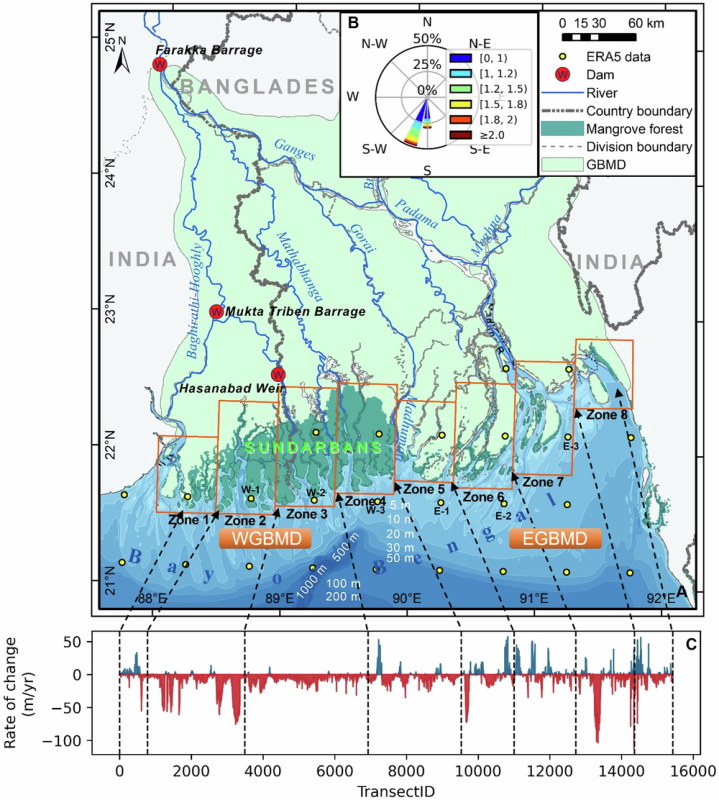
Map showing the condition of the Delta covering Bangladesh and West Bengal, India. Nature.com via SANDRP
A new study has found that monsoon-driven waves are the main cause of mangrove erosion in the Ganges-Brahmaputra-Meghna Delta (GBMD), the world’s largest mangrove ecosystem. Between 1988 and 2022, the delta recorded a small overall increase in mangrove area, but its shoreline continued to retreat as waves eroded the coastal edge. The researchers found that sea-level rise and tropical cyclones further intensified this wave-driven erosion.
At the same time, tidal currents helped offset some of these losses by transporting and depositing sediments in channels, backshore areas and around sandbanks, creating new sites for mangrove growth. The study highlights that while mangroves are naturally regenerating in some areas, monsoon wave action remains the dominant force driving mangrove loss in the delta, with climate change further increasing the risk. - SANDRP