

- PM to address UNGA in Bangla today |
- UNGA President Warns Against Fading Attention to Rohingya |
- PM Proposes Five Urgent Steps to Resolve Rohingya Crisis |
- Govt Appoints Indonesian Firm to Operate Cox’s Bazar SPM |
- ADB lowers Bangladesh’s growth forecast to 4 % in FY2027 |
Trump's New Tariffs Spark Forced-Labour Debate
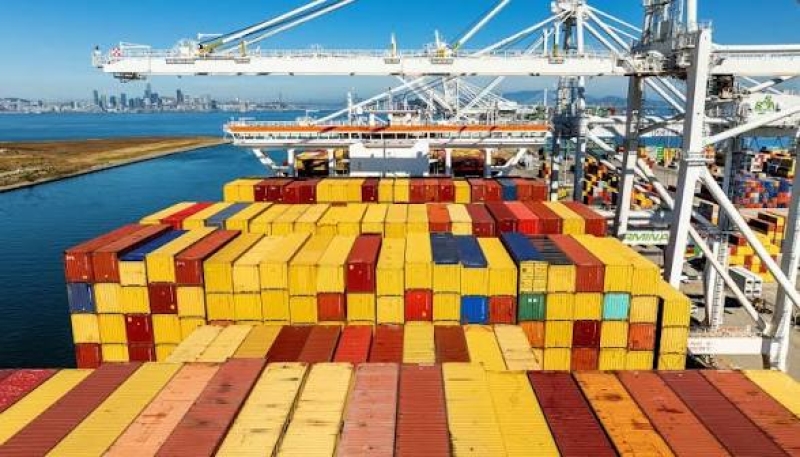
Cargo containers line a ship at the Port of Oakland on Wednesday, Aug. 6, 2025, in Oakland, Calif.
The Trump administration's new round of tariffs on more than 60 countries has triggered criticism from governments, businesses and trade experts, who argue the measures are less about combating forced labour than replacing broader tariffs struck down by the US Supreme Court earlier this year.
The new tariffs, ranging from 10% to 12.5%, took effect as temporary worldwide tariffs expired. They were imposed under Section 301 of the US Trade Act of 1974, which allows the president to levy trade sanctions against countries found to engage in "unjustifiable", "unreasonable" or "discriminatory" trade practices.
The United States said the affected countries either lack effective bans on imports produced with forced labour or have failed to enforce them adequately. Together, the targeted economies account for about 99% of US imports.
However, many governments rejected the allegations, arguing that countries with vastly different records on forced labour were subjected to identical tariff rates. Critics also questioned the methodology behind the US investigation, noting that Washington released few details explaining how individual tariff rates were determined.
Trade experts said the administration was effectively using Section 301 as a way to impose long-term tariffs without seeking congressional approval.
Barry Appleton, professor of law and co-director of the Center for International Law at New York Law School, said the approach allowed the administration to establish permanent tariffs while bypassing Congress.
The Office of the United States Trade Representative (USTR) said it consulted all 60 economies under review, held two rounds of public hearings, received more than 2,100 public comments, and engaged with trading partners before reaching its decision.
Even so, analysts argued there was limited public evidence showing that many of the affected countries had failed to enforce forced-labour import bans.
Scott Lincicome, vice-president for general economics and trade policy at the Cato Institute, questioned whether countries such as those in Europe, Norway and Switzerland had genuinely failed to police forced labour.
Several governments also criticised the decision.
Brazil described the tariffs as "arbitrary and unjustified", while Australia's trade minister defended his country's record on combating modern slavery and questioned the basis for the new duties.
The policy has also drawn criticism from sections of US industry.
The National Council of Textile Organizations (NCTO) objected to a mechanism allowing textile and apparel imports from Bangladesh, Cambodia, Indonesia and Malaysia to qualify for tariff-rate quotas linked to imports of US cotton and textiles.
NCTO President and CEO Kim Glas argued the arrangement could disadvantage American textile manufacturers despite the administration's stated goal of protecting domestic industry.
The report also noted that previous US efforts to curb forced-labour imports have produced mixed results.
The Uyghur Forced Labor Prevention Act, enacted in 2021, blocks imports from China's Xinjiang region unless companies can prove goods were produced without forced labour. However, investigations have continued to uncover forced-labour-linked products entering global supply chains.
Trade groups and legal experts urged Washington to adopt a more comprehensive approach by introducing clear enforcement benchmarks, greater transparency in investigations and technical assistance to help countries strengthen their forced-labour enforcement systems.