

- Next President Likely From BNP Standing Committee |
- Resignation of President Mohammed Shahabuddin for ill health |
- Why President Shahabuddin resigned from office |
- President Mohammed Shahabuddin Resigns |
- Experts Call for Better Flood Forecasting, Urban Planning |
US Tariff Gives Bangladesh Edge Over RMG Rivals
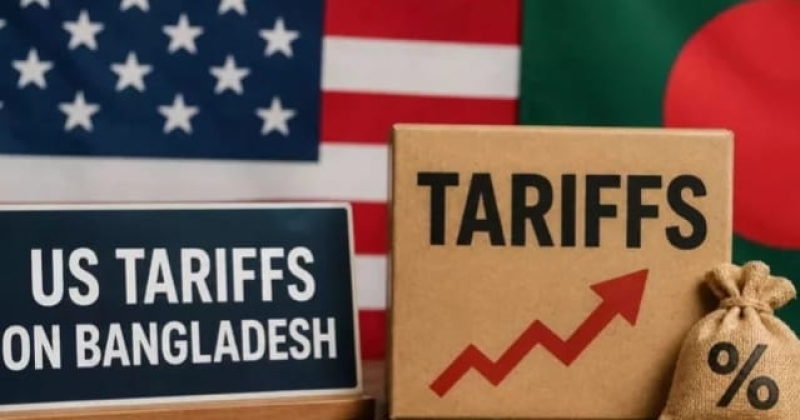
Bangladesh has secured a competitive advantage over major apparel-exporting rivals after being placed in the lower 10% tariff tier under the newly implemented US Section 301 tariff regime, giving its ready-made garment (RMG) sector a 2.5-percentage-point edge over countries including China, Vietnam and Thailand.
The new tariff structure took effect on July 24, replacing the temporary Section 122 tariff framework with a permanent legal mechanism following the completion of the US Trade Representative's (USTR) Section 301 forced-labour investigation.
According to an analysis by Mohiuddin Rubel, founder and CEO of Bangladesh Apparel Voice, the new regime formalises temporary tariff measures introduced after the US Supreme Court struck down the previous reciprocal tariff framework in February 2026.
Following that ruling, the US administration imposed a temporary universal 10% tariff under Section 122 of the Trade Act. The Section 301 tariffs were introduced immediately after the temporary measure expired, ensuring uninterrupted tariff coverage.
The USTR's action covers 60 economies representing 86 countries. Bangladesh is among only 17 economies assigned the lower 10% tariff rate, while China, Vietnam, Thailand and 35 other countries face the higher 12.5% tariff.
Rubel noted that Bangladesh secured the lower tariff after signing the Agreement on Reciprocal Trade (ART) with the United States in February 2026, committing to a ban on imports produced through forced labour.
Other countries, including India, Sri Lanka and Trinidad and Tobago, also qualified for the lower tariff tier after introducing forced-labour import bans between June and July, while Cambodia qualified through both an ART commitment and an interim ban.
The new framework also directs the USTR to establish two three-year Tariff Rate Quotas (TRQs)—one for general US textile imports and another specifically for products using US cotton.
If implemented, the quotas would allow a specified volume of Bangladeshi textile and apparel exports to enter the US market duty-free.
Bangladesh is one of only four countries—alongside Cambodia, Indonesia and Malaysia—eligible for the proposed TRQs. Major competitors such as Vietnam, China and India have been excluded.
However, the quota mechanism has not yet been activated, as the USTR has yet to announce an implementation date. Until then, the 10% Section 301 tariff will continue to apply to all Bangladeshi shipments.
Despite Bangladesh's tariff advantage and potential access to duty-free quotas, Rubel said the country must improve productivity, diversify its product range, increase value addition and invest in innovation to fully capitalise on its stronger competitive position in the US market.