

- Bus Fares Rise by 17 Paisa Per Kilometre |
- PM arrives in New York to attend 81st UNGA session |
- Jatri Kalyan Samity urges withdrawal of increased fuel prices |
- Global Diesel Shortage Likely to Persist Into 2027 |
UN chief urges binding global cooperation on AI, warns against ‘killer robots’
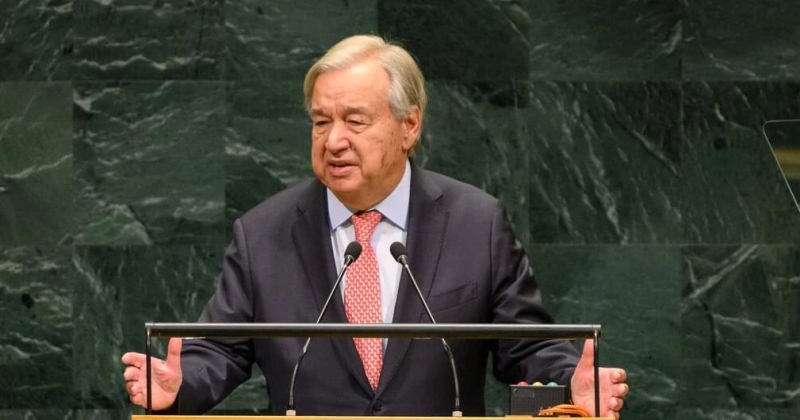
Secretary-General António Guterres addresses the opening of the General Debate of the UN General Assembly’s 81st session. Photo: Collected
With about 100 days left in his tenure as UN Secretary-General, António Guterres on Tuesday called for stronger international cooperation to govern artificial intelligence, warning that life-and-death decisions must never be left to machines.
Presenting his annual report of the Organization, Guterres delivered a wide-ranging speech in which he portrayed the world’s major crises as interconnected manifestations of a broader struggle over how power is exercised and who controls it.
“The greatest power is not the power to dominate. It is the power to build a future that works for everyone,” he said.
He described the past decade as a period of eroding international norms, marked by attacks on civilians, deaths of humanitarian workers, disregard for international law and declining trust among nations.
Guterres said power is being reshaped in three major ways: the emergence of new state powers, the transfer of significant authority from governments to private corporations and individuals, and the growing role of AI and autonomous weapons in decisions once reserved for humans.
“The faultlines in our world are widening,” he said. “Cracks have become canyons.”
Rather than accepting global fragmentation as inevitable, he called for renewed international cooperation and a genuinely global system based on interdependence and shared rules.
He also warned against a division into rival blocs with separate economic and security systems, a scenario he has described in recent years as the “Great Fracture.”
No real ceasefire in sight
Referring to the continuing crises in the Middle East, Ukraine, Sudan and Myanmar, Guterres said purported ceasefires have often amounted to little more than “lesser fires,” while civilians continue to suffer.
He renewed his call for compliance with orders issued by the International Court of Justice regarding Gaza and warned that the expansion of settlements in the Israeli-occupied West Bank threatens to eliminate the possibility of a two-State solution.
He also condemned Russia’s full-scale invasion of Ukraine as a clear violation of the UN Charter.
Renewing his longstanding call for reform of the UN Security Council, Guterres described the continued lack of permanent African representation as “unjust and indefensible,” particularly given that the 15-member body was established in a vastly different geopolitical era.
‘Equality is not a dream; it is a decision’
Guterres highlighted the contrast between record levels of global wealth and the billions of people who still lack adequate access to food, clean water, education and healthcare.
He said inequality is not simply an economic issue, but also concerns power over opportunities, resources and people’s ability to determine their own futures.
He reiterated his longstanding criticism of an international financial system that leaves developing countries burdened by debt while they face climate disasters they contributed little to causing.
He called for faster debt relief, stronger multilateral development banks and fairer access to Special Drawing Rights created by the International Monetary Fund.
Guterres also focused on gender inequality, announcing that the UN has achieved full gender parity across senior leadership, headquarters staff and professional roles for the first time in its history.
“Equality is not a dream; it is a decision,” he said, pointing to progress within the UN as evidence that entrenched power structures can be changed.
Climate change and AI pose twin challenges
On climate change, Guterres described the crisis as the “most profound intergenerational power imbalance” and warned that breaching the 1.5°C threshold is becoming nearly certain.
He called on polluters to “pay” and urged developed countries to triple adaptation funding.
He noted that major oil companies have made substantial profits since Russia’s invasion of Ukraine, while global adaptation finance for developing countries remains only a fraction of that amount.
Turning to AI, Guterres warned that power is increasingly concentrated in data, computing capacity and algorithms, with technological development moving faster than humanity’s ability to govern it.
“The danger is not technology,” he said. “The danger is technology without accountability.”
‘Killer robots must have no place in our future’
Guterres said safeguards for AI must be established and stressed that children must never be used as test subjects for unregulated systems.
“Life-and-death decisions must never be surrendered to machines,” he warned. “Killer robots must have no place in our future.”
He called for a multilateral AI risk-management framework with independent oversight, reiterating that children should not become test subjects for unregulated systems and that machines must never be entrusted with life-and-death decisions.
Stronger, not weaker
Guterres reaffirmed that peace, development and human rights are inseparable pillars of the UN Charter, rejecting any notion that human dignity and rights can be separated from security and opportunity.
He recalled that the United Nations was created more than 80 years ago, amid the devastation of World War II, as an expression of hope by people who refused to surrender the future to fear and by countries that recognized that their futures were interconnected.
Vowing to carry that “spirit of resolve” through the remainder of his tenure, Guterres said he would continue to champion the values of the UN Charter even after leaving office as Secretary-General.
“The world does not need a weaker United Nations,” he said. “It needs a UN strong enough to face the world as it is and determined enough to build the world as it should be.”