

- Woman killed, 4 of her family missing in Meghna boat capsize |
- State can never be strong keeping citizens powerless: PM at UNGA |
- Trump welcomes Xi in Washington as US-China trade truce extended |
- Prevention at heart of govt’s healthcare reform: PM |
- Death toll rises to 11 following typhoon-induced downpours in Japan |
Bangladesh Calls For Inclusive Global Cyber Governance
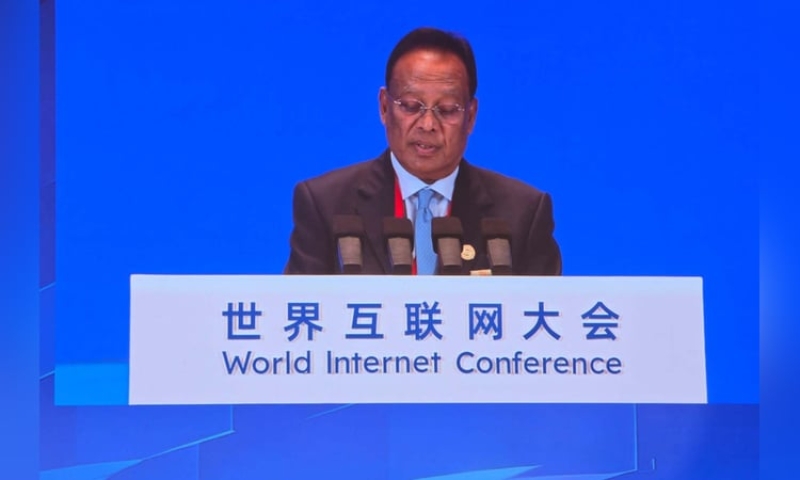
Posts, Telecommunications and Information Technology Minister Faqir Mahbub Anam delivered his keynote address as a special guest at the opening ceremony of the prestigious World Internet Conference 2026 in China.
Posts, Telecommunications and Information Technology Minister Faqir Mahbub Anam has unveiled a three-point proposal aimed at promoting multilateral cyber governance, expanding equitable access to technology and knowledge, and narrowing the global digital divide to build a more inclusive digital future.
The minister presented the proposal while delivering a keynote address as a special guest at the opening ceremony of the World Internet Conference 2026 in China, according to a ministry press release issued on Wednesday.
Also serving as the Science and Technology Minister, Faqir Mahbub outlined three key priorities to advance shared digital prosperity.
The first pillar focuses on capacity building and knowledge transfer through greater investment in digital infrastructure and collaborative platforms to develop Bangladesh's young talent, including cybersecurity professionals, digital experts and future innovators.
The second pillar calls for affordable connectivity by promoting accessible technology transfer and strengthening cooperation with global technology leaders to help bridge the digital divide.
The third pillar advocates treating digital public goods as a global public asset by making intellectual property (IP) frameworks and data architectures more open and accessible for the benefit of the international community.
The conference, held under the theme "Pooling Intelligence on the Silk Road, Embarking on a Digital Future: Jointly Building a Community with a Shared Future in Cyberspace," took place at the Xi'an International Convention Center.
Addressing emerging cyber challenges, the minister said cyber governance must be multipolar, transparent and firmly rooted in international law to effectively combat cybercrime, disinformation and data colonialism.
Recalling the legacy of the ancient Silk Road, he said digital connectivity should be built on the same principles of trust and mutual confidence.
"Our digital superhighways must be built on the same foundation of trust. Bangladesh stands ready to be a reliable partner in this journey, driven by connectivity, youthful energy and innovation," he said.
The minister said the conference theme closely aligns with Bangladesh's aspirations to build a modern, technology-driven and knowledge-based economy.
He noted that nearly 65 percent of Bangladesh's population of 180 million is young and of working age, providing a strong demographic foundation for the country's digital transformation.
Highlighting Bangladesh's progress, Faqir Mahbub said more than 90 percent of the population now has access to mobile connectivity, while Mobile Financial Services (MFS) have expanded financial inclusion for farmers and small entrepreneurs.
He added that government services are increasingly being delivered through the National Portal and the d-Nothi electronic file management system, while the digitalisation of land records, healthcare and other public services is saving citizens millions of working hours each year.
The minister said Bangladesh is also investing heavily in artificial intelligence, fintech innovation and advanced data centre infrastructure, alongside developing technology-driven solutions such as machine learning-based flood forecasting and drone-assisted precision agriculture.
Describing Bangladesh's strategic position between South and Southeast Asia, he said the Digital Silk Road has become an important driver of the country's digital economy.
He added that high-speed submarine cable connectivity is helping integrate Bangladesh's digital economy with China's technological ecosystem and ASEAN's manufacturing networks.
The two-day conference, held from 21 to 22 July, brought together around 800 participants from 52 countries and regions.
Discussions focused on artificial intelligence, digital trade, Silk Road e-commerce, cultural heritage preservation, smart healthcare and global digital cooperation.
Representatives from leading Chinese and international technology companies, including Qualcomm, Lenovo, ZTE, 360 Group, Sugon, Waterdrop, Qixin Technology and Penghua Fund, also took part in the conference.