

- Board of Peace quietly met with UNRWA, ex-agency chief says |
- Man arrested with cocktail ingredients, 9,000 masks in Keraniganj |
- Anthrax detected in 3 of 11 people tested in Rangpur |
- Woman killed, 4 of her family missing in Meghna boat capsize |
- State can never be strong keeping citizens powerless: PM at UNGA |
China Powers Up ‘Artificial Sun’ Fusion Project Milestone
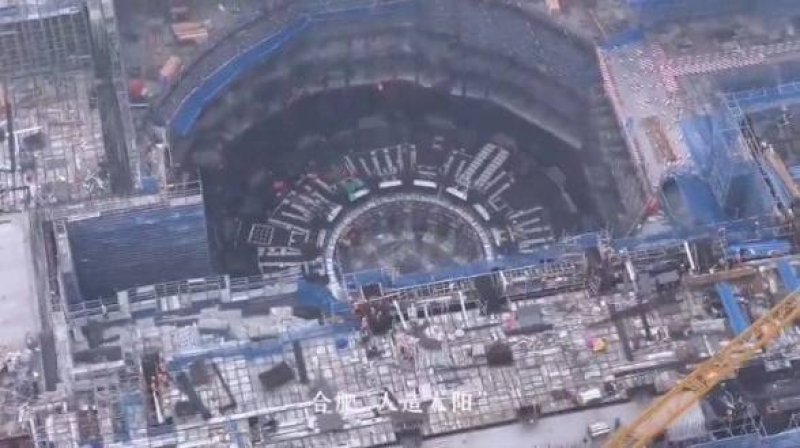
China’s ‘artificial sun’ is an experimental reactor designed to recreate the nuclear fusion process that powers the Sun. China plans to use it to produce cleaner energy
China’s superconducting magnets have passed key tests at the Institute of Plasma Physics, Chinese Academy of Sciences marking a major engineering milestone in the country’s “artificial sun” project.
The 582-tonne superconducting magnet is a key component of the fusion reactor China is trying to build. It is designed to keep plasma—hotter than even the Sun’s core—suspended without touching the reactor.
Although humanity is still far from generating commercial electricity through nuclear fusion, magnets like these are the lynchpin of the process.
China’s ‘artificial sun’ is an experimental reactor designed to recreate the nuclear fusion process that powers the Sun. China plans to use it to produce cleaner energy.
Nuclear fission and nuclear fusion are two types of opposite nuclear reactions that release immense amounts of energy. The former is a process where a large nucleus, such as Uranium 235, is split into smaller nuclei. In fusion, lighter atoms such as hydrogen and helium, are combined to create heavier ones in a process that creates a lot more energy than fission.
While scientists have created isolated fusion reactions, using fusion to generate power is a lot more difficult because it involves sustaining extreme heat, volatile plasma, and several other engineering hurdles. On earth, fusion is still far away, but in space it is the principle that powers our friendly neighbourhood sun and several other stars.
Fusion is common in the sun because the star is made up of plasma, often called the fourth state of matter. When solids melt, they turn into liquids. When liquids are heated, they turn into gases.
When these gases too are heated even further, the electrons of particles separate from the atoms resulting in plasma. Plasma is essential for nuclear fusion, but creating and controlling plasma is one of the biggest engineering challenges.
The Sun’s core is estimated to be nearly 15 million degrees Celsius. But the sun has an enormous gravitational force which squeezes atoms together to make sure they keep colliding with one another. Earth’s gravity cannot do that.
To compensate, scientists heat up the plasma to nearly 100 million degrees Celsius, making collisions between hydrogen nuclei much more likely, without producing any carbon dioxide. But when hydrogen reaches that hot plasma state, there is no material that can contain it.
Therefore, scientists have to use magnetic fields to create an invisible cage which keeps the plasma suspended and stops it from touching the reactor.
To keep this superheated plasma from escaping, scientists use Tokamak, a doughnut-shaped fusion reactor that traps plasma using powerful magnetic fields. Sixteen giant D-shaped superconducting magnets are arranged around the Tokamak to generate a 6.5-tesla magnetic field.
This traps the plasma inside and makes sure it doesn’t touch the reactor’s walls. A magnetic field of 6.5 tesla (the unit used to measure magnetic field strength) is several thousand times stronger than Earth’s magnetic field, which is about 0.00005 tesla.
These D-shaped superconducting magnets are the key components that generate the Tokamak’s magnetic field. Each magnet measures 21 metres by 12 metres and weighs 582 tonnes.
It is the largest superconducting fusion magnet ever built. It has the capacity to store nearly three times the energy compared to the magnet built at the International Thermonuclear Experimental Reactor (ITER), which is an international nuclear fusion research project located in France. Furthermore, it has been designed to remain operational for 60 years.
What makes superconductor magnets even more fascinating is that they are built using superconductors which, unlike ordinary wires, can carry electricity without any resistance. This allows massive amounts of electric currents to flow through them continuously. But they only work when they are cooled down to extremely low temperatures.
Source agencies