

- Heatwaves Cost Bangladesh Nearly Tk 77,000 Crore a Year |
- Protecting Bangladesh’s coastal people From Tide-induced Loss, Damage |
- Four Warehouses Linked to Salman Muqtadir’s In-Laws Sealed |
- Dengue surge: N’ganj hospitals treat patients on floors, verandas |
- Dhaka ranks 5th among world’s most polluted cities on Friday |
Manpower export jumps 11 pc in Sept, Malaysia market still closed
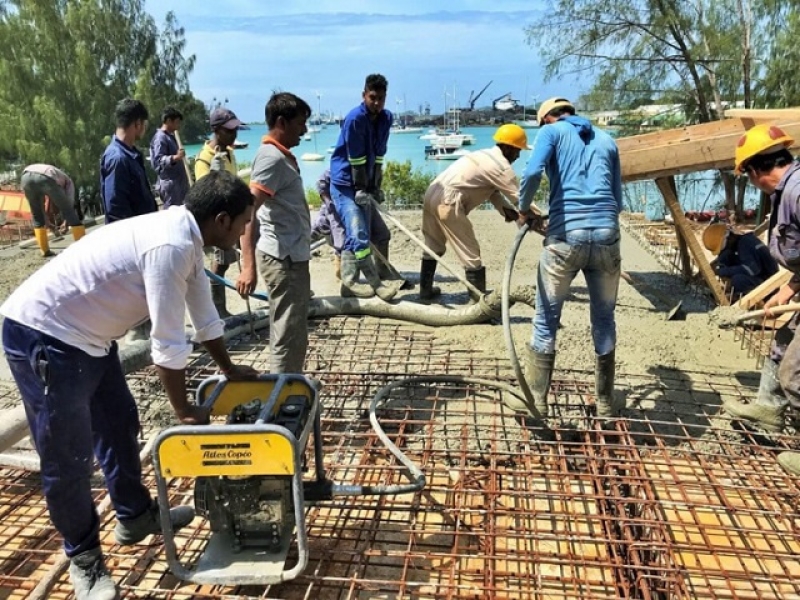
Migrant workers doing construction work, - Seychelles Nation via Wikimedia Commons.
By Imtiaz Ahmed
The manpower export posted an over 11 per cent growth during the month of September over the previous month of August giving a slight relief to the job seekers of Bangladesh, leaders of Bangladesh Association of International Recruitment Agencies (BAIRA) said.
Bangladesh exported a total of 70, 304 workers to different countries in the month as against 62,924 workers in August, 2026, according to the data of BMET.
Of the total, 32, 915 workers were exported to KSA, 8306 to Singapore, 6282 to Qatar, 5020 to Maldives, 4538 to Kuwait, 4442 to UAE, 1249 to Portugal, 1097 to Italy, 774 to Jordan and 692 to Laos, according to BMET.
The government of Bangladesh worked hard to reopen Malaysia labour market, the issue was lost during the month of September when only 305 workers exported to the South East Asian Country.
The month of September was less tense in the Middle-East that helped post manpower from Bangladesh, said a BAIRA leader.
Bangladesh exported a total of 569973 workers to different countries during the January—September period of 2026 as against 838892 workers to different counties during the same period 2025 showing a 47 per cent drop, according to BMET
The US-Israel imposed war on Iran has not only created uncertainty in the global energy markets, but also increased prices of the products hurting the economies across the world, said an economist of the Dhaka University.
Meanwhile, higher oil prices are a natural result of the latest approach by the U.S., which implies a substantial extension of the trouble in the Middle East with little hope of a near-term resolution, said Bjarne Schieldrop at SEB Research.
The U.S. threats come as Iran curbs flows through the Strait of Hormuz, which handled about one-fifth of global daily oil and liquefied natural gas supplies before the conflict began in late February. Latest Iran offer to reopen the strait has been opposed by the US.
The manpower export of Bangladesh during January –August period of 2026 dropped over 32 per cent as against the same period of the last calendar year, according to the data of the Bureau of manpower, Employment and Training (BMET)
Bangladesh exported a total of 499,680 workers to different countries during January—August period of the current calendar year as against 739,870 workers during same period of the last calendar year, according to the data of BMET.
Meanwhile, BNP Standing Committee member Amir Khasru Mahmud Chowdhury recently said BNP has a plan to create one crore jobs in one and a half years and it is not a political slogan, rather it has a well-planned, realistic and implementable roadmap for that.
“We have made this promise after doing homework and analysing the possibilities. Our plan includes skill development, creating entrepreneurs, preparing workers to increase remittances and exploring creative and digital sectors,” he told a roundtable meeting at a city hotel.
According to Xinhua, the World Bank has revised Bangladesh's growth prospects to a downward trajectory, forecasting a GDP (gross domestic product) growth of 4.6 percent for the 2026-27 fiscal year (FY) starting in July.
In its latest Global Economic Prospects (GEP) report released recently, the Washington-based lender has also revised its GDP growth forecast for the country downward for the outgoing fiscal year 2025-26, cutting it by 0.8 percentage points to 3.8 percent, down from the 4.6 percent projected in its January 2026 report.
The updated assessment highlights increasing worries about ongoing inflation, sluggish private-sector growth, weaknesses in the financial system, and rising global instability.
The Bangladeshi government unveiled a record 9.38 trillion taka (nearly 77 billion U.S. dollars) proposed national budget, targeting economic growth of 6.5 percent for the current 2026-27 fiscal yea.
Meanwhile, Malaysian Human resources minister R Ramanan said their government has no plans to bring in more foreign workers for now, despite claims that Malaysia would take in 200,000 Bangladeshi workers over the next six months, according to the Strait Times.
Ramanan said the government remains committed to reducing Malaysia’s reliance on foreign workers to 10% of the total workforce by 2030.
“How does it make sense for 200,000 workers to come in within six months? Does that mean we are going to bring in more than 1,000 Bangladeshis every day?
“It’s illogical. It doesn’t make sense at all,” he told FMT.
He was responding to Bangladeshi local government, rural development and cooperatives state minister Mir Shahe Alam’s claim that Malaysia would take in about 200,000 Bangladeshi workers in stages over six months, beginning at the end of this month.
Ramanan said discussions with his Bangladeshi counterpart revealed that there had been some confusion over the statement.
Earlier, government spokesman Fahmi Fadzil also denied the claim, saying the Bangladeshi state minister’s statement did not represent Dhaka’s official position.
Ramanan said the intake of foreign workers was determined by the needs of individual industries and sectors, subject to the ceiling set by the economy ministry under the 13th Malaysia Plan (13MP).
“Only if there is a genuine need will we discuss it in the Cabinet,” he said.
The Malaysian government previously said it would maintain the foreign worker ceiling at 13% of Malaysia’s total workforce, after reducing the country’s reliance on foreign labour from 15%.
Deputy investment, trade and industry minister Sim Tze Tzin had also said Malaysia would not increase its reliance on foreign labour despite demand from businesses.
Meanwhile, State Minister for LGRD and Cooperatives of Bangladesh Mir Shahe Alam recently said Malaysia will hire about 200,000 workers from Bangladesh in the next six months.
The recruitment process will be implemented through various agencies in the country, he said.
All these processes will start soon, Shahe Alam told reporters after Malaysian High Commissioner to Bangladesh Mohd Shuhada Othman called on LGRD and Cooperatives Minister Dr Abdul Moyeen Khan at the Secretariat here.
Mir Shahe Alam and Local Government Division Secretary Md Shahidul Hassan were present at the meeting
“There are about eight lakh registered Bangladeshi workers in Malaysia. There are some unregistered workers. Our minister has requested the Malaysia authorities to register them. About 10,000 students from Bangladesh study in Malaysia,” he said.
Bangladesh Prime Minister's Information and Broadcasting Adviser Dr Zahed Ur Rahman said Malaysia has expressed interest in recruiting around 200,000 workers from Bangladesh within the next six months due to the Bangladesh government's continued diplomatic efforts.
Of them, 10,000 workers will have the opportunity to go completely free of charge following a special request from the Bangladesh government, he said.
Zahed stated this at a weekly briefing on the progress of various government activities held at the conference room of the Press Information Department (PID) at the Secretariat.
Meanwhile, the energy crisis in Bangladesh in recent days has halted the production of local and export-oriented industries and even in some cases stopped the expansion of the industries and generation of new jobs, said a leading exporter of Bangladesh.
The creation of new jobs in the Bangladesh markets during the last two years has rather lost momentum since July political upheaval in 2024. The interim government passed 18 months and hosted a credible parliamentary election on February 12, 2026. But economists, policy-makers and business leaders question progress in the job markets in the last two years.
The global economy is going through turmoil against the backdrop of the US-Israel war on Iran, Russia-Ukraine war, political turmoil in Syria, Iraq and Libya and political tension in the middle-east. The economy of Bangladesh is bleeding under the price hike of energy.
The policy and decision-makers should give proper statements based on real scenarios of the job markets including Malaysia.