

- US Supreme Court Voids Donald Trump Global Tariffs |
- India looks forward to engaging with new govt in Bangladesh |
- No more running after doctors, services to reach doorsteps |
- ‘Revolutionary’ shift in economy, stock market soon: Amir Khashru |
- Stocks end week sharply lower as DSE, CSE indices tumble |
New Govt Launches 180-Day Plan to Tackle Key Priorities
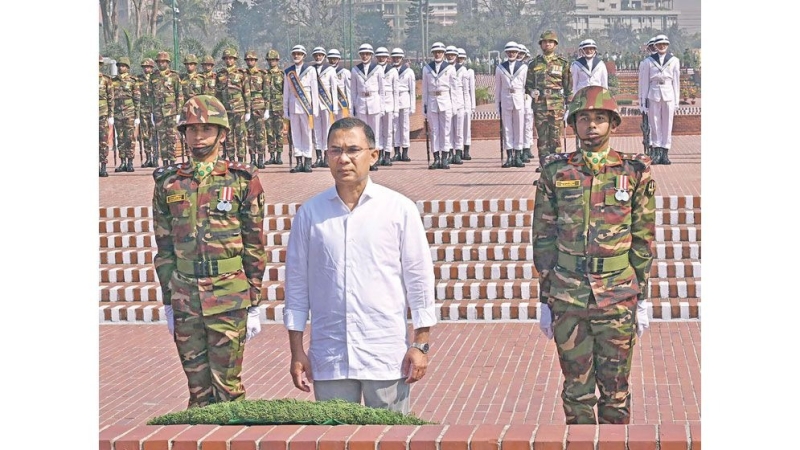
Newly elected Prime Minister Tarique Rahman observes a moment of silence after paying tribute to the martyrs of the Liberation War at the National Martyrs’ Memorial in Savar on Wednesday.
The newly formed government, led by Prime Minister Tarique Rahman, on Wednesday outlined three immediate priorities: controlling commodity prices, improving law and order, and ensuring uninterrupted electricity and gas supply during Ramadan.
These decisions were taken at the first cabinet meeting, held at the Secretariat in the afternoon, where a special 180-day action plan was also adopted to implement the commitments made by the BNP during the 13th National Parliamentary Election 2026.
The new cabinet, sworn in on Tuesday, consists of the prime minister, 25 ministers and 24 state ministers, along with 10 advisers appointed with the rank of minister or state minister.
Earlier in the day, the prime minister and his cabinet paid tribute to Liberation War martyrs at the National Memorial in Savar before heading to the Secretariat.
The meeting, beginning around 3pm, was largely introductory. The prime minister exchanged greetings with his colleagues, and Cabinet Secretary Dr Nasimul Ghani and other secretaries were present. He also held a separate meeting with the secretaries. On arrival at the Secretariat around 12:30pm, Tarique Rahman was received by the Cabinet Secretary and Principal Secretary to the Prime Minister, ABM Abdus Sattar.
According to cabinet sources, the prime minister provided guidelines to ministries in line with his party’s election manifesto. Ministers were instructed to promptly inform the Prime Minister’s Office of the responsibilities and initiatives their ministries will undertake under the 180-day plan.
Briefing journalists after the meeting, Home Minister Salahuddin Ahmed said the first cabinet meeting is traditionally held on a government’s first day. All cabinet members and advisers were present.
He noted that while most governments adopt a 100-day programme, the new administration has opted for a broader 180-day plan. “Discussions were held, and the plan will be shared soon,” he added.
“Our primary focus is on keeping commodity prices under control, improving law and order, and ensuring no disruption to power and energy sectors,” Salahuddin said, noting that the prime minister gave clear directives on these issues.
Information and Broadcasting Minister Zahir Uddin Swapan echoed the focus on these three priorities, adding that ministers will submit their plans to the prime minister within days for further instructions.
State Minister for Finance and Planning Zunaid Saki said the prime minister instructed all concerned to take immediate measures to provide relief to the public in terms of prices, law and order, and electricity and gas supply. He stressed that commitments must be implemented without delay.
Responding to questions about corruption, Saki said cabinet members were told to remain vigilant so that no one could exploit their positions for corrupt purposes or political shelter, affirming the government’s commitment to transparency.
State Minister for Foreign Affairs Shama Obaed Islam said ministries were instructed to carry out their responsibilities in line with BNP’s election pledges. Salahuddin added that secretaries were reminded to act according to the manifesto, the Constitution, and existing laws, with merit as the only consideration.
Senior Secretary of the Land Ministry, ASM Saleh Ahmed, said public confidence in the BNP manifesto should guide secretaries to work professionally and fulfil the people’s expectations.
Wednesday marked the prime minister’s first full working day at the Secretariat, symbolically shifting high-level governance back to the administrative hub after more than a decade of PMO-centred operations.