

- WB ready to support Bangladesh amid external economic shocks: Khosru |
- PM, World Bank President Discuss Bangladesh’s Development |
- Bus Fares Rise by 17 Paisa Per Kilometre |
- PM arrives in New York to attend 81st UNGA session |
Yunus Urges Lasting Reforms to End Vote Rigging
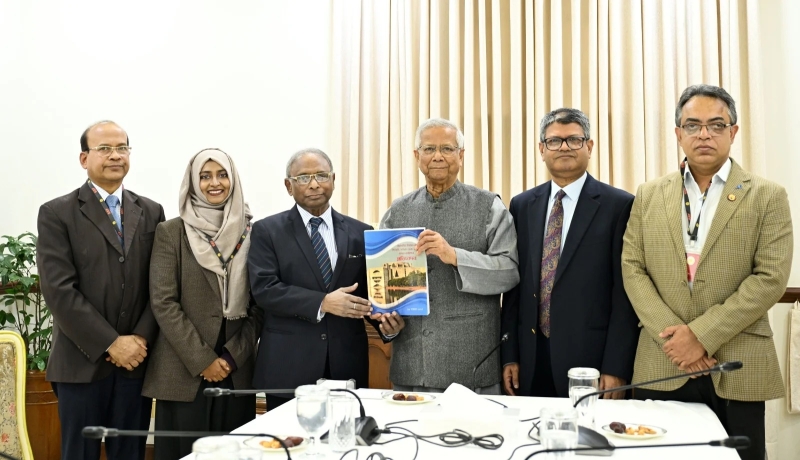
The committee on investigating alleged irregularities in the 2014, 2018 and 2024 general polls submitted its report to Chief Adviser Professor Muhammad Yunus today at the State Guest House Jamuna.
Chief Adviser Professor Muhammad Yunus on Monday stressed the need for decisive and lasting measures to prevent any recurrence of election rigging, as a high-level committee submitted its report on alleged irregularities in the 2014, 2018 and 2024 general elections.
The report was formally handed over to Prof Yunus at the State Guest House Jamuna by the committee’s chief, Justice Shamim Hasnain, along with members Shamim Al Mamun, Kazi Mahfuzul Haque (Supon), Barrister Tazrian Akram Hossain and Dr Md Abdul Alim.
Following the submission, the committee members discussed key findings and observations of their investigation with the Chief Adviser.
Receiving the report, Prof Yunus said the extent of manipulation uncovered by the probe must be fully placed before the nation.
“We had heard about vote rigging and knew certain things. But the way the entire process was distorted so shamelessly—crushing and twisting the system and writing verdicts on paper according to their own wishes—must be documented and presented before the people. There must be a complete record,” he said.
He noted that elections organised with public funds had effectively punished the entire nation.
“The people of this country watched helplessly. They could do nothing,” he said, adding that to provide even some relief to citizens, those responsible must be identified and exposed.
“We must know who did it and how it was done. Measures must be taken so that election rigging never happens again,” Prof Yunus added.
Law, Justice and Parliamentary Affairs Adviser Dr Asif Nazrul, Industries Adviser Adilur Rahman Khan, Information and Broadcasting Adviser Syeda Rizwana Hasan, Cultural Affairs Adviser Mostofa Sarwar Farooki and others were present at the meeting.
Later, the committee chief and members briefed reporters outside Jamuna, outlining the major findings of the investigation. The Chief Adviser’s Press Secretary Shafiqul Alam was also present.
According to the report, the 2014 general election was “completely staged and meticulously pre-planned”. Of the 300 parliamentary seats, 153 were filled without contest, while the remaining 147 were subjected to what the report described as a so-called election.
The investigation concluded that these arrangements were made following decisions taken at the highest level of the state to ensure the Awami League remained in power.
The report said that widespread international criticism of the uncontested 2014 polls prompted the ruling party, under the leadership of Sheikh Hasina, to pursue a strategy to present the 2018 election as a “competitive” one.
However, it noted that the BNP and other opposition parties, failing to grasp the depth of this long-term plan, chose to participate in the election.
According to the findings, in the 2018 polls ballot papers were stamped during the night in around 80 percent of polling centres to secure victory for the Awami League.
The report also highlighted what it termed a “dishonest competition” within the administration to ensure a ruling party win, resulting in voter turnout exceeding 100 percent in some centres.
For the 2024 election, the report said that with the BNP and other opposition parties staying away, a new tactic was adopted to give an appearance of competition by fielding so-called “dummy” candidates.
The investigation found that the strategies behind all three elections were devised at the highest level of the state, with the administration, police, Election Commission and intelligence agencies used to carry them out.
It also revealed the existence of a special group of officials known as the “Election Cell”, formed to coordinate and implement these plans.
According to the report, between 2014 and 2024 the election system was effectively taken out of the hands of the Election Commission and placed largely under the control of the administration. During this period, the administration emerged as the dominant force in conducting elections, sidelining the constitutional role of the Election Commission.