

- High medicine prices threaten healthcare of poor communities |
- Curtain falls on a political giant as Khaleda Zia passes into history |
- BNP Expels Nine Leaders Over Defiance and Poll Bids |
- India, Pakistan FMs to Attend Khaleda Zia’s Funeral |
- Global Leaders Pay Tribute as Condolences Pour In for Khaleda Zia |
Khaleda Zia: 41 years at BNP’s helm - an uncompromising leader
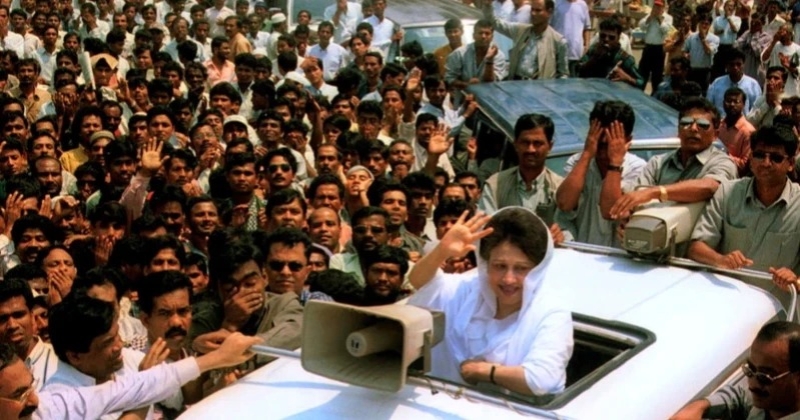
Khaleda Zia, Bangladeshi opposition leader and former prime minister, waves at the start of a 400-kilometer protest march from Dhaka to the northern village of Dinajpur, May 16, 1999. (AP Photo-Pavel Rahman, File)_1
For over four decades, Khaleda Zia, Bangladesh’s first woman prime minister, led the Bangladesh Nationalist Party (BNP) for 41 consecutive years as its chairperson, shaping not only her own remarkable political journey but also the course of the nation’s turbulent politics.
Khaleda Zia, who entered politics as a homemaker with no prior political experience following the assassination of her husband and BNP founder Ziaur Rahman in 1981, went on to shape a remarkable 43-year political journey.
To keep the party united amid internal divisions and political uncertainty following Ziaur Rahman’s death and the military takeover by General Hussain Muhammad Ershad, senior BNP leaders persuaded Khaleda Zia to join politics in January 1982.
According to the BNP website, Khaleda Zia became a primary member of the party on January 3, 1982. She was made Senior Vice Chairperson in March 1983 and was appointed Acting Chairperson on January 12, 1984.
On May 10, the same year, she was elected BNP Chairperson unopposed. She completed 41 years in that position in May this year.
Under her leadership, BNP came to power thrice and played a central role in Bangladesh’s political history.
She became Prime Minister by winning the fifth, sixth, and eighth parliamentary elections in 1991, 1996, and 2001, and notably never lost any election she personally contested.
In 1991, Khaleda Zia became Bangladesh’s first woman Prime Minister and the second woman head of government in the Muslim world after Pakistan’s Benazir Bhutto. During her tenure, parliamentary democracy was restored in the country.
Her political career was marked by a long struggle against military rule under Ershad and later political rivalry with Sheikh Hasina.
Political analysts describe her as a charismatic leader who fought against authoritarian rule for nearly two and a half decades. She was also called an uncompromising leader for her steadfast struggle against autocratic ruler HM Ershad.
Khaleda Zia’s leadership faced its most difficult period during the Awami League government, when she was convicted in two cases and jailed. She remained in prison for more than two years before being released in March 2020 through an executive order during the Covid-19 pandemic. Her sentence suspension was later extended periodically.
Following the fall of the Awami League government after the July Mass Uprising on August 5, 2024, Khaleda Zia was freed through another executive order.
She left for London on January 7, 2025, for advanced medical treatment and returned home on May 6 after 117 days abroad. In recent months, she was hospitalised several times due to various health complications.
Born on August 15, 1945, Khaleda Zia was originally named Khaleda Khan. Her family nickname was ‘Putul’. She married Ziaur Rahman in 1960 when he was a captain in the Pakistan Army and later adopted the name Khaleda Zia.
Widowed at the age of 36, she raised her two sons, Tarique Rahman and late Arafat Rahman Koko, on her own.
Despite criticism from some quarters that she rose to power through political inheritance, observers note that she established her leadership in a male-dominated political landscape through determination and political skill.
Late political analyst and author Mahfuz Ullah wrote a book on her life, in which he noted that Khaleda Zia carved out her own political space through merit and leadership at a time when few women led major political parties.
In Bangladesh’s political history, Khaleda Zia has remained one of the most influential and enduring figures.
Khaleda Zia was admitted to Evercare Hospital on the night of November 23 on the advice of a medical board after being diagnosed with infections in her heart and lungs and died at 6pm today (Tuesday).
Meanwhile, she had been nominated for three constituencies — Dinajpur-3, Feni-1 and Bogura-7 — for the upcoming 13th parliamentary election. However, the party kept alternative candidates for her seats in view of her critical health condition. - UNB