

- Dhaka's air quality ‘moderate’ during Eid holiday |
- Thousands of tourists flock to Kuakata during Eid festival |
- 45th anniversary Ziaur Rahman's death Saturday |
- India’s Muslims denied public spaces for Eid prayers |
- China steps up efforts to protect rare golden monkeys at world heritage site |
July Uprising: Democratic Aspirations Bought Back With Blood
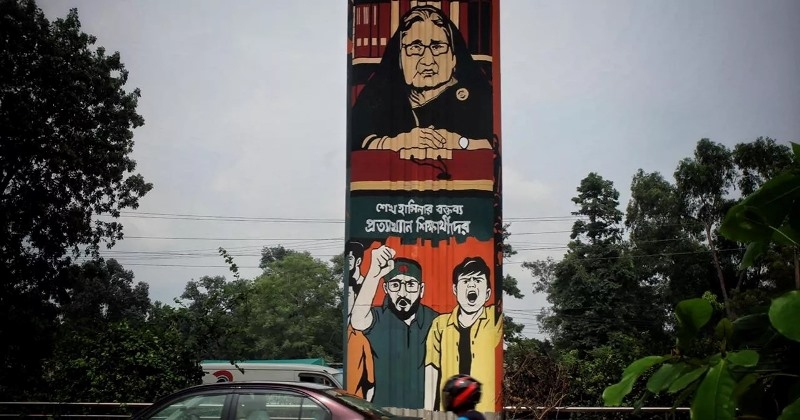
Graffiti on a Dhaka Metro pillar. Photo Tahiyat Nazifa Noor - UNB.
Mostafa Kamal Majumder
Graffitis on the July uprising fill the main thoroughfares of capital Dhaka at people celebrate its first anniversary on Tuesday. In July 2024, Bangladesh experienced a political and moral upheaval that reshaped its national identity. What began as a protest against discriminatory job quotas evolved into a sweeping movement that dismantled a fifteen-year autocracy and reignited the country’s democratic aspirations.
The uprising was sparked by students demanding merit-based recruitment in government jobs as against 56% of positions allocated through quotas, sidelining meritorious candidates. But when the regime responded with inflammatory verbal attack and violence—deploying police and armed party cadres—the protest transformed into a national revolt. Prime Minister Sheikh Hasina’s divisive rhetoric only intensified public outrage. The movement quickly became a referendum on authoritarianism itself.
The repression was brutal. Over 1,400 people were killed, including children and women according to UN figures. Armed vigilantes of Chhatra League and Jubo League cadres operated alongside police forces, turning campuses and city streets into battlegrounds. Yet, amid the chaos, voices of courage emerged.
Abu Sayeed, a student at Begum Rokeya University, became a symbol of resistance. On July 16, he stood unarmed before riot police and was fatally shot. His final words, captured on video—“We are not afraid. We are the future of this country”—echoed across social media and galvanized the movement.
The uprising was the culmination of a 15-year struggle against authoritarian rule marked by: Denial of voting rights and manipulated elections; Enforced disappearances and secret killings; Judicial and administrative capture by partisan forces; Economic plunder, banking collapse, and capital flight plus Erosion of sovereignty through foreign dependency.
In Toronto, the diaspora commemorated the uprising with exhibitions and cultural events. “Even while living abroad, we envision a Bangladesh where justice, democratic values, economic equity, and inclusion are the foundation of governance,” said youth activist Srijoni during a memorial gathering. Former student leader Nasir Ud Duza reflected, “The 2024 uprising was a unified eruption against misrule and absence of democracy. We can only repay our martyrs by accelerating the transition to an equal, democratic, and secular Bangladesh.”
The uprising also left deep psychological scars. Families were torn apart, homes raided, and thousands displaced. “My brother was taken from our home in the middle of the night. We still don’t know where he is,” said Mahinur, a university student from Rajshahi. Her testimony, shared during a candlelight vigil in Ottawa, underscored the human cost of resistance.
With Sheikh Hasina’s resignation and departure to India on August 5, an Interim Government led by Professor Muhammad Yunus took charge. In a historic development, political parties reached consensus on key reforms: decentralization of executive power, proportional representation, judicial independence, and constitutional safeguards for civil liberties.
As Bangladesh prepares for general elections in early 2026, the spirit of July continues to guide its path. The martyrs are remembered not only in speeches and ceremonies but in graffitis, murals, songs, and the renewed civic engagement of a generation that refused to be silenced.
The July 2024 uprising was not just a political rupture—it was a moral awakening. It reminded the nation that democracy is not inherited; it is earned through sacrifice, solidarity, and the unwavering belief in a just future.
(The writer is a renowned journalist and editor of GreenWatch Dhaka online newspaper)