

- RMG exports to UK almost $1bn in first two fiscal months |
- Trump Rejects Iran Proposal to Reopen Strait of Hormuz |
- Govt to Buy Rooftop Solar Power at Tk 10.50 Per Unit |
- Over 30 tourism clusters being developed in country: PM |
- Bangladesh, US sign strategic civil nuclear cooperation agreement |
Civil society, people laud PM’s UNGA speech
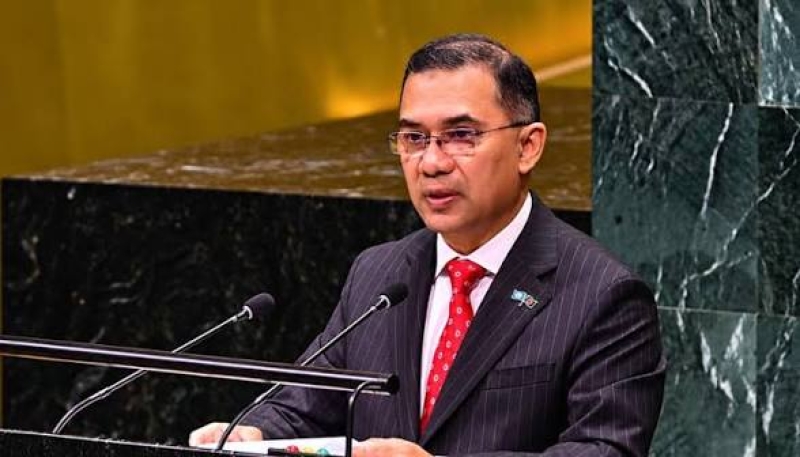
Prime Minister Tarique Rahman’s maiden address at the 81st session of the United Nations General Assembly (UNGA) has drew applause from civil society members and common people.
Tarique Rahman in his speech has presented a broad roadmap for rebuilding Bangladesh, reviving its economy and strengthening its role in promoting global peace and cooperation.
National Professor Prof Dr Mahbub Ullah said Tarique Rahman’s speech came against the backdrop of the country that had been battered by more than one and a half decades of political and economic exploitation, leaving the country’s economy deeply weakened.
Mahbub Ullah, also an economist and political analyst, said, the premier presented the government’s 3-R strategy- Recovery, Restoration and Reconstruction- before the international community as a framework for repairing and rebuilding the country.
He said implementation of the strategy would require extensive economic and institutional work. The tax-to-GDP ratio would need to rise by three percentage points to strengthen Bangladesh’s capacity to finance development amidst major challenges of inflation and global energy crisis.
“Bangladesh is also facing the burden of accumulated domestic and foreign debt. Interest payments and loan installments could become a major constraint on development in the coming years, although borrowing itself need not be problematic if borrowed resources are used productively and generate returns for the economy,” he said.
The premier also identified banking-sector reform as an important requirement for revitalising the national economy, he said.
At the same time, Mahbub Ullah noted that the prime minister did not seek foreign assistance from wealthy countries as the principal means of overcoming Bangladesh’s economic crisis, instead giving emphasis on country’s own commitment and responsibility- a position he described as reflecting a “Bangladesh First” approach.
Noting that the Rohingya crisis was another major focus of the speech, Mahbub Ullah described the prolonged presence of the Rohingyas in Bangladesh as a “big burden” and said the continued failure to secure their return to Myanmar had also created security vulnerabilities.
Prof Dr Md Nurul Amin Bepari, an eminent political scientist, said Rohingya crisis was not created by Bangladesh. Myanmar should play the leading role in the repatriation process. He noted that the involvement of China, India, the United States and the United Nations has transformed the Rohingya issue into a broader international concern.
By raising the issue at the UNGA, Bangladesh has clearly presented its position to the international community, Bepar said, adding that previous assurances on repatriation had not produced a sustainable solution.
Political analyst Dr Kazi Mohammad Mahbubur Rahman also said the Rohingya issue was articulated with particular clarity in the address.
“Prime Ministers from our country had attended UNGA sessions before, but this address stands out for several reasons. For the first time, our position on the Rohingya issue was articulated with utmost clarity,” he said.
Dr Kazi Mahbubur also highlighted the PM’s emphasis on people’s empowerment. United Nations actively advocates people’s empowerment worldwide and the prime minister’s commitment to empowering Bangladesh’s people gave an international dimension to a key domestic priority.
“PM’s 3-R strategy and Bangladesh’s opposition to warfare further reinforced the country’s commitment to peace and reconstruction,” he said, adding that the speech placed strong emphasis on peaceful resolution of international conflicts through dialogue, diplomacy and mutual cooperation rather than military confrontation.
Maruf Kamal Khan, editor of Bangla daily Protidiner Bangladesh, described the address as a strong expression of Bangladesh’s aspirations for global peace at a time of wars, conflicts, violence and bloodshed around the world.
He quoted PM’s statement “the world will change through humanity, not deadly weapons,” saying the speech projected a message of peace and recalled the legacy of Shaheed President Ziaur Rahman.
The prime minister also reaffirmed Bangladesh’s support to an independent Palestinian state and called for a resolution of the longstanding Palestinian issue, he mentioned.
The premier maintained that lasting peace in the Middle East and security across the world would remain difficult to achieve without resolving the issue, he said.
Tarique Rahman also upheld Bangladesh’s position in favour of nuclear disarmament, Maruf Kamal said, adding that climate change, women’s education and empowerment, child health and safety and the responsible use of artificial intelligence were also highlighted in PM’s speech.
Prime Minister’s focus on climate change received particular attention because of Bangladesh’s vulnerability as a densely populated country, he added.
The prime minister called for international cooperation to address the growing risks posed by climate change. Women’s education and employment were presented as important instruments of empowerment, he said.
Principal Information Officer Syed Abdal Ahmed said the 17-minute speech in Bangla highlighted the need for world peace, peaceful resolution of international conflicts and stronger multilateral cooperation.
The premier also drew international attention to Bangladesh’s key concerns, including the Rohingya crisis, economic development, environmental issues and democratic state reforms, he said.
Abdel Ahmed said the prime minister referred to the July movement and the restoration of democracy and rule of law through the February 12 election.
He presented the government’s 3-R strategy as a long-term roadmap for rebuilding the state.
Ahmed said the Prime Minister emphasized on diplomatic dialogue and cooperation over military force and called for redirecting military spending toward development.
It also marked the third UNGA speech in Bangla by a member of the Zia family, following Shaheed President Ziaur Rahman in 1980 and former Prime Minister Begum Khaleda Zia in 1993, highlighting the family’s association with Bangladesh’s political history and global representation, he said.
Public reactions reported by BSS reflected particular appreciation for the prime minister’s decision to speak in Bangla at the global forum.
Dhaka University student Tamzid said the address made him feel proud as it has presented the aspirations of his generation.
Shopkeeper Mohammad Shaheen of Nilkhet said he appreciated the fact that the prime minister brought the concerns of ordinary Bangladeshis to the international forum.
Pedestrian Mohammad Jasim similarly expressed pride over the speech’s emphasis on Bangladesh’s dignity, economic recovery and the Rohingya crisis.
For building a prosperous Bangladesh, the prime minister also expressed his commitment to creating an investment-friendly environment capable of attracting domestic and foreign investment.
PM has kept the door open for dialogue with neighbouring countries on issues concerning Bangladesh’s national interests, reports BSS.
“We believe that any problem should be resolved through dialogue, diplomatic processes, and mutual cooperation,” he said.