

- Resignation of President Mohammed Shahabuddin for ill health |
- Why President Shahabuddin resigned from office |
- President Mohammed Shahabuddin Resigns |
- Experts Call for Better Flood Forecasting, Urban Planning |
- Fakhrul Urges Public to Ignore Resignation Rumours |
Resignation of President Mohammed Shahabuddin for ill health
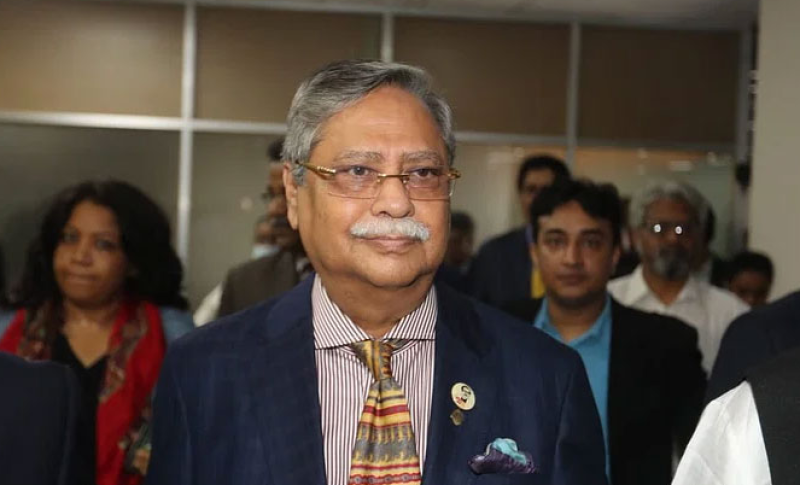
President Mohammed Shahabuddin
President Shahabuddin steps down citing ill health, Speaker Hafiz Uddin Ahmed assumes office as Acting President as Bangladesh enters a new constitutional transition shaped by the legacy of the July-August uprising and the country's evolving political landscape
Special Correspondent:
President Mohammed Shahabuddin has resigned from office, bringing an end to his tenure as Bangladesh's 22nd President and closing a chapter that witnessed one of the most turbulent periods in the country's constitutional history. His resignation, formally accepted on Friday by Speaker Major (Retd.) Hafiz Uddin Ahmad, has triggered the constitutional process for electing a new head of state while placing the Speaker in charge as Acting President.
The resignation ends days of intense speculation over Shahabuddin's political future amid persistent reports that he was preparing to step down because of deteriorating health. Although rumours had circulated for weeks, the matter became official after the Parliament Secretariat confirmed receiving his resignation letter and the Speaker accepted it shortly after returning to Dhaka from Thailand.
Speaking briefly to journalists after the development became public, Shahabuddin confirmed the decision in his characteristic understated manner.
"It's already public knowledge. What's the point of hearing it from me? I am sick, so it is done," he said.
When asked whether he had signed the resignation letter, he replied, "I've already told you. You can understand the rest."
In his resignation letter addressed to the Speaker of Parliament, Shahabuddin said he was stepping down because severe and prolonged health complications had left him physically and mentally unable to continue performing the constitutional responsibilities of the country's highest office.
The outgoing President wrote that since assuming office on April 24, 2023, he had tried to uphold the Constitution and discharge his duties with sincerity, neutrality and dedication. However, his physical condition had steadily worsened despite continuous treatment.
According to the letter, Shahabuddin has long suffered from coronary heart disease, hypertension, diabetes and kidney-related illnesses. He previously underwent coronary artery bypass surgery, while doctors recently diagnosed him with autonomic neuropathy, a rare neurological disorder affecting the body's involuntary nervous system.
He said the disease occasionally causes him to lose consciousness without warning, making it increasingly difficult to carry out official engagements, receive foreign dignitaries, chair constitutional functions and perform other responsibilities attached to the presidency.
His physicians, he wrote, advised prolonged treatment, continuous medical supervision and complete rest, making it impossible for him to continue serving as President.
For these reasons, Shahabuddin submitted his resignation under Article 50(3) of the Constitution, which allows the President to resign by addressing a letter to the Speaker of Parliament.
Beyond citing health concerns, Shahabuddin's resignation letter also provides a rare account of the constitutional challenges Bangladesh experienced following the July-August 2024 student-led mass uprising that fundamentally reshaped the country's political landscape.
The movement, which began as a protest demanding quota reforms in public sector recruitment, rapidly evolved into a nationwide anti-government campaign after violent crackdowns on demonstrators. The unrest culminated on August 5, 2024, when then Prime Minister Sheikh Hasina left office amid massive public protests, ending more than 15 years of uninterrupted Awami League rule.
As constitutional head of state during one of the country's most volatile political transitions, Shahabuddin found himself at the centre of unprecedented legal and constitutional questions.
In his resignation letter, he recalled that after the political upheaval, Bangladesh faced the possibility of a constitutional vacuum. To resolve the crisis, he sought the opinion of the Appellate Division of the Supreme Court under Article 106 of the Constitution, which empowers the President to seek the Supreme Court's advisory opinion on important legal questions.
Based on that constitutional advice, he initiated the process of forming the interim government that subsequently assumed responsibility for state administration.
He also noted that he held consultations with leaders of various political parties to facilitate consensus during the transition period and help create conditions for holding a credible national election.
According to Shahabuddin, these steps helped prevent a major constitutional crisis and ensured continuity of governance during one of the most uncertain moments in Bangladesh's democratic history.
Although his role during the transition was welcomed by many constitutional experts for ensuring institutional continuity, it also drew criticism from some political quarters, reflecting the highly polarised political atmosphere that followed the July Movement.
Shortly after receiving the resignation, Speaker Major (Retd.) Hafiz Uddin Ahmad formally accepted it and announced that he had assumed the responsibilities of Acting President in accordance with the Constitution.
Addressing a press conference at the Jatiya Sangsad complex, Hafiz Uddin confirmed that Shahabuddin had resigned solely because of health reasons.
"The President resigned due to health reasons, and I have accepted his resignation," he said.
"In accordance with the Constitution, I will also discharge the responsibilities of the Acting President."
He explained that no separate oath was required because he had already taken the constitutional oath upon assuming office as Speaker of Parliament.
Under Article 54 of the Constitution, whenever the office of the President becomes vacant through resignation, death, removal or any other reason, the Speaker performs the functions of the President until a new President is elected.
With Shahabuddin's resignation accepted, Hafiz Uddin immediately became Acting President while simultaneously retaining his position as Speaker.
Earlier on Friday, the Speaker had returned to Dhaka after cutting short a medical visit to Thailand amid growing speculation surrounding the presidency. Shortly after his arrival, Parliament announced an urgent press briefing, signalling that a major constitutional development was imminent.
Mohammed Shahabuddin assumed office as Bangladesh's 22nd President on April 24, 2023, after being elected unopposed by Parliament.
A former district judge, Anti-Corruption Commission commissioner and freedom fighter, Shahabuddin entered office during the final phase of the Awami League government. However, much of his presidency came to be defined not by ceremonial duties but by the constitutional upheaval that followed the July-August 2024 mass uprising.
His decision to consult the Supreme Court and facilitate the formation of the interim administration became one of the defining constitutional moments of his presidency.
He subsequently oversaw the transition that eventually led to the restoration of an elected government through the parliamentary election that brought the Bangladesh Nationalist Party (BNP)-led administration to power.
Throughout that period, the presidency remained an important constitutional institution responsible for preserving continuity while executive authority shifted during an exceptionally volatile political environment.
Although the office of the President in Bangladesh is largely ceremonial, the position assumes critical importance during constitutional emergencies, transitions of power and situations involving government formation.
Shahabuddin's resignation therefore carries significance beyond a routine constitutional change. It symbolically marks the conclusion of the institutional transition that began with the July-August uprising and continued through the interim administration and subsequent national election.
The resignation also opens the way for Parliament to elect a new President who will serve as the country's constitutional head of state under the newly elected government.
With the BNP enjoying a commanding parliamentary majority following the latest national election, political observers expect the next President to be elected without significant difficulty once the ruling alliance finalises its nominee.
The Constitution provides that Parliament will elect a new President through a vote of Members of Parliament. Until that election is completed and the successful candidate takes the oath of office, Acting President Hafiz Uddin Ahmad will continue performing all constitutional responsibilities assigned to the head of state.
These include appointing constitutional office holders where necessary, signing bills passed by Parliament, accrediting ambassadors, administering oaths to constitutional officials and representing the Republic in ceremonial state functions.
For Bangladesh, Shahabuddin's resignation marks not merely the departure of an ailing President but the closing of a remarkable constitutional chapter shaped by political upheaval, judicial consultation, democratic transition and institutional continuity. As the country prepares to elect its next President, attention now shifts to Parliament, where the next occupant of Bangabhaban will be chosen to preside over a new phase in Bangladesh's constitutional and political journey.