

- 10 ways to save money as oil prices surge |
- Eid procession eases festive boredom in Dhaka: Asif Mahmud |
- Unease in Japan as Trump uses Pearl Harbor to defend Iran war |
- Congress looks for Trump's exit plan as the Iran war drags on |
- Eid al-Fitr festival celebrated in Bangladesh |
Climate-Resilient Housing Key for Asia-Pacific Cities
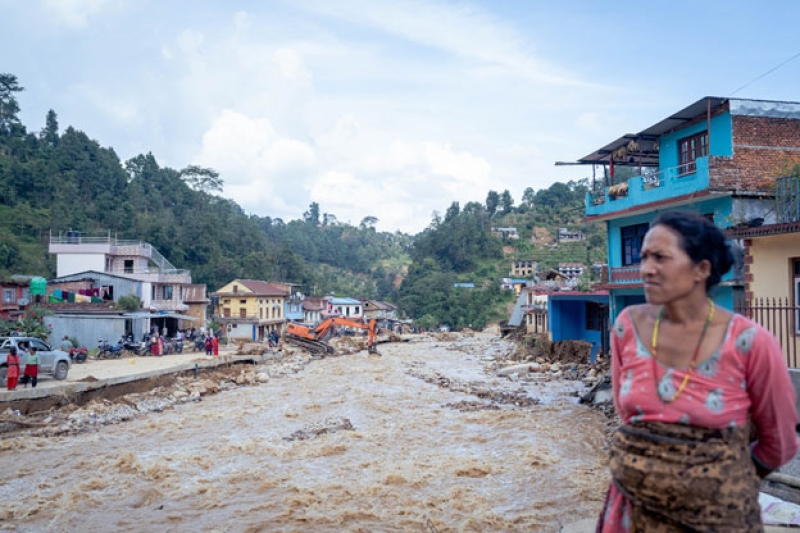
A woman looking at the flooding and landslides in Panauti Muncipality of central Nepal in October 2024. Housing resilience is essential in preventing urban loss and saving lives.
Access to adequate housing is a foundation of resilient cities. Safe and affordable homes provide stability, enable residents to access essential services, and strengthen communities’ capacity to withstand and recover from shocks. Yet housing is often treated as a downstream outcome of urban development or disaster recovery rather than as a strategic investment in resilience.
The Asia and the Pacific SDG Progress Report 2026 delivers a stark warning. The region is not on track to achieve the Sustainable Development Goals, and 88 per cent of measurable targets are projected to be missed by 2030 at the current pace. Progress across SDG 11 indicators shows mixed trends. While some indicators are improving, disaster losses and infrastructure damage continue to rise.
This widening gap between policy commitments and real-world outcomes exposes a growing resilience deficit in urban systems. Accelerating progress on SDG Target 11.1, which calls for access to adequate, safe and affordable housing and the upgrading of informal settlements, will be critical to reducing urban vulnerability across Asia and the Pacific.
Regional dialogue increasingly reflects a shift from policy commitments to concrete action aimed at reducing urban vulnerability. Discussions at the 13th Asia-Pacific Forum on Sustainable Development in 2026 and statements at the eighty-first session of the Economic and Social Commission for Asia and the Pacific highlighted housing affordability, informal settlements and climate-resilient housing as growing policy priorities requiring stronger action at the city level.
Across Asia and the Pacific, around 700 million people, nearly one-third of the region’s urban population, live in informal settlements. Many of these communities are located in hazard-prone areas exposed to flooding, extreme heat, landslides and sea-level rise.
Urban informality reflects deeper structural weaknesses in urban systems, including gaps in land governance, planning frameworks and service delivery. These shortcomings concentrate climate risks in the same neighbourhoods where housing conditions are most fragile.
Urban vulnerability is shaped by how cities are built and governed. Unplanned development, weak land-use systems and inadequate housing expose millions of urban residents to climate hazards and disaster risks. In informal settlements, these risks intensify through substandard construction, overcrowding and limited access to water and sanitation.
Climate change further amplifies these vulnerabilities as flooding, extreme heat, water insecurity, land subsidence and air pollution interact within fragile urban systems.
Evidence also shows that improving housing conditions generates broad development gains. Research by Habitat for Humanity International indicates that large-scale upgrading of informal settlements could raise GDP per capita by up to 10 per cent and increase life expectancy by four per cent.
Within just one year, housing improvements could prevent more than 20 million illnesses, avert nearly 43 million incidents of gender-based violence and avoid around 80,000 deaths. These findings highlight that expanding affordable housing and upgrading informal settlements are critical investments in climate adaptation, public health and inclusive development.
A shared but differentiated responsibility
To realign SDG trajectories and move the region closer to a resilient urban future, housing must be recognised as a core component of the urban system. Achieving this requires coordinated action across governments, the private sector and civil society.
Governments: From pilot projects to systemic guarantees
Governments must anchor climate-resilient and adequate housing as a national priority, embedding secure tenure, resilient housing and informal settlement upgrading within urban development, climate adaptation and disaster risk reduction strategies. Regulatory frameworks should enable participatory, in-situ upgrading and community-led tenure solutions that allow residents to invest in climate-resilient housing improvements.
Private sector: From speculative value to resilient value
The private sector can help scale resilient housing solutions by mobilising blended finance that combines guarantees, concessional capital and private investment. These mechanisms can support incremental home improvements, affordable rental supply and climate-resilient retrofits. Companies can also prioritise locally sourced, low-carbon materials and passive design solutions such as cool roofs, insulation and cross-ventilation suited to tropical cities.
Civil society and academia: From isolated initiatives to knowledge-powered coalitions
Civil society organisations and academic institutions play an essential role in co-producing evidence and solutions with communities. This includes exploring nature-based approaches in informal settlements and ensuring policies reflect lived realities on the ground. They also help hold institutions accountable to SDG 11 and climate justice by tracking progress on Target 11.1 and ensuring that policies and investments prioritise the most vulnerable.
Housing will shape the region’s urban resilience
The future of urban resilience in Asia and the Pacific will largely be determined in its informal neighbourhoods. If current trends continue, millions more families will be pushed into precarious and hazard-exposed housing.
Aligning housing policy with climate adaptation, disaster risk reduction and inclusive urban governance therefore offers one of the most powerful pathways to accelerate SDG 11 and strengthen resilience across the region.
Sanjeevani Singh is an Economic Affairs Officer at Economic and Social Commission for Asia and the Pacific. Enid Madarcos is Associate Director for Urban, Land and Policy at Habitat for Humanity International (Asia-Pacific).