

- IMF Forecasts Bangladesh GDP to Rebound to 4.7% in FY26 |
- Arab Allies Urge Restraint as Trump Presses Iran Talks |
- EC asks printing presses not to print election posters |
- Protect your votes, conspiracies still on: Tarique to voters |
- US ambassador warns of China's growing manufacturing dominance |
UN Undermined as ‘Law of the Jungle’ Replaces Rule of Law
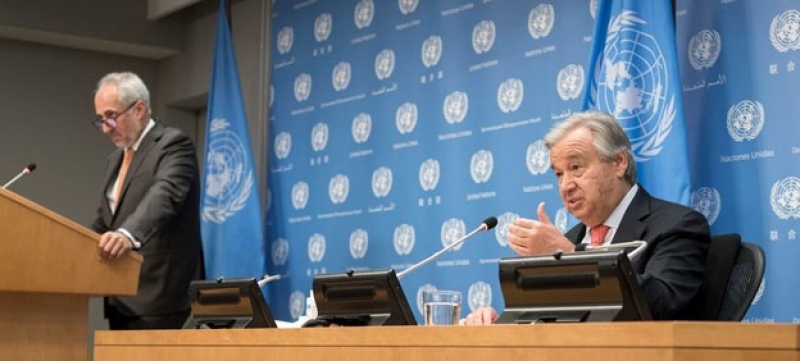
UN Secretary-General António Guterres (seated at right) speaks to reporters at a press conference at UN Headquarters, in New York.
UN Secretary-General Antonio Guterres was dead on target when he told the Security Council last week that the rule of law worldwide is being replaced by the law of the jungle.
“We see flagrant violations of international law and brazen disregard for the UN Charter. From Gaza to Ukraine, and around the world, the rule of law is being treated as an à la carte menu,” he said, as mass killings continue.
A report cited by The New York Times on January 28 quoted a recent study estimating that the four-year war between Russia and Ukraine has resulted in more than two million people killed, wounded, or missing. The study, published last week by the Center for Strategic and International Studies in Washington, said nearly 1.2 million Russian troops and close to 600,000 Ukrainian troops have been killed, wounded, or are missing.
In the war in Gaza, more than 70,000 Palestinians—mostly civilians, including women and children—have been killed since October 7, 2023. The figure rose to over 73,600 by early January 2026, according to reports from the Gaza Health Ministry and various human rights organisations.
These killings have also triggered accusations of war crimes, genocide, and violations of the UN Charter, as seen in cases such as the US invasion of Venezuela and threats to take over Greenland.
Guterres said that in an era crowded with initiatives, the Security Council stands alone in its Charter-mandated authority to act on behalf of all 193 UN member states on issues of peace and security. The Council alone adopts decisions that are binding on all member states.
No other body or ad hoc coalition can legally require compliance with decisions on peace and security. Only the Security Council can authorise the use of force under international law, as outlined in the UN Charter. “Its responsibility is singular. Its obligation is universal,” Guterres said.
Dr Ramzy Baroud, editor of Palestine Chronicle and former managing editor of the London-based Middle East Eye, said the Secretary-General’s statement was long overdue.
Too often, he said, UN officials resort to cautious and euphemistic language when describing egregious violations of international law—especially when those responsible are Security Council veto holders who have sworn to uphold the UN Charter.
Unfortunately, the UN itself has become a reflection of a rapidly shifting world order—one in which states with overwhelming military power dominate the hierarchy, abusing their influence while hollowing out the institutions meant to restrain them.
“We must be honest with ourselves and acknowledge that this crisis did not begin with the increasingly authoritarian misuse of law by the Trump administration, nor is it limited to Israel’s absolute disregard for the international community during its two-year-long genocide in Gaza,” Baroud said.
He argued that the problem is structural, rooted in the way Western powers have long exploited loopholes in the international legal system—weaponising international law against adversaries while shielding allies and advancing strategic interests.
Responding to a question at the annual press briefing on January 29, Guterres said it is evident that some members of the Security Council are themselves violators of international law, complicating the UN’s efforts.
“What we lack is leverage,” he said. “We do not have the power to force countries and leaders to abide by international law. What we have is determination—persuasion, good offices, and alliances—to try to stop the tragedies we are witnessing, from Ukraine to Sudan, and not least Gaza.”
Dr Jim Jennings, president of Conscience International, said the humanitarian crisis described by the Secretary-General is grim but real. Climate change, natural disasters, expanding conflicts, and emerging technologies are fuelling global economic instability and affecting people worldwide.
He said a major global power realignment involving China, the United States, Europe, and the BRICS nations is underway, while US policies continue to deepen inequality by stripping aid from the poorest countries.
“The reduction of funding for UN agencies by the United States is one of the most damaging contributors to the current global crisis,” Jennings said, warning that further cuts could make existing challenges unmanageable.
He called for increased private, corporate, and foundation funding for UN agencies while continuing to advocate responsible government support.
Dr Palitha Kohona, a former chief of the UN Treaty Section, said international relations were historically driven by the whims of powerful states, where might prevailed over law.
Although a rules-based international order gradually emerged with the establishment of the United Nations, he said it remains weak due to the lack of effective enforcement mechanisms.
“The illusion of a stable rules-based order has been shattered,” Kohona said, warning that unless medium and weaker powers unite to uphold international law, the world may enter a period of extreme uncertainty.
Baroud added that the 2003 US-led invasion of Iraq, followed by interventions in Libya and Syria, exemplified the systematic erosion of international law.
The wars in Gaza and Ukraine, and atrocities in Sudan and elsewhere, he said, are not anomalies but the culmination of decades of selective enforcement and legal decay.
Without a serious reckoning, calls to defend international law risk sounding like selective outrage in a system already stripped of credibility, he warned.