

- Tarique Rahman returns home amid rapturous reception |
- Home After 17 Years: Tarique Returns to Gulshan Residence |
- Tarique Calls for United Effort to Build a Safe Bangladesh |
- Tarique leaves for 300 feet area from airport |
- BNP top leaders welcome Tarique Rahman on homecoming |
Democracy Recedes in 2025, but Gen Z Fuels Hope Worldwide
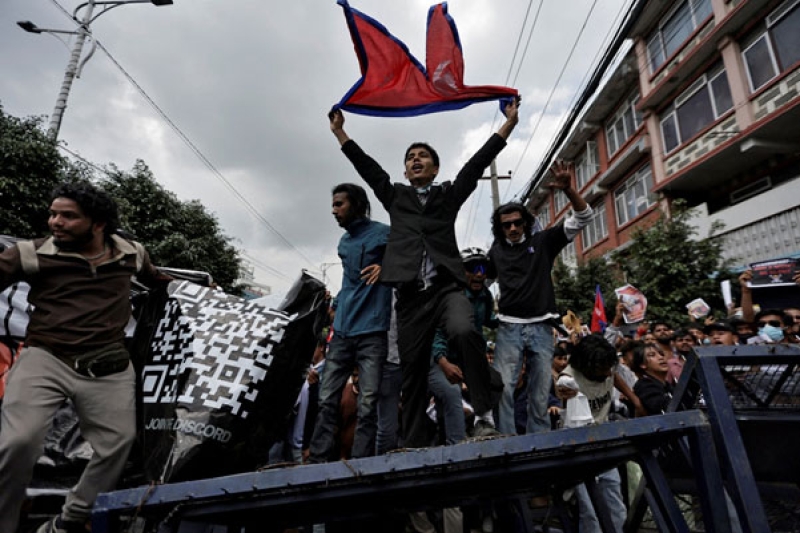
People take part in an anti-corruption protest in Kathmandu, Nepal on 8 September 2025.
2025 has been a terrible year for democracy. Just over 7 per cent of the world’s population now live in places where the rights to organise, protest and speak out are generally respected, according to the CIVICUS Monitor, a civil society research partnership that measures civic freedoms around the world. This marks a sharp drop from over 14 per cent at the same time last year.
Civic freedoms underpin healthy democracies, and the consequences of this stifling of civil society are increasingly apparent. At the end of the first quarter of the 21st century, the world is experiencing 19th-century levels of economic inequality. The wealth of the richest 1 per cent is surging, while some 8 per cent of the world’s population—more than 670 million people—suffer from chronic hunger. Weapons-producing firms, closely intertwined with political elites, are reaping windfall profits as death and destruction rain down in Gaza, Myanmar, Sudan, Ukraine and many other places. It should surprise no one that political leaders fomenting these conflicts are also squashing civic freedoms to avert scrutiny of their motivations.
From Lima to Los Angeles, Belgrade to Dar es Salaam, and Jenin to Jakarta, far too many people are being denied the agency to shape the decisions that affect their lives. Yet these places have also been the sites of significant protests against governments this year. Even as authoritarianism appears to be on the march, people continue to pour onto the streets to insist on their freedoms. As we speak, people in Sofia, Bulgaria, are demonstrating in large numbers against endemic corruption that recently forced the government to resign.
History shows that mass demonstrations can lead to major advances. In the 20th century, people’s mobilisations helped achieve women’s right to vote, the liberation of colonised peoples, and the adoption of civil rights legislation to address race-based discrimination. In the 21st century, progress has been made in marriage equality and other LGBTQI+ rights, and in highlighting the climate crisis and economic inequality through protests. But in 2025, the right to protest—precisely because it can be effective—is under assault by authoritarian leaders. Around the world, the detention of protesters is the most frequently recorded violation of civic freedoms, closely followed by the arbitrary detention of journalists and human rights defenders who expose corruption and rights violations.
This backsliding is now occurring in major, established democracies. This year, the CIVICUS Monitor downgraded Argentina, France, Germany, Italy and the USA to an “obstructed” civic space rating, meaning authorities impose significant constraints on the full enjoyment of fundamental rights. This regression is being driven by anti-rights nationalist and populist forces determined to weaken constitutional checks and balances and advance ballot-box majoritarianism that denies minorities a fair say in economic, political and social life.
The push to degrade democracy by anti-rights forces now coming to fruition has been many years in the making. It accelerated this year with the return of Donald Trump. His administration immediately withdrew support for international democracy-support programmes and instead built links with politicians responsible for crushing civic freedoms and committing grotesque human rights violations. Trump has rolled out the red carpet to El Salvador’s Nayib Bukele, Hungary’s Viktor Orbán, Israel’s Benjamin Netanyahu, Russia’s Vladimir Putin and Saudi Arabia’s Mohammed bin Salman, ushering in a new era of values-free, might-is-right diplomacy that threatens to undermine decades of painstaking progress achieved by civil society.
The fallout is clear. Many wealthy democratic governments that traditionally fund civil society activities have significantly reduced their contributions. At the same time, they have tied remaining support to narrowly defined strategic military and economic interests. In doing so, they have played directly into the hands of powerful authoritarian states such as China, Egypt, Iran, Nicaragua and Venezuela that seek to discredit domestic calls for accountability. Countries including Ecuador and Zimbabwe have introduced laws limiting the ability of civil society organisations to receive international funding.
All these developments are negatively affecting civil society efforts for equality, peace and social justice. Yet the story of 2025 is also one of persistent resistance—and some successes. The courage demonstrated by Generation Z protesters has inspired people around the world. In Nepal, protests triggered by a social media ban led to the fall of the government, offering hope for a much-needed political reset. In Kenya, young protesters have continued to take to the streets to demand political reform despite state violence. In Moldova, a cash-rich disinformation campaign run by a fugitive oligarch failed to sway the national election away from human rights values. In the USA, the number of people joining the No Kings protests continues to grow.
With more than 90 per cent of the world’s population living under conditions of institutional denial of full civic freedoms, anti-rights forces may feel confident. But democratic dissent is brewing, particularly among Generation Z—denied political and economic opportunities yet aware that another world, more equal, just, peaceful and environmentally sustainable, is possible. It is far from game over, and even in difficult times, people will continue to demand their freedoms, with breakthroughs perhaps just around the corner.
Mandeep S. Tiwana is secretary general of CIVICUS, the global civil society alliance.