

- PM Issues Solar Plan to Tackle Energy Crisis |
- Passenger ferry fire in Indonesia leaves 5 dead, dozens missing |
- Sheikh Hasina To Make First Public Appearance |
- Dhaka's Air Quality Remains Moderate |
Rohingya Repatriation Stalls as Political Deadlock Persists
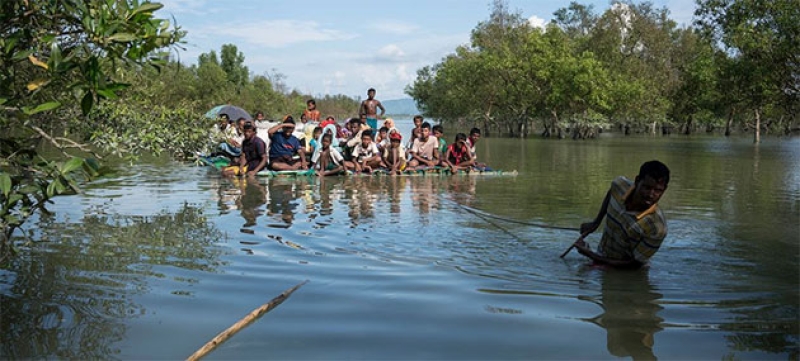
Rohingya refugees cross the Naf River on a makeshift raft while fleeing violence in Myanmar, on their way to Bangladesh.
More than seven years after the mass exodus of Rohingya from Myanmar, the prospect of repatriation remains uncertain as the political conditions necessary for a safe and dignified return remain absent.
Bangladesh continues to host more than one million Rohingya refugees in Cox's Bazar and Bhasan Char following the 2017 military crackdown in Myanmar's Rakhine State. Although repatriation has repeatedly been presented as the preferred long-term solution, every major initiative has failed because Myanmar has yet to guarantee citizenship, security and equal rights for the Rohingya.
A bilateral repatriation agreement signed between Bangladesh and Myanmar in 2017 promised a time-bound return process but lacked legally binding commitments on citizenship, freedom of movement, property restoration and international monitoring.
Subsequent repatriation efforts in 2018 and 2019 collapsed after refugees refused to return without credible guarantees of safety and dignity. A China-backed pilot initiative in 2023 also failed amid renewed armed conflict in Rakhine State and continued uncertainty over the future of the Rohingya community.
Analysts say the central problem is political rather than logistical. While repatriation plans have focused on moving refugees across the border, they have not addressed the root causes of displacement, including Myanmar's refusal to recognise the Rohingya as citizens under its 1982 Citizenship Law and longstanding restrictions on their rights and movement.
The 2021 military coup further complicated the situation by plunging Myanmar into widespread conflict. Rakhine State is now contested by the military and armed groups, making any large-scale repatriation increasingly difficult.
Bangladesh, meanwhile, continues to face mounting challenges from the prolonged refugee crisis. Refugee camps have placed pressure on local resources, forests, water supplies and public services, while security concerns have grown due to human trafficking, organised crime and armed activities inside the camps.
Declining international humanitarian assistance has also worsened conditions, forcing cuts to food assistance, healthcare and education services and increasing the risks of irregular migration by sea.
Experts argue that humanitarian aid alone cannot resolve the crisis. They say any durable solution must include meaningful participation of the Rohingya in decisions affecting their future, including citizenship, education, security and monitoring arrangements.
They also stress that future repatriation should only proceed when refugees can return voluntarily, safely and with dignity. This requires internationally verified guarantees of citizenship or a clear pathway to citizenship, freedom of movement, access to public services, restoration or compensation for lost property and protection from violence.
In the meantime, experts recommend expanding education, skills training and limited livelihood opportunities for Rohingya refugees in Bangladesh to preserve human capital while awaiting conditions for eventual return.
They also call on the international community to sustain humanitarian funding, support host communities, expand third-country resettlement for vulnerable refugees and maintain diplomatic pressure on Myanmar to address the root causes of the crisis.
Analysts conclude that the Rohingya crisis remains fundamentally a political challenge rather than a humanitarian or logistical one, warning that repatriation efforts will continue to fail unless they are based on justice, citizenship and equal rights rather than symbolic agreements.