

- Bangladesh Begins Nuclear Power Era With Fuel Loading |
- With Canal Digging Tarique Revives Zia's Legacy |
- Trans Fat From Edible Oil Reuse Causing Health Risk for Millions |
- Medicinal Plant Farming Turns Lucrative as Demand Soars |
- Trump reviews peace plan; UN calls for Hormuz to reopen |
Selective Solidarity and the Limits of Western Feminism
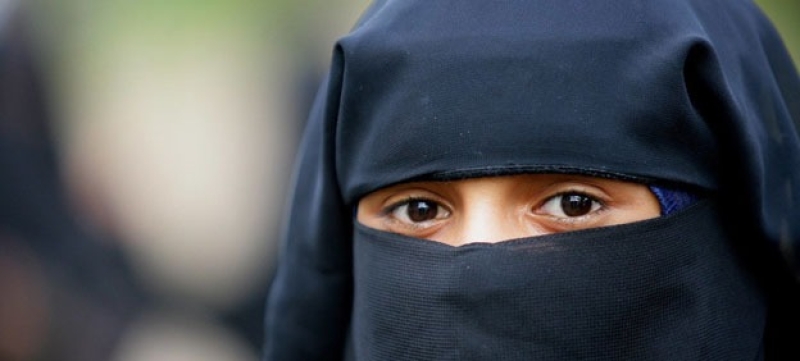
Credit: UNICEF
The veil has been lifted—but not the one you might expect.
It is not the veil that Western discourse has long used as a symbol. Rather, it is the one that concealed the selective nature of Western feminism—its silence on the women it was never truly committed to defending: women from South West Asia and North Africa.
In Against White Feminism, Rafia Zakaria offers a powerful critique of how mainstream feminism can reinforce colonial, racial, and patriarchal systems. Within this framework, the suffering of women of color is often made visible only when it serves a purpose. The image of the “veiled, victimized woman” has repeatedly been used to justify wars, interventions, and foreign policies driven less by liberation than by geopolitical interests. When these women speak for themselves or resist on their own terms, their voices are often ignored or dismissed.
This is not an isolated pattern but a structural one. The situation in Palestine has made this especially visible. The silence surrounding it has exposed the limits of so-called global feminist solidarity and raised difficult questions about who is included within it.
This reflection comes from Arab women aged 50–65, activists and feminists with decades of experience across multiple countries. Now based in the United States, they describe witnessing these contradictions more clearly than ever. Their experiences, along with those of many others, point to a consistent conclusion: the system is not broken; it functions as designed.
Feminist movements have long struggled with patriarchy, sometimes resisting it and sometimes accommodating it. In Western contexts, this struggle has often intersected with racial and colonial hierarchies. In formerly colonized regions, patriarchy cannot be separated from colonialism and imperialism; these systems operate together and must be addressed collectively.
Despite evolving language and more diverse representation, the underlying structures remain largely unchanged. This is especially evident in how women from South West Asia and North Africa are engaged by movements that claim to represent them.
The same narratives that once highlighted Afghan women to justify military intervention now coexist with silence around Palestinian women documenting their own suffering. This contradiction has become increasingly difficult to ignore.
Data from the United States reflects rising discrimination. The Council on American-Islamic Relations recorded 8,658 complaints of anti-Muslim and anti-Arab discrimination in 2024, the highest since tracking began in 1996. Employment-related cases accounted for a significant share, and numbers continued to rise in 2025.
However, statistics alone do not capture the full reality. Personal accounts reveal how voices are often silenced or sidelined depending on political context. One aid worker described being supported when speaking about some conflicts but penalized when speaking about Palestine. Others report professional consequences, social media restrictions, or pressure to remain silent for institutional safety.
Some women say they were discouraged from expressing opinions, advised to alter their appearance for safety, or excluded from leadership roles due to bias and stereotyping. In some cases, even calls for ceasefire and humanitarian aid have been labeled “too political.”
These experiences highlight a broader issue: selective recognition of suffering and selective acceptance of voice.
Western feminism often resists these critiques, but the reality remains that feminist principles cannot be applied selectively. Oppression is interconnected, and so must be the response to it. Palestinian women, like all women, experience layered forms of violence and continue to resist them.
A feminism that ignores these realities risks becoming inconsistent with its own principles.
Scholars have described this dynamic as a form of “white saviorism,” where women from certain regions are portrayed primarily as victims in need of rescue, rather than as agents of their own struggle. This framing often excludes structural factors such as war, occupation, and economic sanctions.
In Western political discourse, approaches may differ, but the outcome often remains similar: limited recognition of agency and selective amplification of voices.
From decades of experience in conflict-affected regions, one conclusion is clear: women in South West Asia and North Africa do not need to be “saved.” They need violence to end and their voices to be heard without conditions.
This is where the limits of conditional solidarity become visible. Support often appears when it carries no political cost and fades when accountability is required.
The concept of intersectionality highlights how overlapping identities can intensify discrimination. Today, this is evident in how race, religion, gender, and geopolitics intersect for many women from these regions. Yet responses from mainstream feminist spaces often remain inconsistent.
Ultimately, solidarity cannot be partial. If it excludes certain women based on geography or politics, it loses its meaning.
What is required now is not symbolic support, but consistency. If women’s rights are truly human rights, they must apply to all women—without exception.