

- 40-foot-long dead whale float to Kuakata sea |
- Bangladesh’s export earnings fall by 7.09pc in May |
- New Force Commander of UNFICYP Lt Gen Minhazul Alam meets PM |
- BERC raises retail power tariff by Tk 1.52 per unit |
Why Asia-Pacific Cities Must Become Climate ‘Sponges’
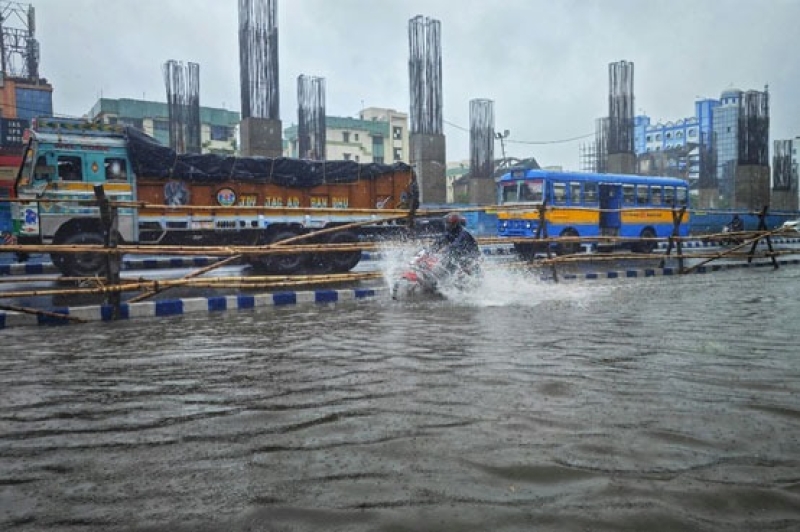
A motorcycle rider riding through flood in Kolkata, India. Cities should transform into sponges to absorb flood as part of climate adaptation.
As the Pacific recovers from a severe cyclone season and Asia braces for the monsoon, flood preparedness has become a defining test of sustainable urban development.
The Asia and the Pacific 2026 SDG Progress Report delivers a stark message. While progress has been made in poverty reduction, health, and basic infrastructure, the region is falling behind in climate action, disaster resilience, and biodiversity—areas now critical for long-term development.
The widespread flooding seen across the region in November 2025 was not just an isolated weather event. It marked a new baseline. From Hat Yai to Colombo, dense urban areas remained underwater for days, exposing millions of people and causing billions in economic losses.
Climate extremes are intensifying across the Asia-Pacific, increasing pressure on urban drainage systems, with water inflow rising by more than 53%. In coastal regions, flooding disrupts transport, isolates communities, delays emergency responses, and leads to saltwater intrusion that damages agriculture and freshwater supplies.
ESCAP analysis shows that risks will continue to grow, particularly in low-lying river deltas, small island nations, and rapidly expanding coastal cities. For instance, Seenu Atoll in the Maldives is projected to experience a sixfold increase in population exposure to coastal flooding by 2050.
Several regions—including Jiangsu Province in China, West Bengal in India, Khulna and Barisal divisions of Bangladesh, and Bến Tre and Bạc Liêu provinces in Viet Nam—are expected to see hundreds of thousands more people exposed to coastal flooding over the next 25 years.
In the face of such risks, cities can only remain engines of growth if they are resilient. The key question is why some cities are overwhelmed by floods while others cope far better. The answer lies in whether rainwater is treated as a resource or simply as waste.
Traditional “grey” infrastructure—pipes, pumps, and drainage channels—focuses on removing water quickly. However, in today’s changing climate and increasingly dense urban environments, this approach is no longer sufficient.
The “sponge city” concept offers an alternative. It combines green, blue, and grey infrastructure—such as permeable surfaces, parks, wetlands, bioswales, and improved drainage systems—to absorb, store, and gradually release rainwater where it falls.
China’s Sponge City Initiative, launched in 2015, demonstrates how integrated planning can retrofit existing urban areas and guide future development. The approach expands water absorption and storage capacity, reduces peak runoff, and uses engineered systems where necessary.
Early results are promising. In Wuhan, sponge city measures helped reduce incidents of overflow and pipe overloading by around 50% during peak rainfall periods. Over time, such systems can also be more cost-effective than traditional infrastructure while offering additional benefits, including cooler urban environments, improved air quality, enhanced biodiversity, and better public spaces.
Sponge city strategies are now evolving further, integrating digital tools such as “digital twins” to simulate rainfall, predict flood risks, and optimise infrastructure performance in real time. This transforms static drainage systems into adaptive water management networks.
Urban resilience is also closely tied to ecological health. The Asia-Pacific region holds 30–40% of the world’s wetlands, yet only about 22% are formally protected. As wetlands are degraded or lost, cities lose natural flood buffers just as climate risks intensify. Protecting and restoring these ecosystems is therefore essential.
However, sponge city solutions are not a complete answer. Their effectiveness depends on governance capacity, proper maintenance, land availability, and coordinated planning. They must be supported by strong early warning systems and comprehensive disaster risk management.
Efforts are underway to support this transition, with regional initiatives providing data, risk analysis, and targeted financing to strengthen resilience in vulnerable areas.
Ultimately, cities across the Asia-Pacific can no longer rely on outdated drainage systems designed for a different climate. Adopting sponge city principles is not just a technical choice—it is a development necessity.
Strengthening urban resilience is essential to achieving climate and sustainability goals and protecting development gains that are increasingly at risk from rising floods.