

- Resumption of US Tests May Trigger Threats from Other Nuke Powers |
- Zubaida goes to Evercare again at night to stay beside Khaleda |
- Urgent earthquake preparedness underlined to minimise damage |
- International Day of Persons with Disabilities celebrated at Barura |
- Bangladesh achieves 97% typhoid vaccine coverage for children |
Resumption of US Tests May Trigger Threats from Other Nuke Powers
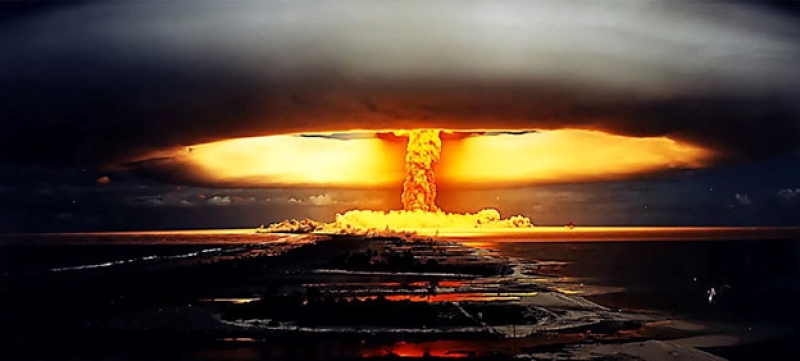
A nuclear test is carried out on an island in French Polynesia in 1971. Credit- CTBTO
By Thalif Deen
UNITED NATIONS, Dec 5 2025 (IPS) - President Donald Trump’s recent announcement to resume nuclear testing rekindles nightmares of a bygone era where military personnel and civilians were exposed to devastating radioactive fallouts.
In the five decades between 1945 and the opening for the signature of the Comprehensive Nuclear-Test-Ban Treaty (CTBT) in 1996, over 2,000 nuclear tests were carried out all over the world. The United States conducted 1,032 tests between 1945 and 1992.
According to published reports and surveys, it was primarily military personnel who participated in U.S. nuclear weapons testing. The U.S. government initially withheld information about the effects of radiation, leading to health problems for many veterans.
And it was not until 1996 that Congress repealed the Nuclear Radiation and Secrecy Agreements Act, which allowed veterans to discuss their experiences without fear of treason charges.
Although a 1998 compensation bill did not pass, the government has since issued an apology to the survivors and their families.
Some civilians were exposed to radioactive fallout from early nuclear tests, like the Trinity test in New Mexico. And like atomic veterans, these civilians also suffered from long-term health effects due to their exposure to radiation, the reports said.
Dr. M.V. Ramana, Professor and Simons Chair in Disarmament, Global and Human Security Director pro tem of the School of Public Policy and Global Affairs at the University of British Columbia, Vancouver, told IPS one doesn’t know exactly what kind of nuclear tests might be conducted.
Even though the United States has not ratified the Comprehensive Test Ban Treaty, in 1963, it did sign and ratify the “Treaty banning nuclear weapon tests in the atmosphere, in outer space and under water,” commonly known as the Partial Test Ban Treaty.
Since then, he pointed out, all of its nuclear tests have been conducted underground. There are two kinds of environmental dangers associated with underground nuclear tests. The first is that radioactive contamination may escape into the atmosphere, either at the time of the explosion or more gradually during routine post-test activities.
“More than half of all tests conducted at the Nevada Test site have led to radioactivity being released to the atmosphere. The second is that the radioactivity left underground makes its way over a long period of time into groundwater or to the surface.”
In 1999, he said, scientists detected plutonium 1.3 kilometers away from a 1968 nuclear weapons test in Nevada. In addition to these environmental dangers, the greater danger is that if the United States resumes nuclear weapon testing, then other countries would follow suit.
“Already, we have seen calls to prepare to resume testing from hawks in other countries, such as India.”
Decades ago, Ramana pointed out, when the US government planned to test nuclear weapons at Bikini atoll, the Women’s International League for Peace and Freedom (WILPF) said, “What should be vaporized is not an obsolete battleship but the whole process of the manufacture of the atomic bomb.”
“That statement is still relevant. We should be shutting down the capacity to build and use nuclear weapons, not refining the ability to carry out mass murder,” declared Dr. Ramana.
Meanwhile, in the five decades between 1945 and the opening for signature of the Comprehensive Nuclear-Test-Ban Treaty (CTBT) in 1996, over 2,000 nuclear tests were carried out all over the world.
• • The United States conducted 1,032 tests between 1945 and 1992.
• • The Soviet Union carried out 715 tests between 1949 and 1990.
• • The United Kingdom carried out 45 tests between 1952 and 1991.
• • France carried out 210 tests between 1960 and 1996.
• • China carried out 45 tests between 1964 and 1996.
• India carried out 1 test in 1974.
Natalie Goldring, Acronym Institute’s representative at the United Nations, told IPS that President Trump’s threat to resume US nuclear testing is remarkably shortsighted and dangerous, even by his impulsive and reckless standards.
“President Trump seems to be making the incorrect assumption that the US government always gets the last move in foreign policy. He attempts to conduct foreign policy by issuing pronouncements, rather than engaging in the hard work of policymaking and diplomacy or even ensuring that his actions are legal.”
In this case, he is apparently assuming that the US government can unilaterally decide to resume nuclear testing without prompting the same actions from other countries, she said.
Proponents of permanent nuclear weapons development and nuclear weapons testing claim that testing preserves the reliability of the arsenal and sends a message of US strength to potential adversaries.
“But the United States already has a robust testing program to ensure the reliability of its nuclear weapons. Rather than demonstrating strength, a US return to nuclear weapons testing could be used as a justification to do the same by other current and prospective nuclear weapons states. In effect, it could be a self-fulfilling prophecy.”
As William Broad recently reported in the New York Times, part of the challenge of interpreting President Trump’s pronouncement on nuclear testing is that it’s not clear what he means. Does he mean full-scale, supercritical testing, or is he talking about testing that produces an extremely small explosion, such as hydronuclear testing?
Either way, the US government would be breaking the testing moratorium that it has observed since 1992, she pointed out.
“Nuclear testing has ramifications and costs in many areas, including human, political, economic, environmental, military, and legal. States with nuclear weapons tend to focus on the perceived military and political aspects of these weapons.”
But they frequently ignore the profound human, economic, and environmental costs for those who were soldiers or civilians at or near test sites or in the areas surrounding those sites. Little attention or funding has been provided to survivors or to cleaning up the land poisoned by nuclear testing, said Goldring.
Rather than resuming nuclear testing, those funds could be used to help remedy the effects of past tests, including reducing some of the human and environmental costs.
Instead of threatening to resume nuclear tests and risking that other countries with nuclear weapons will follow our dangerous example, President Trump could take more constructive actions.
One immediate example is that the last nuclear arms control agreement between the US government and Russia, New START, expires early next year. This agreement limited the number of deployed nuclear weapons for both the United States and Russia and contained useful verification provisions that are unlikely to continue when the agreement expires.
It’s probably too late to negotiate even a simple follow-on agreement, but the US and Russia could still commit to maintaining New START’s limits, said Goldring.
If President Trump really wants to be the peacemaker he claims to be, he could commit the United States to the Treaty on the Prohibition of Nuclear Weapons (TPNW).
The TPNW is a comprehensive renunciation of nuclear weapons programs; States commit themselves not to develop, test, produce, acquire, possess, stockpile, use, or threaten to use nuclear weapons.
“Rather than taking us backwards, as President Trump proposes to do, we need to move forward.”
In 1946, Albert Einstein wrote, “The unleashed power of the atom has changed everything save our modes of thinking and we thus drift toward unparalleled catastrophe.”
The TPNW offers a way forward out of this predicament. Testing will perpetuate and exacerbate the human, environmental, and economic costs, among others, she said.
This article is brought to you by IPS NORAM, in collaboration with INPS Japan and Soka Gakkai International, in consultative status with the UN’s Economic and Social Council (ECOSOC).
IPS UN Bureau Report