

- Philip Sangma arrested for aiding Hadi murder suspects escape |
- Govt Issues Notice on Visa Extension for Expatriates |
- Khamenei Warns US, Israel in First Speech as Leader |
- Protests, Walkout Mark President’s Address in Parliament |
- UNSC fails to adopt resolution for halting Middle East crisis |
Protests, Walkout Mark President’s Address in Parliament
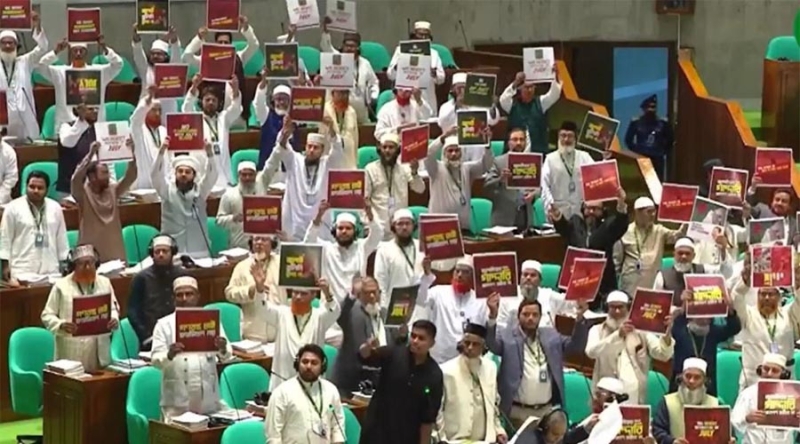
The first sitting of Bangladesh’s 13th Parliament opened with protests, political debate and ceremonial proceedings, as lawmakers gathered for a session marked by both celebration of democracy and visible political tensions.
The session began shortly after 11:00 am with the recitation of the Holy Quran, formally launching the inaugural meeting of the new parliament. The Speaker’s chair initially remained vacant as the House convened under the temporary chairmanship of senior lawmaker Khandaker Mosharraf Hossain, who presided over the early proceedings.
Traditionally, the outgoing Speaker or Deputy Speaker presides over the first session of a newly elected parliament until a new Speaker is elected. However, this time the situation was unusual. Former Speaker Shirin Sharmin Chaudhury stepped down in September 2024 and has not appeared publicly since, while former Deputy Speaker Shamsul Haque Tuku remains in custody in connection with a criminal case. As a result, the parliament began its work without the customary presiding officials.
During the session, lawmakers elected Hafiz Uddin Ahmed as the new Speaker. The nomination was proposed by Chief Whip Nurul Islam and supported by another lawmaker before being approved by voice vote in the chamber.
Soon after, Member of Parliament Kaiser Kamal was elected Deputy Speaker. The proposal for his appointment was placed by a government whip and endorsed by other lawmakers, receiving unanimous approval.
Following the elections, President Mohammad Shahabuddin administered the oath of office to the Speaker and Deputy Speaker at his office inside the parliament complex. Later, a new cabinet member was sworn in as well, with Tangail–8 lawmaker Ahmed Azam Khan taking oath as a minister.
The parliamentary session resumed after a short break, though proceedings were briefly disrupted by technical problems with the microphone system. Speaker Hafiz Uddin Ahmed had to use a handheld microphone to address the chamber and asked lawmakers to remain patient while the malfunction was fixed. The session was later paused again for the midday prayer.
Prime Minister Tarique Rahman delivered a speech early in the sitting, paying tribute to those who sacrificed their lives in political movements from the Liberation War of 1971 to the July uprising. He also honoured former prime minister Khaleda Zia, describing her as a leader who fought for democracy throughout her life and never compromised with authoritarian rule.
Rahman said the new parliament belongs to the people of Bangladesh and expressed hope that it would become a vibrant forum reflecting public aspirations. He called for cooperation between the government and the opposition to build a self-reliant nation and emphasised that national development should remain above political divisions.
Speaker Hafiz Uddin Ahmed, in his remarks, described the parliament as a symbol of democracy and said the people of Bangladesh had historically resisted authoritarian rule. He paid tribute to those killed in the July uprising and expressed hope that both government and opposition lawmakers would work together in the national interest. He also noted that he had resigned from his position in the BNP’s standing committee in order to maintain neutrality as Speaker.
The session later turned to the adoption of condolence motions. Lawmakers discussed the political legacy of former prime minister Khaleda Zia before the House formally adopted a resolution expressing grief at her passing. Members also paid tribute to those killed in the July uprising, with several lawmakers speaking about their sacrifices.
During the discussion, Home Minister Salahuddin Ahmed said Khaleda Zia would have been happiest to witness the functioning of the new parliament. He described her as a symbol of democracy and said her influence would continue to inspire political movements in the country.
Other lawmakers including Mirza Fakhrul Islam Alamgir and Andalib Rahman Partho also spoke on the condolence motion. Members stood in silence for one minute in honour of the deceased leaders and martyrs.
Opposition lawmakers raised additional demands during the debate. Some members asked that several individuals be included in the condolence list, including activists and political figures they considered victims of past political conflicts. The Speaker assured the House that the requested names would be incorporated.
Opposition leader Shafiqur Rahman congratulated the newly elected Speaker and Deputy Speaker but said the parliament must ensure fairness for both the government and opposition. Addressing the Speaker directly, he said the chamber had been built on the sacrifices of the July movement and urged him to uphold justice and impartiality.
The most dramatic moment of the day came when President Mohammad Shahabuddin entered the chamber to deliver his address. As the Speaker invited him to begin speaking, lawmakers from the opposition benches stood up holding placards and chanting slogans. The placards carried messages accusing the government of betraying the spirit of the July uprising.
Despite repeated appeals from the Speaker to maintain order, the protests continued. President Shahabuddin began his speech amid the commotion, while members from the treasury benches responded by thumping their desks in support.
Opposition lawmakers eventually staged a walkout during the speech.
In his address, the President spoke about the political changes that followed the mass uprising and the fall of what he described as a fascist government. He highlighted the interim government’s initiatives taken in memory of the July martyrs and outlined the priorities of the current administration.
The President also discussed Bangladesh’s economic situation, including inflation and foreign exchange reserves, and said the government was committed to public welfare programmes. He stressed the importance of combating corruption, strengthening law and order, and expanding social protection.
Among the initiatives mentioned were plans to provide family cards for households, expand social safety programmes, and improve economic opportunities. The President also said the government had prioritised women’s empowerment by introducing free education for women up to the postgraduate level and expanding microcredit programmes.
Environmental measures were also highlighted, including a nationwide campaign to plant 50 million trees each year.
The President further addressed global issues, referring to tensions in the Middle East and their potential economic impact on countries like Bangladesh. He expressed hope that the government’s policies would help maintain economic stability while promoting growth in agriculture, technology and other sectors.
After concluding his speech, the President left the parliament chamber, bringing an eventful and sometimes turbulent opening session to a close.
The sitting was attended by several notable figures in the visitors’ gallery, including Nobel laureate Muhammad Yunus along with members of Prime Minister Tarique Rahman’s family.
Despite moments of disruption, the first session of the 13th Parliament signalled the start of a new legislative term, with both government and opposition leaders pledging to uphold democratic values while navigating the country’s political challenges.