

- GK irrigation pump station being redesigned as Ganges water levels fall |
- PM to visit India when atmosphere turns conducive: Humaiun Kobir |
- PM set to embark on maiden overseas tour with Malaysia visit Sunday |
- Food grain stocks in country exceed 20.6 lakh tons |
- Dhaka, Beijing Likely to Sign 15–17 Agreements |
Freedom of expression belongs to all except govt: Adviser
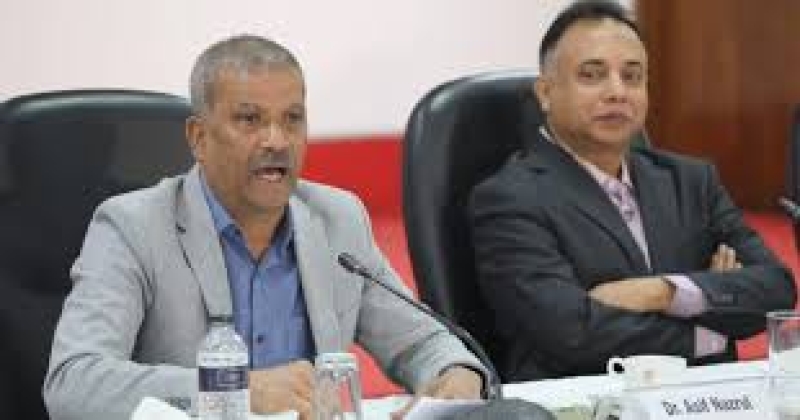
Freedom of expression belongs to everyone except the government, Law Adviser Dr Asif Nazrul said on Saturday.
He came up with the remarks while speaking at a policy dialogue titled “Political Parties, Human Rights, and Freedom of Expression” organised by the Centre for Governance Studies (CGS) at the CIRDAP Auditorium in Dhaka.
Political leaders, civil society representatives, academics, lawyers, journalists, and human rights activists participated in the dialogue. The discussion focused on the extent to which human rights and freedom of expression are reflected in political discourse in the context of the upcoming national election.
Asif Nazrul mentioned that significant reforms have been undertaken, including transferring key judicial matters to the higher courts, enacting a human rights law that he described as one of the strongest in South Asia, and expanding legal aid services that now benefit ten times more people than before.
He claimed that the Digital Security Act has improved by 90 percent and that more than 20,000 cases have been resolved.
He acknowledged widespread cyberbullying against him following the July Uprising and emphasized that comprehensive reform requires time.
He stressed the need for self-reflection by political parties and the media, calling for honesty, conscience, tolerance, and accountability to move the country forward over the next five to ten years.
CGS President Zillur Rahman, who moderated the event, said that as elections approach, human rights and freedom of expression tend to shrink further. Laws are easily turned into political tools, while violence, clashes, threats, and harassment become difficult to control.
Dr Iftekharuzzaman, Executive Director of Transparency International Bangladesh (TIB) that human rights are universal and not relative.
He argued that political parties in Bangladesh capitalize on money, power, and religion, and that the state is enabling the growth of mob power.
He urged political parties to engage in self-reflection and include Indigenous peoples’ rights in their election manifestos. He emphasized the importance of upholding the country’s founding principles and called for the elimination of conflicts driven by money, power, and religion.
Barrister Sara Hossain, Executive Director of Bangladesh Legal Aid and Services Trust (BLAST), said that although Section 54 of the Code of Criminal Procedure has been amended, its implementation remains deeply problematic.
She rejected claims that courts had indiscriminately granted bail in the past. She questioned why journalists now hesitate to report on enforced disappearances and killings, pointing to fear of being targeted.
She stressed the absence of genuine consensus-building and warned against labeling certain communities as “minorities” while ignoring unequal access to rights.
She highlighted that mob violence disproportionately affects specific groups and urged political parties to assess whether their supporters genuinely stand for human rights and freedom of expression.
She also called for critical discussion of colonial-era laws such as blasphemy, anti-terrorism, and defamation statutes, and emphasized the need for inclusion and public awareness.
Parvez Karim Abbasi, Executive Director of CGS, stressed the need to give due importance to human rights and freedom of expression.
He questioned whether political parties themselves allow free expression internally and criticized the culture of personality worship and unfulfilled promises after gaining power, reports UNB.
Among others, Muktadir Rashid Romeo,who covered crime and politics for almost 15 years at New Age; Bazlur Rashid Firoz, General Secretary of the Bangladesh Socialist Party (BASAD); Didar Bhuiyan, Joint General Secretary of the Rastro Songskar Andolon; Ragib Ahsan Munna, Presidium Member of the Communist Party of Bangladesh (CPB); Mosharraf Ahmed Thakur, university teacher and political activist, also spoke.