

- COP31 Update: Developing Nations Demand Action, Reject |
- Bangladesh Beat Sri Lanka 4-0 to Top Group |
- PM, Chinese vice-president discuss investment, climate cooperation |
- Shafiqur challenges Salahuddin over foreign intelligence agency link claim |
- 372 armed attacks kill 316 in CHT over five years: Salahuddin |
Urban health needs one clear leader and many partners, seminar told
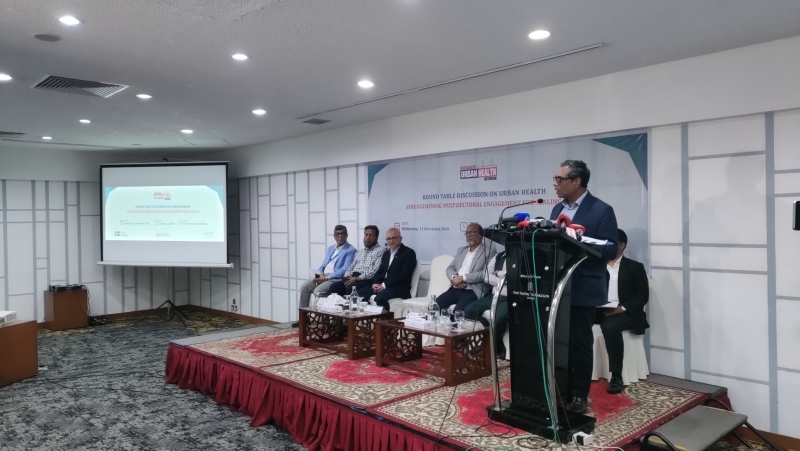
Discussion on Urban helth was held at Pan Pacific Sonargaon Hotel on Wesnesday 11 November 2026.
Policymakers call for multisectoral action as 192 urban health centres move to the health ministry
Dhaka, 11 November 2026 – Urban health in Bangladesh cannot be fixed by the health sector alone. It needs clear government leadership, defined roles for the ministries and city authorities involved, and lasting financing beyond project cycles. This was the message from senior policymakers, development partners and experts at a roundtable in Dhaka today.
The Bangladesh Urban Health Network (BUHN) organised the roundtable, titled "Urban Health: Strengthening Multisectoral Engagement for Scaling Up,"; with support from UNICEF Bangladesh and the Embassy of Sweden. It was held at Padma Hall, Pan Pacific Sonargaon Dhaka. Dr. M. A. Muhit, Minister of State, Ministry of Health and Family Welfare (MoHFW), attended as Chief Guest. BUHN Chairman Dr. Mohammad Zahirul Islam chaired the session. Dr. Shakhawat Hossain Sayantha, Associate Professor at Bangladesh Medical University (BMU), anchored the program.
In the keynote presentation, Dr. Manal Mizanur Rahman, Respiratory Medicine Specialist, Bangladesh Medical University, noted that 53.8 million people, nearly a third of the population, now live in urban areas. Gaps within cities remain stark. Only 28% of slum households have an improved, unshared toilet, against 54% in non-slum areas. Neonatal mortality in city-corporation slums stands at 27 per 1,000 live births. The presentation also described a turning point for the sector. In April 2026 the Cabinet Division decided to transfer 192 urban primary healthcare facilities from local government to the Health Services Division. In the same month, ECNEC approved a new project to set up 170 integrated urban health centres in Dhaka and Chattogram.
“Urban primary healthcare is now part of the national health system, and the government will lead it as such,” said Dr. M. A. Muhit. “Our task is to make sure the 192 transferred centres and the new facilities work as one network, with medicines on the shelves, doctors at their posts and services that people living in slums can actually reach. We will work hand in hand with the city corporations, development partners and NGOs to make that happen.”
“Children growing up in urban slums face some of the worst health outcomes in the country, and they are often hidden behind city averages,” said Dr. Dewan Md. Emdadul Hoque, Health Manager, UNICEF Bangladesh. “The handover of urban health centres to the health ministry is a chance to put mothers, newborns and children at the centre of urban primary healthcare. UNICEF is committed to supporting the government in that effort.”
“This transition will succeed only if everyone knows who leads, who delivers and who is accountable,” said Dr. Md. Shamim Hayder Talukder, Member Secretary, BUHN, and CEO, Eminence Associates for Social Development (EASD).
“BUHN will keep bringing government, city authorities, partners and communities to the same table, so that the urban poor are not left behind as the system changes.”
Participants agreed on four areas for joint action: governance and coordination between ministries; equitable, good- quality primary healthcare; climate-resilient urban health services; and sustainable financing, partnerships and digital innovation. Representatives of DGHS, LGED, the Health Economics Unit, IEDCR, WHO, the World Bank, UNFPA, NGOs, academia and the media joined the discussion.
Closing the session, Dr. Mohammad Zahirul Islam said BUHN would turn the recommendations into a policy brief and keep convening stakeholders to follow up on progress. – Press release