

- PM Opens July Memorial, Renovated Osmani Udyan in Dhaka |
- SPM Contract Cost Rises by $31m Despite Tender Rules |
- Cabinet Approves Secretariat Relocation to Sher-e-Bangla Nagar |
- Nearly Half of Bangladesh’s Families Are in Debt: BBS |
- Bangladesh Seeks Details on Execution of Two Nationals |
The Hidden Cost of Handing Smartphones to Children
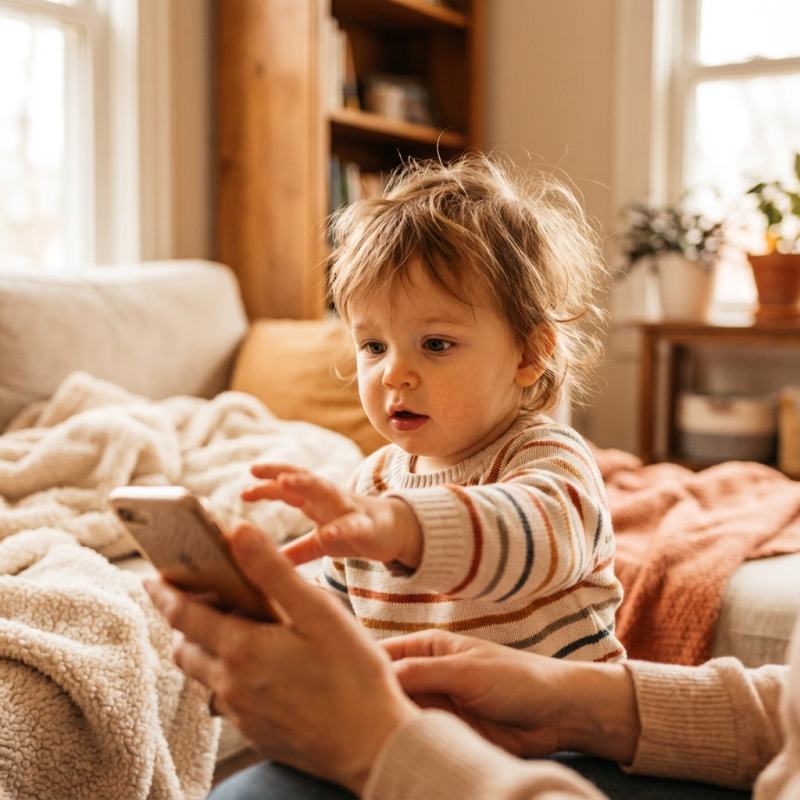
A baby obsessed with a smartphone.
Special Correspondent
A baby barely old enough to speak reaches for a smartphone, and within seconds a colourful cartoon, nursery rhyme or game appears on the screen. The child becomes quiet. The parents get a few minutes of peace. The scene may look harmless, even convenient. Increasingly, however, it is becoming a familiar feature of modern family life.
At many homes, smartphones are being introduced to children long before they can read, write or even properly understand what the device is. Some parents proudly tell relatives that their toddler can open YouTube, find cartoons, play games or swipe through videos without help. For some, a child’s ability to handle a smartphone is seen almost as evidence of intelligence. But the question is: what is the child losing while learning to use the device?
The concern is not that smartphones are inherently harmful or that children should be kept away from technology forever. Digital tools can support learning, creativity and communication when used appropriately. The problem begins when a screen becomes a substitute for conversation, play, movement, sleep, books and the ordinary human interaction through which young children learn about the world.
Early childhood is one of the fastest periods of physical, cognitive, emotional and social development. The World Health Organization says this is a time when children’s habits are formed and family lifestyles can have lasting effects on health and wellbeing.
For many parents, the attraction is obvious. A smartphone can instantly calm a crying child, keep a restless toddler occupied during meals, make a long journey easier or provide exhausted parents with some much-needed quiet. But a screen that keeps a child silent is not necessarily helping the child develop.
Young children learn primarily through interaction. They need to hear adults speak, respond to facial expressions, imitate sounds, touch objects, move their bodies, ask questions, make mistakes and receive responses. A smartphone can provide stimulation, but it cannot fully reproduce the responsive, two-way interaction between a child and its parents.
A major systematic review and meta-analysis published in JAMA Pediatrics examined 42 studies involving 18,905 children. It found that greater quantities of screen use were associated with poorer language skills. By contrast, educational content and co-viewing with caregivers were associated with stronger language skills. The researcher also found that later introduction of screen exposure was associated with stronger language skills.
That distinction is important. The issue is not simply whether a child watches something educational. It is also what happens around the screen. Is a parent sitting beside the child, talking about what is happening? Is the child being encouraged to ask questions? Or is the smartphone being used as a digital babysitter?
The difference can be profound.
Every hour spent staring at a screen is an hour that cannot simultaneously be spent running, jumping, playing with toys, drawing, looking at picture books or talking to parents and other children.
This is what child-development experts often describe as displacement. The danger is not only the screen itself but what excessive screen use pushes a child out of daily life.
WHO recommends that infants under one year should not have sedentary screen time. For one-year-olds, screen time is not recommended, while for two-year-olds and children aged three to four, sedentary screen time should generally be no more than one hour a day, with less being better. The organisation also recommends substantial amounts of physical activity for young children.
For children aged three to four, for example, WHO recommends at least 180 minutes of physical activity spread throughout the day, including at least 60 minutes of moderate-to-vigorous activity.
These are not arbitrary numbers. They reflect the basic needs of a growing child. Yet a child who spends several hours watching videos or playing games may gradually become less interested in physical play. The sofa becomes more attractive than the playground. The screen becomes more rewarding than a box of building blocks.
That can have consequences for physical health.
A systematic review and meta-analysis of 16 studies found that children exposed to at least two hours of screen time a day had higher odds of overweight or obesity than those with less than two hours, with an odds ratio of 1.67.
These studies do not mean that every child who uses a smartphone will become overweight. Nor do they establish that screen use alone causes obesity. But they point to a consistent concern: excessive sedentary screen use can contribute to an unhealthy lifestyle by reducing movement.
WHO places sleep alongside physical activity and sedentary behaviour as fundamental components of healthy development. Children aged three to four should receive 10 to 13 hours of good-quality sleep, while younger children require even more.
The American Academy of Pediatrics advises parents to ensure that media use does not displace sleep, exercise, reading aloud, play and social interaction.
This is particularly important because poor sleep in childhood is not merely a problem of tiredness the following morning. Sleep supports memory, learning, emotional regulation and physical development.
A 2024 systematic review focusing on preschool children examined the relationship between excessive screen use, sleep patterns and behavioural and cognitive factors. Its findings add to the growing body of evidence linking excessive screen exposure with concerns around sleep and aspects of behaviour and cognition. A smartphone delivers an endless stream of rapidly changing images, sounds and rewards.
Real life is slower. A child waiting for a parent to finish a conversation has to learn patience. A child playing with another child has to negotiate. A child building a tower with blocks learns about balance and problem-solving. A child listening to a bedtime story learns language, imagination and emotional connection. These seemingly ordinary experiences are the building blocks of childhood.
The danger of excessive screen exposure is therefore not simply that children may become "addicted to phones". It is that they may gradually become less accustomed to activities that require sustained attention, imagination and social engagement.
The American Academy of Pediatrics advises against routine digital media use for children younger than 18 months, except for video chatting. For children aged 18 to 24 months, it recommends that parents who introduce digital media choose high-quality content and watch it together with the child. For children aged two to five, it recommends no more than one hour a day of high-quality programming, preferably with parents watching alongside them.
There is another uncomfortable truth: children often copy adults. A toddler who sees parents checking their phones repeatedly during meals, conversations or family gatherings is learning that the device deserves constant attention. The solution therefore cannot be limited to controlling the child. Parents need to examine their own behaviour.
Instead of handing over a phone whenever a child becomes restless, adults can offer alternatives: a storybook, drawing materials, building blocks, music, outdoor play or simple conversation. At mealtimes, the family can talk. During travel, children can observe the world outside the window. Before bedtime, parents can read a story. These activities may appear old-fashioned in a digital age. In reality, they are precisely the experiences that help children develop.
It would be wrong to portray every screen as dangerous. Digital technology has an important place in modern education and communication. A carefully selected educational programme watched with a parent can be very different from hours of algorithm-driven videos. A video call with a distant grandparent is not the same as endless gaming. A creative drawing application is not equivalent to passive scrolling.
The question, therefore, should not be "Should children ever use technology?" It should be: "When, why, how much and under whose guidance should they use it?"
Parents do not necessarily need to confiscate every device overnight. What children need most is a predictable family routine. Young children can be encouraged to play outdoors every day. Screens can be removed at least an hour before bedtime. Most importantly, adults can spend time with children without a device competing for their attention. Childhood is meant to be noisy, messy, curious, physical and social.
And before placing a smartphone into a tiny hand, parents should ask themselves a simple question: What important part of childhood will this screen replace?