

- US to Pause Immigrant Visas for 75 Countries Including Bangladesh |
- 11-Year Run of Record Global Heat Continues: UN Agency |
- Gaza Ceasefire Not Enough as Children Continue to Die |
- Bangladesh Sets Guinness Record With 54 Flags Aloft |
- Gambia Tells UN Court Myanmar Turned Rohingya Lives Hell |
Physicians Urge Unimpeded Aid for Gaza Reproductive Care
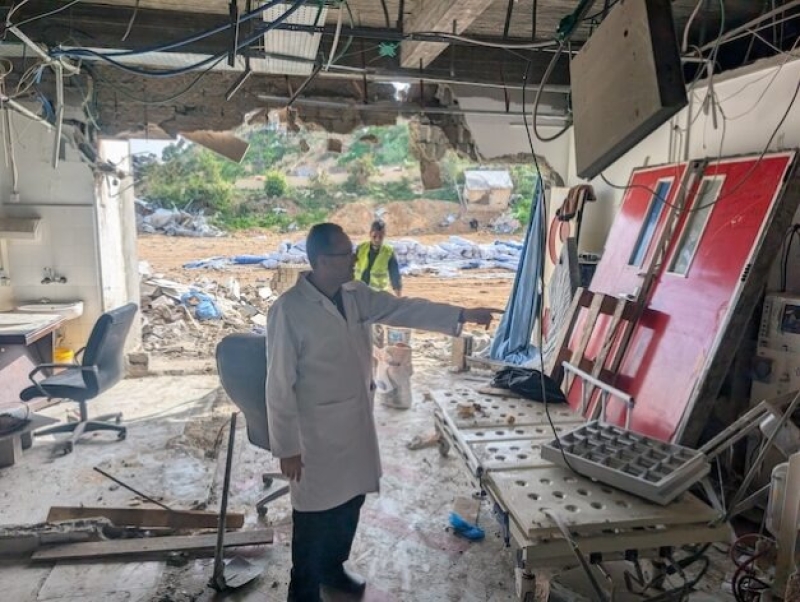
Cardiologist Dr. Marwan Sultan, then Director of the Indonesian Hospital in north Gaza, in February 2025 showing damage to hospital equipment following an Israeli attack on the facility a few months prior. In July 2025, Dr. Sultan was killed in an Israeli strike on the apartment where he was sheltering with his family.
Israel must lift all restrictions on medicine, food and aid entering Gaza, rights groups have demanded, as two reports released on January 14 document how maternal and reproductive healthcare in the territory has been almost completely destroyed.
In two separate joint reports, Physicians for Human Rights, in collaboration with the Global Human Rights Clinic at the University of Chicago Law School, and Physicians for Human Rights–Israel (PHR-I) detail how the war in Gaza has led to rising maternal and neonatal mortality, unsafe childbirth conditions and the systematic destruction of health services for women.
The reports, prepared by the two independent organisations, provide detailed clinical analysis of the collapse of Gaza’s health system and its medical consequences, alongside first-hand testimonies from clinicians and from pregnant and breastfeeding women forced to care for their newborns under extreme conditions.
The organisations said that despite only marginal improvements for many women following the current ceasefire, Israel must roll back aid restrictions and immediately ensure access to essential healthcare in Gaza.
“Israel’s destruction of Gaza’s health infrastructure, combined with untreated malnutrition resulting from restrictions on food and medical supplies, including baby formula, has created an environment in which the fundamental biological processes of reproduction and survival have been systematically destroyed,” said Sam Zarifi, Executive Director of Physicians for Human Rights. “This has resulted in known and foreseeable harm, pain, suffering and death.”
He added that Israel must immediately allow food and essential medical supplies to enter Gaza under a proper medical response plan for the besieged population.
Israeli military operations following Hamas’s attack on Israel on October 7, 2023, have caused widespread destruction across Gaza, including healthcare facilities. According to UNICEF, 94 percent of hospitals have been damaged or destroyed.
Maternal and reproductive healthcare services have been severely affected. Before the war, Gaza had eight neonatal intensive care units (NICUs) with 178 incubators. Today, the number of incubators has dropped by 70 percent. In northern Gaza, 105 incubators across three NICUs have been reduced to barely any functioning units.
UNICEF reported that the number of low birth weight babies has nearly tripled compared to pre-war levels, while first-day infant deaths have increased by 75 percent.
The two reports present similar findings. One report focuses on the period between January and October 2025, during which a ceasefire was agreed. It details how, between May and June last year, the Palestinian Ministry of Health recorded a 41 percent drop in Gaza’s birth rate compared to the same period in 2022. The ministry also reported more than 2,600 miscarriages and 220 pregnancy-related deaths occurring before delivery.
Premature births and low birth weight cases rose sharply, with more than 1,460 babies born prematurely and over 2,500 admitted to neonatal intensive care. At least 21 newborns reportedly died on their first day of life.
The second report includes personal testimonies highlighting the severe challenges faced by pregnant women and new mothers, including lack of safe access to healthcare, childbirth in unsanitary conditions, hunger and acute food shortages during breastfeeding.
One woman, Samah Muhammad Abu Mustafa, a 30-year-old mother of two from Khuza’a in Khan Younis, described walking long distances through rain at night while in labour due to the lack of vehicles and ambulances. She said the hospital conditions she encountered were “horrifying,” recounting overcrowding, women giving birth in corridors and shortages of anaesthesia that forced her to deliver naturally despite medical advice to the contrary.
Despite the October 2025 ceasefire, serious challenges remain. “Maternal health units in Gaza are largely non-functional and face critical shortages of essential medicines, consumables and equipment,” said Lama Bakri, a project coordinator at PHR-I. She noted that neonatal and diagnostic equipment, including portable incubators, remains scarce or blocked.
Malnutrition also continues to pose a serious threat. UNICEF officials reported alarmingly high rates of acute malnutrition among pregnant and breastfeeding women, with around 38 percent of those screened between July and September 2025 affected.
Long-term demographic consequences are also feared. Experts warned that even with reconstruction, Gaza may face generations of children suffering lifelong health complications and developmental challenges due to damage sustained before birth.
While humanitarian organisations stress that recovery is possible with sustained international cooperation and political will, they emphasise that meaningful progress depends on unrestricted access to medical supplies, equipment and reconstruction materials.
Both reports concluded that the damage to maternal and reproductive healthcare in Gaza reflects a broader pattern of systematic harm to women and children, which they described as reproductive violence. Israel has denied the allegations, stating that its military operations comply with international law and that healthcare facilities were targeted only when used for military purposes.
Under international humanitarian law, healthcare facilities are afforded special protection, and any attack must comply with principles of distinction, proportionality and precaution. Failure to do so constitutes a violation of international law, according to the United Nations.